Giriraj Singh shares PM Modi's mantra for top-3 economy
Synopsis
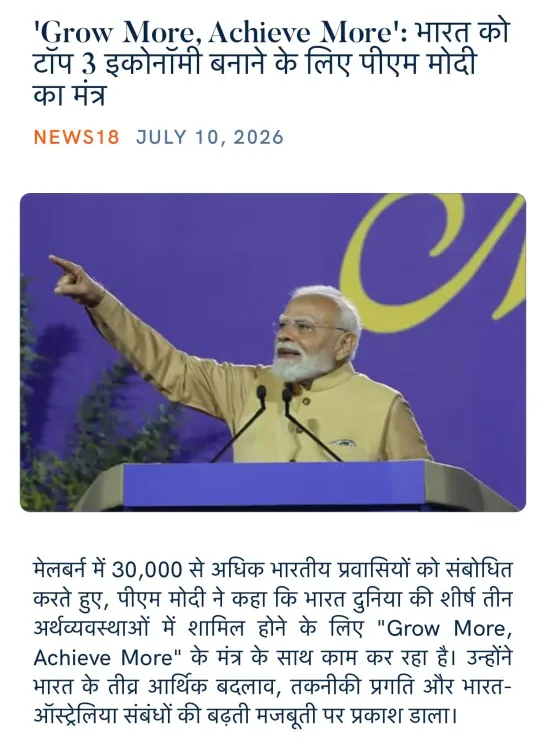
Union Textiles Minister Giriraj Singh amplified PM Modi's 'Grow More, Achieve More' economic mantra on X, highlighting the India-Australia partnership as a pillar of India's ambition to become a top-three global economy under the Viksit Bharat@2047 framework.
Key Takeaways
Giriraj Singh , Union Textiles Minister and BJP Lok Sabha MP from Begusarai , shared PM Modi's economic vision on X on 10 July 2026 .
The slogan 'Grow More, Achieve More' is framed as PM Modi's mantra for making India a top-three global economy .
India is currently the fifth-largest economy by nominal GDP, having overtaken the UK in 2022 .
The India-Australia ECTA (2022) is a key bilateral instrument supporting export-led growth and supply-chain diversification.
The messaging aligns with the Viksit Bharat@2047 framework, which links domestic manufacturing incentives to international partnerships.
MSME exporters and the textiles sector are among the primary stakeholders expected to benefit from this economic strategy.
Union Textiles Minister Giriraj Singh on Friday, 10 July 2026 shared a post on X amplifying Prime Minister Narendra Modi's economic vision, framing the slogan 'Grow More, Achieve More' ('ज़्यादा उगाओ, ज़्यादा पाओ') as the guiding mantra for making India one of the world's top three economies.
Context
The post, shared via the NaMo App, references PM Modi's stated ambition to elevate India into the top tier of global economies — a goal that has anchored the ruling dispensation's economic communication since 2014. The mention of Australia alongside India in the framing points to the growing strategic and economic partnership between the two nations as a lever for achieving that target.
Giriraj Singh, who represents Begusarai in Bihar in the Lok Sabha, is a senior BJP leader known for consistently amplifying the central government's economic messaging on social media platforms.
Policy Backdrop
India overtook the United Kingdom in 2022 to become the fifth-largest economy by nominal GDP, reinforcing official projections that place the country among the top three by the early-to-mid 2030s. The broader framework driving this ambition is Viksit Bharat@2047, which ties domestic manufacturing incentives to international economic partnerships.
The India-Australia Economic Cooperation and Trade Agreement (ECTA), signed in 2022, expanded market access for Indian goods and services, deepening supply-chain cooperation, critical-minerals collaboration, and educational linkages with one of India's key Quad partners. The Make in India initiative, launched in 2014, remains the primary domestic policy vehicle aimed at raising manufacturing's share of GDP and supporting export-led growth.
Stakeholders and Impact
The economic vision articulated by PM Modi and amplified by ministers like Giriraj Singh has direct implications for Indian manufacturers and MSME exporters, who stand to benefit most from expanded bilateral trade frameworks and production-linked incentives. The textiles sector, which Singh oversees, is among the largest employment-generating industries in India and a key pillar of export diversification strategy.
The India-Australia partnership, in particular, offers Indian exporters — including textile producers — preferential access to a high-income market while opening avenues for technology transfer and supply-chain integration in sectors critical to long-term industrial growth.
What's Next
Attention will now turn to the next India-Australia Joint Ministerial Commission meeting, where trade and investment targets are expected to be reviewed. On the domestic front, any textile-sector export incentives announced in the forthcoming Union Budget or the Foreign Trade Policy review will be closely watched as concrete steps toward the top-three economy goal. The consistency of such messaging from senior ministers signals that economic nationalism and bilateral engagement will remain central themes in the government's political communication ahead of key policy announcements.
Point of View
Reinforcing the government's long-running narrative of export-led growth ahead of what could be a significant budget or trade-policy cycle. The explicit India-Australia framing is notable — it signals that bilateral economic diplomacy with Quad partners is being woven into domestic political messaging, not just foreign-policy channels. For the textiles ministry specifically, aligning with the top-three economy goal provides political cover for sector-specific export incentives that may follow. The 'Grow More, Achieve More' formulation is crafted to resonate with both rural producers and urban entrepreneurs, broadening the coalition behind the government's economic agenda.
NationPress
10 Jul 2026
Frequently Asked Questions
What is PM Modi's mantra for making India a top-3 economy?
PM Modi's stated mantra is 'Grow More, Achieve More', which emphasises export-led and manufacturing-driven growth as the path to making India one of the world's three largest economies.
When will India become a top-3 economy?
Official government projections place India among the top three global economies by the early-to-mid 2030s, building on India's rise to fifth place by nominal GDP in 2022.
What is the India-Australia ECTA and how does it help India's economy?
The India-Australia Economic Cooperation and Trade Agreement, signed in 2022, gives Indian goods and services preferential access to the Australian market and supports supply-chain and critical-minerals cooperation.
What is Viksit Bharat 2047?
Viksit Bharat@2047 is the Indian government's long-term development vision targeting a fully developed India by 2047, the centenary of independence, with top-tier global economic status as a central goal.
Why did Giriraj Singh share this post about India's economy?
As Union Textiles Minister and a senior BJP leader, Giriraj Singh regularly amplifies the central government's economic messaging on social media, and this post fits that established pattern of ministerial communication.