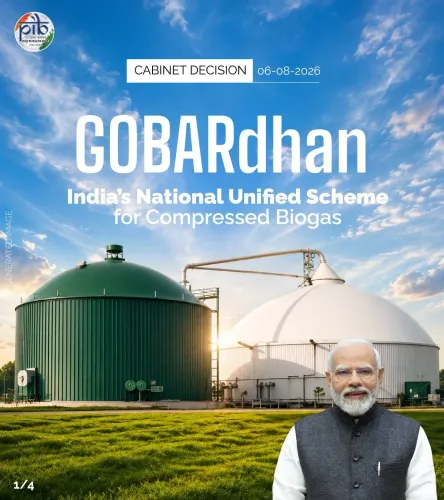
GOBARdhan scheme to save ₹40,000 crore in imports, add 1.5 lakh jobs
Synopsis
India's Cabinet has cleared a ₹23,731 crore bet on homegrown biogas — one that promises to slash ₹40,000 crore in fossil fuel imports, create 1.5 lakh jobs, and expand CBG output ten-fold in a decade. The GOBARdhan scheme's guaranteed offtake framework and MSME credit cover mark a structural shift from past bioenergy half-measures.
Key Takeaways
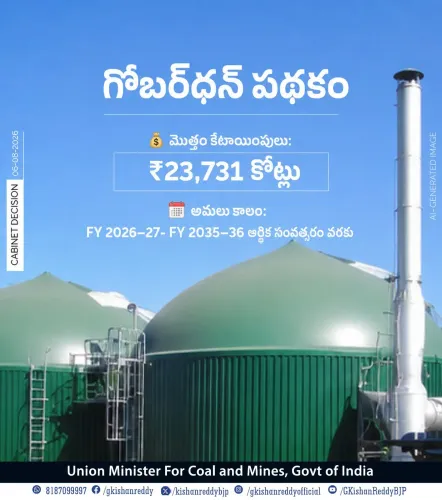
The Union Cabinet approved the GOBARdhan National Circular Bioenergy Scheme with an outlay of ₹23,731 crore , running from FY27 to FY36 .
The scheme is projected to save over ₹40,000 crore in foreign exchange and add more than ₹75,000 crore to national GDP.
An estimated 1.5 lakh jobs are expected to be created across the CBG value chain.
CBG production is targeted to expand nearly ten-fold over a decade , displacing 10 million metric tonnes of fossil fuel use.
As of now, 1,908 CBG/Bio-CNG plants are registered; 217 are commissioned producing 0.4 MMSCMD , and 339 are under construction.
CBG procurement obligations for City Gas Distribution entities are set at 3% in FY27 , 4% in FY28 , and 5% from FY29 onwards.
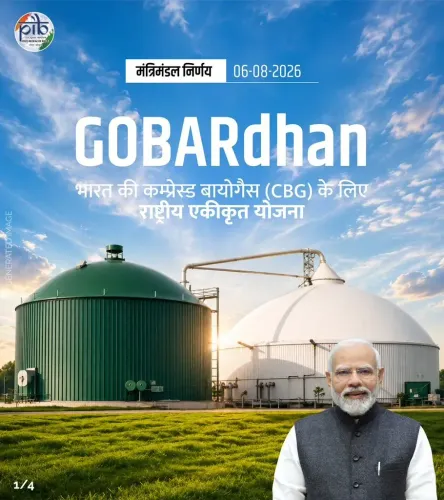
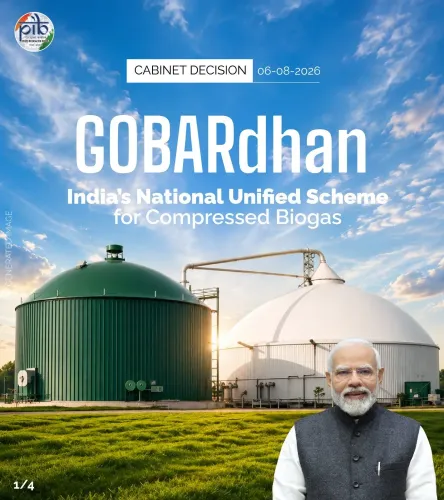
The Union Cabinet, chaired by Prime Minister Narendra Modi, has approved the GOBARdhan National Circular Bioenergy Scheme with a total outlay of ₹23,731 crore, with the government projecting savings of over ₹40,000 crore in foreign exchange, addition of more than ₹75,000 crore to national GDP, and the creation of 1.5 lakh jobs, according to an official statement released on Friday, 7 August. The scheme will run from FY27 to FY36, establishing compressed biogas (CBG) as a central pillar of India's future energy mix.
What the Scheme Promises
The GOBARdhan scheme is designed to expand compressed biogas production nearly ten-fold over a decade, mobilise private investment, and build a circular bioeconomy. A dedicated CBG Offtake Assurance framework will guarantee market access for producers, with an administered price set at ₹2,110 per MMBTU. Capital assistance of up to ₹2 crore per TPD and 85 per cent credit guarantees for MSMEs are also on offer, lowering the entry barrier for smaller operators.
Clean, domestically produced gas from the scheme is projected to displace 10 million metric tonnes of fossil fuel use. Diverting organic waste from landfills is expected to cut more than 40 MT of CO₂ emissions and generate 250 MMT of organic fertiliser, according to the official statement.
CBG Obligation Targets and Market Integration
City Gas Distribution entities will be required to procure CBG in line with a notified obligation trajectory — 3 per cent in FY27, 4 per cent in FY28, and 5 per cent from FY29 onwards — in the CNG (Transport) and PNG (Domestic) segments. Because CBG is chemically equivalent to natural gas, it can be integrated directly into India's existing gas infrastructure without requiring separate distribution networks.
Each CBG plant is also expected to create a local circular economy around agricultural residue, cattle dung, and other organic inputs, generating livelihoods in feedstock supply, transportation, plant operations, and organic manure production.
Where Things Stand on the Ground
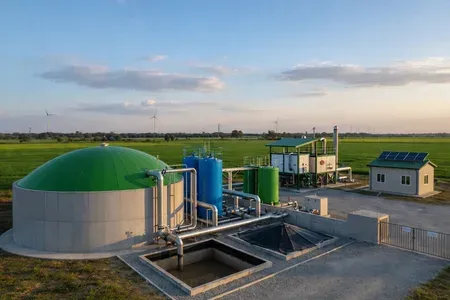
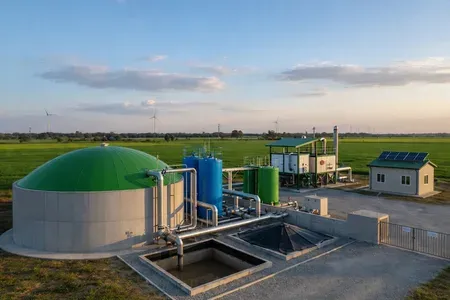
According to the GOBARdhan Unified Registration Portal, a total of 1,908 CBG/Bio-CNG plants have been registered across the country. Of these, 217 plants have been commissioned and are currently producing 0.4 million standard cubic metres per day (MMSCMD), while 339 plants are under construction. Operators seeking to set up or run a CBG/Bio-CNG plant can register through the portal to access benefits and support from the Ministry of Petroleum and Natural Gas (MoPNG).
Why This Matters for India's Energy Strategy
India's natural gas demand is rising across transport, households, industry, and commercial sectors. This comes amid a broader national push to reduce dependence on imported fossil fuels and cut carbon emissions. Notably, this is the first scheme to combine a guaranteed offtake framework with capital subsidies and MSME credit support in the biogas space — a structural departure from earlier, more fragmented bioenergy incentives. Whether the ten-fold production expansion target can be met will depend heavily on feedstock aggregation and private sector participation at scale.
Point of View
Feedstock aggregation at village level, remains unaddressed in the current framework. With 217 plants commissioned against 1,908 registered, the gap between registration and production is already stark; the ten-fold expansion target will test whether administrative incentives can overcome ground-level logistics. The ₹40,000 crore import-saving projection is credible only if private capital flows in at the pace the government assumes — and that is far from guaranteed without a track record of timely disbursals.
NationPress
21 Sept 2026
Frequently Asked Questions
What is the GOBARdhan National Circular Bioenergy Scheme?
GOBARdhan is a Central government scheme approved by the Union Cabinet with a ₹23,731 crore outlay, aimed at scaling up compressed biogas (CBG) production in India from FY27 to FY36. It seeks to reduce fossil fuel imports, create 1.5 lakh jobs, and build a circular bioeconomy using agricultural waste, cattle dung, and other organic feedstocks.
How much will GOBARdhan save in foreign exchange?
According to an official government statement, the scheme is projected to save over ₹40,000 crore in foreign exchange by reducing dependence on imported fossil fuels. It is also expected to add more than ₹75,000 crore to India's GDP.
What support does the scheme offer to CBG plant operators?
The scheme provides an administered offtake price of ₹2,110 per MMBTU, capital assistance of up to ₹2 crore per TPD, and 85 per cent credit guarantees for MSMEs. Operators can register through the GOBARdhan Unified Registration Portal to access these benefits from MoPNG.
What are the CBG procurement obligations for city gas distributors?
City Gas Distribution entities are required to procure CBG at 3 per cent of their CNG (Transport) and PNG (Domestic) volumes in FY27, rising to 4 per cent in FY28 and 5 per cent from FY29 onwards, in line with the notified CBG Obligation trajectory.
How many CBG plants are currently operational in India?
According to the GOBARdhan Unified Registration Portal, 1,908 CBG/Bio-CNG plants have been registered nationally. Of these, 217 have been commissioned and are producing 0.4 million standard cubic metres per day (MMSCMD), while 339 are under construction.