India signs 7 FTAs in 5 years to diversify export markets

Synopsis
India has quietly assembled one of its most active FTA pipelines in decades — seven deals in five years, an India-EU agreement concluded after years of stalled talks, and an India-US interim trade framework now in negotiation. The ₹25,060 crore Export Promotion Mission running to FY 2031 signals that market-access deals are only half the plan; execution and MSME uptake are the other half.
Key Takeaways
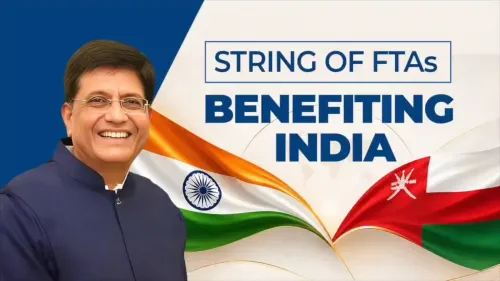
India signed 7 FTAs in the last five years , including deals with the UAE , UK , Australia , Oman , Mauritius , EFTA , and New Zealand .
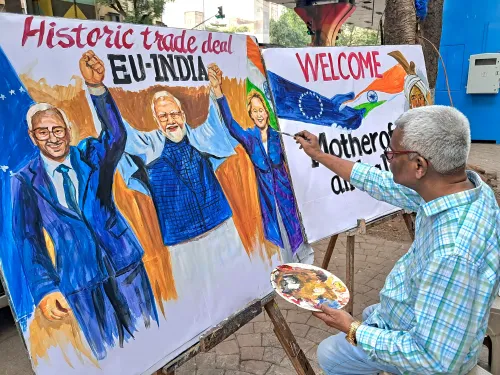
The India–EU FTA negotiations concluded on 27 January 2026 , ending years of stalled talks.
India and the US announced a framework for an Interim Trade Agreement on 7 February 2026 ; negotiations are ongoing.
The Export Promotion Mission (EPM) , launched in 2025 , carries an outlay of ₹25,060 crore through FY 2030–31 .
Key beneficiary sectors include textiles , apparel , and leather goods , with a focus on MSMEs , startups, and artisans.
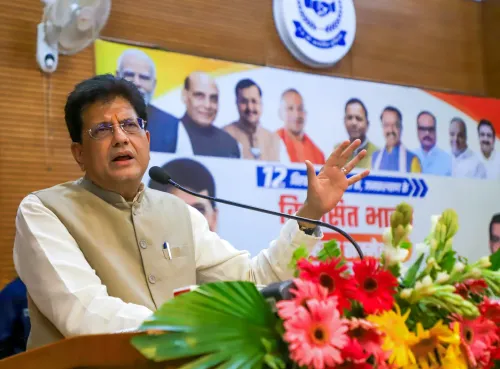
India has signed seven Free Trade Agreements (FTAs) in the last five years as part of a broad push to diversify export markets and strengthen trade ties with major economies, Minister of State for Commerce Jitin Prasada informed the Lok Sabha in a written reply on 21 July 2025. The disclosure, made through a statement tabled in Parliament, outlines a multi-pronged strategy spanning bilateral deals, ongoing negotiations, and export promotion initiatives.
Seven FTAs Signed in Five Years
The seven agreements concluded include the India–Mauritius Comprehensive Economic Cooperation and Partnership Agreement (CECPA), India–UAE CEPA, India–Australia Economic Cooperation and Trade Agreement (Ind-Aus ECTA), India–European Free Trade Association (EFTA) Trade and Economic Partnership Agreement (TEPA), India–Oman CEPA, India–UK Comprehensive Economic and Trade Agreement (CETA), and the India–New Zealand FTA.
Notably, the India–European Union FTA negotiations concluded on 27 January 2026 — a landmark development given that talks between the two sides had stalled for nearly a decade before being revived. Separately, India and the United States announced on 7 February 2026 that they had reached a framework for an Interim Agreement on reciprocal and mutually beneficial trade, with negotiations described as ongoing.
What These Agreements Are Designed to Deliver
According to the parliamentary statement, FTAs are entered into primarily to expand bilateral trade by broadening market access and leveraging trade complementarities. The agreements are designed to deliver preferential market access for goods from labour-intensive sectors — particularly textiles, apparel, and leather goods — with the stated aim of boosting employment and export competitiveness.
The deals also include provisions on Technical Barriers to Trade (TBT) to promote mutual recognition of standards and regulatory requirements, facilitating smoother access for Indian goods in partner markets. The government said it engages with trading partners through Joint Committees and Working Groups to resolve specific export problems, including sanitary and phytosanitary (SPS) concerns and non-tariff barriers (NTBs).
Export Promotion Mission and MSME Focus
Beyond trade agreements, the government has launched the Export Promotion Mission (EPM) in 2025 with a total outlay of ₹25,060 crore for the period FY 2025–26 to FY 2030–31. The mission is designed to strengthen India's export competitiveness, with a particular focus on Micro, Small and Medium Enterprises (MSMEs), startups, artisans, and small exporters seeking to tap cross-border e-commerce channels.
The government also works through Indian Missions overseas, Export Promotion Councils (EPCs), and industry associations to identify and address market access concerns in key destinations including the European Union, Africa, and Southeast Asia.
What Comes Next
With the India–EU FTA concluded and India–US interim trade negotiations underway, the next phase of India's FTA strategy will test whether concluded agreements translate into measurable export growth — particularly for sectors like textiles and electronics that carry the largest employment multipliers. The ₹25,060 crore EPM outlay running through FY 2030–31 will be a key instrument in that effort.
Point of View
But the harder question is utilisation — past agreements, including the ASEAN FTA, saw Indian exporters under-use preferential tariffs due to compliance costs and rules-of-origin complexity. The India-EU conclusion is genuinely significant after nearly a decade of on-off talks, but its commercial value depends on what was conceded on data localisation, intellectual property, and government procurement. The India-US interim framework, meanwhile, is a political signal as much as a trade one — the details will determine whether it meaningfully reduces the tariff friction that has accumulated since 2018. The ₹25,060 crore EPM is the right complement to market-access deals, but its MSME focus will only deliver if small exporters can actually navigate FTA compliance without prohibitive overhead.
NationPress
22 Jul 2026
Frequently Asked Questions
Which seven FTAs has India signed in the last five years?
India has signed FTAs with Mauritius (CECPA), the UAE (CEPA), Australia (Ind-Aus ECTA), the European Free Trade Association (EFTA TEPA), Oman (CEPA), the United Kingdom (CETA), and New Zealand. The details were disclosed by Minister of State for Commerce Jitin Prasada in a written reply to the Lok Sabha on 21 July 2025.
Has the India-EU Free Trade Agreement been finalised?
Yes. The India–European Union FTA negotiations concluded on 27 January 2026, according to the parliamentary statement. This ends years of stalled talks between the two sides, though implementation timelines have not yet been publicly detailed.
What is the status of the India-US trade agreement?
India and the United States announced on 7 February 2026 that they had reached a framework for an Interim Agreement on reciprocal and mutually beneficial trade. Formal negotiations are ongoing and no final deal has been signed yet.
What is the Export Promotion Mission and who does it target?
The Export Promotion Mission (EPM) was launched in 2025 with a ₹25,060 crore outlay covering FY 2025–26 to FY 2030–31. It is designed to strengthen India's export competitiveness, with a particular focus on MSMEs, startups, artisans, and small exporters engaged in cross-border e-commerce.
Which sectors benefit most from India's FTAs?
Labour-intensive sectors such as textiles, apparel, and leather goods are identified as primary beneficiaries, as FTAs provide preferential market access that supports both export growth and employment in these industries.