Goyal Says Innovation Is in India's DNA

Synopsis
Commerce Minister Piyush Goyal on 14 June 2026 posted that 'innovation is in India's DNA,' signalling continued government commitment to its decade-long policy push spanning Startup India, the Atal Innovation Mission and the National IPR Policy.
Key Takeaways
Union Commerce and Industry Minister Piyush Goyal posted on 14 June 2026 that 'innovation is in India's DNA.' Startup India , launched in January 2016 , provides tax incentives and funding support to India's growing startup ecosystem.
The Atal Innovation Mission under NITI Aayog has built tinkering labs and incubators across schools and industries since 2016 .
The National IPR Policy ( May 2016 ) and the India Innovation Index ( 2019 ) complement these efforts by protecting and benchmarking indigenous innovation.
Key stakeholders include startups , MSME exporters and research institutions that rely on policy continuity for funding and growth.
Analysts will watch for R&D allocation increases or new innovation missions in the next Union Budget .
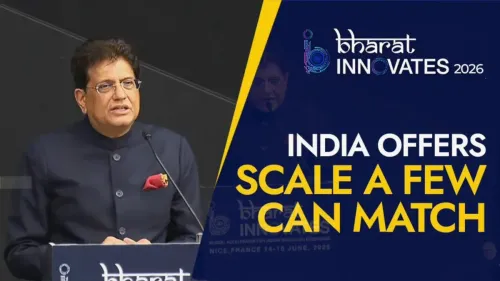
Union Commerce and Industry Minister Piyush Goyal on Sunday, 14 June 2026, declared that innovation is intrinsic to India's national character, posting a brief but pointed message on X that underscores the government's sustained emphasis on building a technology-driven economy.
Context
The minister's three-word assertion — 'Innovation is in India's DNA' — is short in form but deliberate in signal. It arrives as New Delhi continues to position itself as a global hub for startups, deep-tech ventures and indigenous research, with Commerce and Industry being the nodal ministry for several flagship programmes that operationalise this ambition.
Goyal oversees policy levers ranging from trade facilitation to investment promotion, making his articulation of India's innovation identity directly relevant to how the government frames its economic diplomacy and domestic industrial strategy.
Policy Backdrop
The assertion draws on a decade of layered policy architecture. Startup India, launched in January 2016, created a framework of tax incentives, compliance relief and funding access that has since grown India's recognised startup ecosystem into one of the largest in the world. Alongside it, the Atal Innovation Mission — established under NITI Aayog in 2016 — built physical infrastructure for grassroots innovation through tinkering labs and incubators in schools and colleges.
The National IPR Policy, adopted in May 2016, strengthened the patent regime to encourage inventors to protect and commercialise indigenous ideas. The India Innovation Index, first released in 2019, introduced a state-level benchmarking tool that created competitive incentives for sub-national governments to invest in innovation ecosystems.
The broader Make in India campaign, running since 2014, has consistently framed design and innovation — not just assembly — as central to India's manufacturing identity, aligning with efforts to reduce import dependence in technology-intensive sectors and attract global venture capital.
Stakeholders and Impact
The message resonates most directly with startups, MSME exporters and research institutions that depend on policy continuity and ministerial advocacy to attract funding and talent. For the startup community in particular, a Commerce Minister's public reaffirmation of innovation as a national trait carries weight in investor confidence and in bilateral trade conversations where India's technology credentials are increasingly on the table.
For research institutions, the framing supports the case for sustained or increased public R&D allocation, a perennial demand ahead of each Union Budget. Industry bodies in sectors such as semiconductors, pharmaceuticals and clean energy — all areas where India has announced targeted production-linked incentives — also stand to benefit from the narrative that positions domestic innovation as a structural strength rather than an aspiration.
What's Next
Observers will watch whether this messaging precedes a concrete policy announcement — such as enhanced R&D allocation in the next Union Budget, a new sector-specific innovation mission, or fresh targets under the India Innovation Index framework. State governments that have performed well in innovation rankings may also use the minister's statement to reinforce their own investment pitches.
With India's trade negotiations and bilateral technology partnerships increasingly tied to its credibility as an innovation economy, Goyal's framing is likely to recur in diplomatic and commercial forums in the months ahead.
Point of View
The post also carries legislative signalling value — it may foreshadow Budget-cycle debates on R&D spending or intellectual property reform. Ultimately, the gap between rhetorical affirmation and measurable innovation outcomes — patent filings, deep-tech exits, R&D as a share of GDP — will determine how durable this narrative proves to be.
NationPress
13 Sept 2026
Frequently Asked Questions
What did Piyush Goyal say about innovation in India?
On 14 June 2026, Commerce and Industry Minister Piyush Goyal posted on X that 'innovation is in India's DNA,' reaffirming the government's framing of innovation as central to India's economic identity.
What is the Startup India scheme?
Startup India is a flagship government programme launched in January 2016 that provides tax incentives, easier regulatory compliance and funding support to build an ecosystem for innovative startups across the country.
What is the Atal Innovation Mission?
The Atal Innovation Mission is a NITI Aayog initiative established in 2016 to create tinkering labs, incubators and institutional infrastructure to promote grassroots innovation in schools and industries.
How does India measure innovation at the state level?
The India Innovation Index, first released by NITI Aayog in 2019, benchmarks state-level innovation performance, creating competitive incentives for state governments to invest in their local ecosystems.
What could follow Piyush Goyal's innovation statement?
Policy watchers expect possible announcements of increased R&D allocations or new sector-specific innovation missions in the next Union Budget, as well as state-level follow-up to India Innovation Index rankings.