Goyal: New global markets opening for Indian farmers
Synopsis
Commerce and Industry Minister Piyush Goyal declared that new global markets are opening for Indian farmers, tying the message to Prime Minister Modi's Mann Ki Baat programme and the government's ongoing agricultural export push rooted in the 2018 Agricultural Export Policy.
Key Takeaways
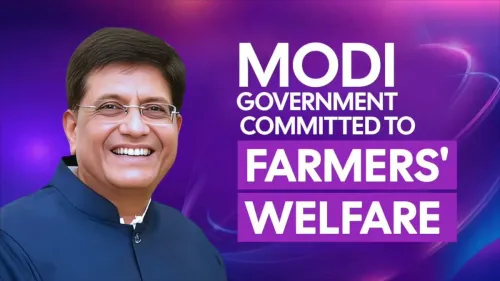
Piyush Goyal posted on 25 October 2026 that new markets around the world are opening for India's farmers .
The message was tagged to #MannKiBaat , Prime Minister Modi's monthly radio address, giving it wide rural reach.
India's Agricultural Export Policy , launched in 2018 , underpins the government's drive to diversify farm-export destinations.
The Commerce Ministry has pursued free trade agreements and bilateral market-access deals to reduce tariff and sanitary barriers on farm goods.
Monthly agricultural export data from the Commerce Ministry will be the key metric to watch for progress on this goal.
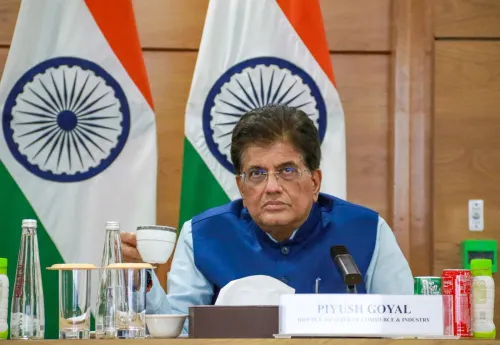
New export doors are swinging open for India's farmers, Union Commerce and Industry Minister Piyush Goyal declared on Sunday, 25 October 2026, echoing a theme from Prime Minister Narendra Modi's monthly radio programme Mann Ki Baat — signalling that agricultural trade expansion remains firmly at the centre of the government's economic agenda.
Goyal posted in Hindi: 'Bharat ke kisanon ke liye duniya mein naye baazar khul rahe hain' — 'New markets are opening up around the world for India's farmers' — tagging the message to #MannKiBaat, the Prime Minister's direct-to-citizen broadcast where farm welfare and export growth are recurring touchstones.
The policy engine behind the claim
The remark sits on a foundation laid as far back as 2018, when the government launched the Agricultural Export Policy — a framework designed to diversify the destinations for Indian farm produce and move the sector away from dependence on a handful of traditional buyers. The logic was straightforward: more markets mean more bargaining power, more stable prices, and ultimately a fatter income for the farmer.
Since then, the Commerce Ministry has pursued a dual track — free trade agreements on one side, bilateral market-access negotiations on the other — to chip away at the tariff walls and sanitary barriers that block Indian fruits, grains, processed foods, and dairy from competing globally. Each new FTA signed, each phytosanitary clearance won, adds another lane on that highway to the world.
Why the Mann Ki Baat connection matters
Goyal's decision to anchor this message to Mann Ki Baat is deliberate. The monthly address gives government messaging its widest rural reach — it is broadcast across All India Radio's vast network, the medium that still reaches kitchens and fields where smartphones do not. Attaching a trade-policy point to that platform signals that farm exports are being positioned not as a technocratic Commerce Ministry win, but as a tangible benefit that every cultivator should feel in their own income.
The Commerce Ministry regularly publishes monthly agricultural export data as a scorecard for this ambition. Analysts and agricultural exporters will watch those numbers — alongside any fresh FTA announcements involving farm products — to test whether the optimism in Goyal's post is backed by hard volumes at the border.
For Indian farmers, the promise of a world that wants what they grow is not new — but a Commerce Minister saying it loudly, in sync with the Prime Minister's public address, is a reminder that the push is very much alive. The next harvest of data will tell whether the doors are truly open, or still being unlocked.
Point of View
And successive FTA negotiations have kept it alive. The challenge has always been the gap between ministerial optimism and verifiable export volume growth; until monthly data confirms a sustained uptick in farm-product receipts, the claim remains more aspiration than achievement. Goyal's amplification nonetheless raises the political stakes: a visible promise demands a visible result.
NationPress
25 Oct 2026
Frequently Asked Questions
What did Piyush Goyal say about Indian farmers on 25 October 2026?
He posted that new markets around the world are opening for India's farmers, tagging the message to Mann Ki Baat.
What is India's Agricultural Export Policy?
Launched in 2018 , it is a government framework to diversify and expand the destinations for Indian farm exports and integrate Indian agriculture with global markets.
What is Mann Ki Baat and why is it relevant to farm exports?
Mann Ki Baat is Prime Minister Narendra Modi's monthly radio address broadcast across India. Tagging farm-export messages to it ensures the widest possible rural audience hears the government's trade promises directly.
How is India expanding global markets for farmers?
Through free trade agreement negotiations and bilateral market-access deals aimed at reducing tariffs and sanitary barriers that restrict Indian agricultural products in foreign markets.
How can we track whether new markets are actually opening for Indian farmers?
The Commerce Ministry releases monthly agricultural export data that shows real trade volumes; new FTA announcements covering farm products are the other key indicator to watch.