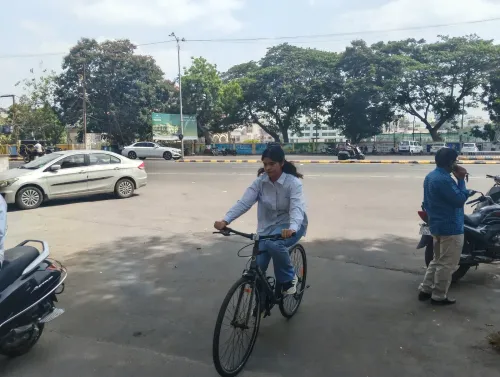
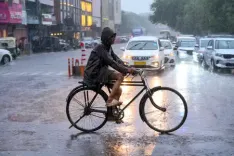
GST Deputy Commissioner cycles to office, heeding Modi's fuel-saving appeal
Synopsis
A GST Deputy Commissioner in New Delhi has ditched his car for a bicycle, directly crediting PM Modi's fuel-conservation appeal. It is a small but telling signal: the government's messaging on the global energy crisis is reaching its own officials — and they are making it visible.
Key Takeaways
Narendra Yadav , Deputy Commissioner, GST Department , has switched from a luxury car to a bicycle for his daily commute in New Delhi .
He cited PM Modi 's appeal to conserve petrol and diesel amid the global fuel crisis linked to the West Asia conflict .
Yadav argued that individual conservation efforts, if adopted widely, can become a major public movement.
He is a brand ambassador for the Fit India Movement and highlighted cycling's benefits for controlling diabetes and blood pressure.
He acknowledged Opposition criticism but said India cannot ignore the international energy situation.
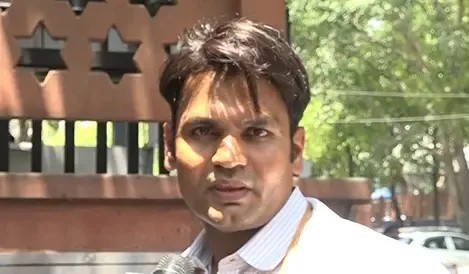
Narendra Yadav, Deputy Commissioner in the GST Department, has traded in his luxury car for a bicycle to commute to work in New Delhi, citing Prime Minister Narendra Modi's appeal to citizens to conserve petrol and diesel amid a global fuel crisis linked to the West Asia conflict. The gesture, small in scale but symbolic in intent, illustrates how the PM's conservation message is resonating at the ground level of government service.
Why Yadav Made the Switch
Speaking to reporters, Yadav said the country is navigating a period of significant global challenges, and that every citizen bears a responsibility to take small but meaningful steps in the national interest. "The cycle is not just an eco-friendly mode of transport but also beneficial to maintain fitness. Given PM Modi's appeal to save fuel, I find the cycle the best option," he said.
Yadav also noted a practical upside: given Delhi's notorious traffic congestion, cycling to his office takes roughly the same time as driving. He advised fellow citizens to consider cycling for short-distance errands, market trips, or office commutes where distances are manageable.
A Call for a Broader Public Movement
Yadav expressed hope that his example would encourage colleagues in his office to follow suit. He argued that individual action, even if it seems marginal in isolation, can snowball into a significant public movement if adopted across the country. "Rather, if people across the country gradually join such a campaign, it can turn into a major public movement. We should focus on what we can contribute in such times," he said.
He acknowledged that the Opposition has raised questions over the government's handling of the fuel situation, but maintained that the international energy crisis cannot be ignored. "We cannot ignore the international fuel crisis and hence should keep making efforts to save as much as we can," he added.
The Fit India Connection
Yadav's commitment to cycling extends beyond fuel conservation. He is a brand ambassador for the Fit India Movement, through which he actively promotes physical fitness and a healthy lifestyle. He pointed out that regular cycling can help control non-communicable diseases such as diabetes and high blood pressure — conditions that are rising rapidly among India's urban population.
"Since the future of the country lies on the shoulders of the youth, they need to maintain a healthy lifestyle," he said, urging young Indians in particular to incorporate cycling into their daily routines.
Broader Context
Prime Minister Modi's appeal to reduce petrol and diesel consumption comes against the backdrop of elevated global crude prices, partly driven by the ongoing conflict in West Asia. India, which imports a substantial share of its crude oil requirements, is particularly exposed to international price volatility. Officials and public figures embracing fuel conservation publicly adds a behavioural dimension to what is otherwise a structural policy challenge. As the government weighs longer-term energy transition strategies, individual-level actions like Yadav's serve as visible, low-cost signals of civic participation in the effort.
Point of View
But it points to something more interesting: the government's fuel-conservation messaging is being internalised and performed publicly by its own bureaucracy. That is a form of soft mobilisation. The harder question is whether symbolic gestures can substitute for structural policy — India's fuel import dependence is a macro problem that no number of bicycle commutes will resolve. Yet public behaviour change, if it scales, does reduce demand at the margins. The real test is whether the Fit India and fuel-conservation narratives converge into a durable urban cycling infrastructure push, or remain confined to individual acts of visible compliance.
NationPress
22 Sept 2026
Frequently Asked Questions
Why did GST Deputy Commissioner Narendra Yadav start cycling to office?
Narendra Yadav switched from his luxury car to a bicycle to commute to his New Delhi office in response to PM Modi's appeal to conserve petrol and diesel amid the global fuel crisis. He said every citizen has a responsibility to take small steps in the national interest during challenging times.
What is PM Modi's appeal regarding fuel conservation?
PM Modi has called on Indian citizens to reduce their consumption of petrol and diesel in the context of a global fuel crisis partly driven by the West Asia conflict. He has framed conservation as both an economic necessity and a message of responsibility to future generations.
What is the Fit India Movement and what is Narendra Yadav's role in it?
The Fit India Movement is a government-backed initiative to promote physical fitness and healthy lifestyles among Indians. Narendra Yadav serves as a brand ambassador for the movement and uses his public profile to encourage cycling as a means of improving health and controlling non-communicable diseases like diabetes and high blood pressure.
How does cycling help amid the global fuel crisis?
Cycling eliminates dependence on petrol or diesel for short-distance commutes, directly reducing individual fuel consumption. If adopted widely, officials like Yadav argue it could develop into a significant public conservation movement that eases India's exposure to volatile global crude prices.
Has the Opposition responded to the government's fuel conservation appeal?
According to Yadav, the Opposition has raised questions over the government's handling of the fuel situation. However, he maintained that the international energy crisis is real and cannot be ignored, and that conservation efforts must continue regardless of political debate.