Modhera Sun Temple turns 1,000: Gujarat's UNESCO-listed solar marvel
Synopsis
One thousand years after Bhimdeva-I commissioned it, Modhera's Sun Temple still catches the equinox sunrise through its Sabha Mandap doors exactly as its builders planned. With UNESCO recognition already secured on the Tentative List and the Uttarardh Mahotsav keeping it culturally alive, Gujarat's millennium-old solar marvel is edging toward the world stage.
Key Takeaways
The Modhera Sun Temple in Mehsana, Gujarat was built in 1026–27 AD during the reign of Solanki king Bhimdeva-I .
Designed in the Maru-Gurjara style , the temple's east-west axis ensures the rising Sun illuminates the shrine at each equinox.
The complex features 108 shrines around the Surya Kund, 52 pillars in the Sabha Mandap (representing 52 weeks), and 24 pillars in the sanctum (representing 24 hours).
UNESCO added the temple to India's Tentative List of World Heritage Sites on 13 December 2022 .
The Gujarat government hosts the annual Uttarardh Mahotsav at the temple each January , featuring classical arts performances.
The Archaeological Survey of India (ASI) is responsible for the monument's conservation and management.
Gujarat's Modhera Sun Temple in Mehsana district marks 1,000 years of architectural heritage in 2026, standing as one of India's most precisely engineered ancient monuments and a growing draw for visitors seeking to witness its legendary solar alignments and intricate stone craftsmanship in person.
A Temple Built Around the Sun
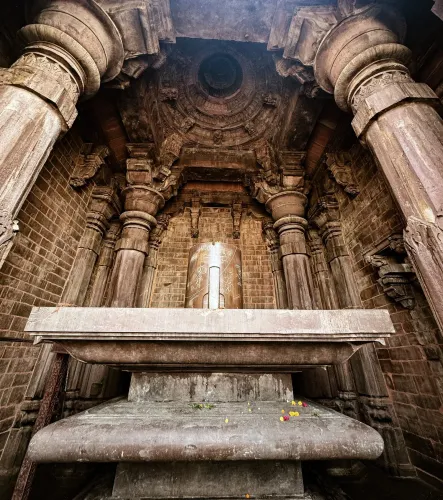
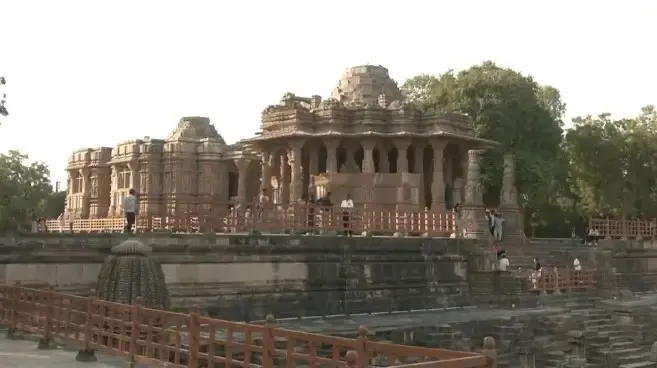
Constructed between 1026 and 1027 AD under the patronage of Solanki dynasty king Bhimdeva-I, the temple was designed in the Maru-Gurjara architectural style and oriented along a strict east-west axis. Its layout comprises three principal sections: the Surya Kund (stepwell), the Sabha Mandap (assembly hall), and the sanctum sanctorum.
The Archaeological Survey of India (ASI), which conserves and manages the monument under India's heritage framework, notes that the east-facing orientation was deliberately planned so that the rising Sun at each equinox shines directly through the Sabha Mandap's doors and onto the shrine. According to UNESCO's description of the complex, this solar alignment represents one of the most deliberate acts of astronomical planning in classical Indian temple architecture.
Architectural Symbolism in Stone
Every element of the temple encodes a unit of time. The 52 pillars of the Sabha Mandap are traditionally associated with the 52 weeks of the year, while the 24 pillars inside the sanctum sanctorum are said to represent the 24 hours of the day. The sacred Surya Kund, positioned directly in front of the temple, is ringed by 108 small and large shrines. The Sabha Mandap's walls carry intricately carved panels, and the sanctum once housed the principal idol of the Sun God.
This layering of cosmological symbolism within physical structure is what separates Modhera from most other sun-facing temples of its era — it does not merely face the sun, it is calibrated to it.
Visitors and Living Heritage
The temple continues to attract pilgrims and tourists from across Gujarat and beyond. Shankarbhai Prajapati, a visitor from Gandhinagar, described the experience: 'The Sun Temple of Mehsana is a historical place in Gujarat. It has magnificent carvings inside. It should definitely be visited in today's time.' Another visitor, Chandrikaben, travelled from Kotha village in Kalol to see the monument and echoed the sentiment: 'The Modhera Sun Temple in Mehsana is worth seeing... It is very good, and everyone should come to see it.'
For several years, the Gujarat government has organised the Uttarardh Mahotsav at the complex each January, featuring artists from across the country associated with classical dance, music, and other performing arts — reinforcing Modhera's role as a living cultural venue rather than merely a protected ruin.
UNESCO Recognition and Conservation Status
The temple's international standing was formalised on 13 December 2022, when UNESCO added the Sun Temple, Modhera and its adjoining monuments to India's Tentative List of World Heritage Sites. The UNESCO submission characterised the complex as a defining example of Maru-Gurjara architecture and acknowledged the ASI's ongoing role in its protection and conservation. A formal nomination to the World Heritage List would make Modhera one of Gujarat's most globally recognised historic sites.
As the temple enters its second millennium, its survival — sculptures intact, solar geometry undimmed — positions it as a benchmark for heritage conservation in western India and a candidate for the highest level of global recognition.
Point of View
But sustained global recognition will require a credible management plan that UNESCO's nomination committee demands and that India has struggled to deliver on schedule for other shortlisted sites.
NationPress
22 Sept 2026
Frequently Asked Questions
When was the Modhera Sun Temple built and by whom?
The Modhera Sun Temple was constructed between 1026 and 1027 AD under the reign of Solanki dynasty king Bhimdeva-I. It was built in the Maru-Gurjara architectural style and is located in Mehsana district, Gujarat.
What is the significance of the Modhera Sun Temple's design?
The temple is oriented along a strict east-west axis so that the rising Sun at the equinoxes shines directly through the Sabha Mandap's doors onto the sanctum. Its 52 pillars represent the 52 weeks of the year, its 24 inner pillars represent the 24 hours of the day, and the Surya Kund stepwell is ringed by 108 shrines.
Has UNESCO recognised the Modhera Sun Temple?
Yes. UNESCO added the Sun Temple, Modhera and its adjoining monuments to India's Tentative List of World Heritage Sites on 13 December 2022. A formal inscription on the World Heritage List would require a complete nomination dossier reviewed by UNESCO's World Heritage Committee.
Who manages and conserves the Modhera Sun Temple?
The Archaeological Survey of India (ASI) is responsible for the protection, conservation, and management of the temple under India's applicable heritage conservation framework.
What is the Uttarardh Mahotsav held at Modhera?
The Uttarardh Mahotsav is an annual cultural festival organised by the Gujarat government at the Modhera Sun Temple complex each January. It features performances by artists from across the country in classical dance, music, and other art forms, keeping the ancient site active as a living cultural venue.