Gujarat expands Doodh Sanjeevani Yojana to all tribal ICDS blocks, ₹37.7 crore allocated
Synopsis
Gujarat's Doodh Sanjeevani Yojana — launched by Narendra Modi in 2009 in just six districts — is now reaching all ICDS blocks in tribal areas, backed by ₹37.7 crore in state funds. For the first time, a high-fat milk pilot targets five districts, raising the fat content from 1.5% to up to 4.5% to address child nutrition gaps in some of Gujarat's most underserved communities.
Key Takeaways
Gujarat has extended Doodh Sanjeevani Yojana to all ICDS blocks in tribal districts as of 17 July .
The state has allocated ₹37.709 crore for the expansion, entirely funded by the state government.
A first-ever high-fat milk pilot (₹0.3035 crore) will supply 3% fat milk in Narmada, Dahod, and Dang, and 4.5% fat milk in Valsad and Sabarkantha.
The scheme was originally launched on 24 December 2009 in six tribal districts by then Chief Minister Narendra Modi .
Cooperative dairies including Amul , Banas , Sumul , and Mahi supply fortified milk under the scheme since 2016 .
The scheme now covers 20 districts , up from the original six, with 53 new ICDS blocks added in this round.
The Gujarat government on 17 July announced the full expansion of its flagship nutrition scheme, Doodh Sanjeevani Yojana, to all Integrated Child Development Services (ICDS) blocks in tribal districts — a move that will bring thousands of additional children, pregnant women, and lactating mothers under its ambit. The state has allocated ₹37.709 crore for the expansion, with costs borne entirely by the state government.
What the Expansion Covers
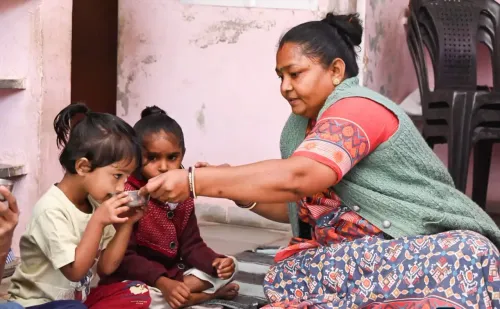
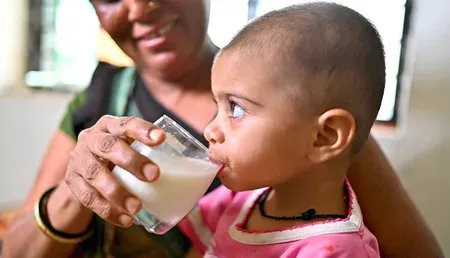
Under the extended scheme, 53 new ICDS blocks in tribal districts will begin receiving 200 ml of fortified flavoured milk per beneficiary. The Women and Child Development Department confirmed that the rollout targets the most nutritionally vulnerable sections of Gujarat's tribal population, with the explicit goal of mainstreaming access to government welfare services.
Alongside the block-level expansion, the state has for the first time approved a pilot programme for high-fat fortified milk, sanctioned at ₹0.3035 crore. Previously, the scheme supplied milk with 1.5% fat content.
High-Fat Milk Pilot: District-Wise Breakdown
The pilot introduces two fat-content tiers. Milk with 3% fat will be supplied in Narmada, Dahod, and Dang districts, while milk with 4.5% fat will be provided in Valsad and Sabarkantha districts. According to the state government, the higher fat content is intended to better meet the physical growth, energy, and nutritional requirements of young children in these areas.
A Scheme With Deep Roots
The Doodh Sanjeevani Yojana was first launched on a pilot basis in six tribal districts on 24 December 2009 by the then Chief Minister Narendra Modi. In 2014, it was expanded to cover 106 ICDS units across 14 additional tribal districts and 20 developing talukas. From 2016 onwards, the cooperative dairy sector was integrated into supply chains — with Banas, Amul, Sumul, and Mahi cooperatives producing and supplying fortified milk — bringing greater operational efficiency to the scheme.
The scheme, which began in just six districts, is now operational across 20 districts, with the bulk of this expansion occurring in the last five years under the Chief Minister Bhupendra Patel-led government.
Impact and What Comes Next
Experts cited by the state government describe the scheme not merely as a milk distribution programme but as a long-term public health investment. The expansion to the remaining ICDS blocks is expected to significantly widen the reach of nutritional support in Gujarat's tribal belt. With the high-fat milk pilot now greenlit, the government's next step will be to assess outcomes in the five selected districts before a potential broader rollout.
Point of View
Making it as much a legacy narrative as a welfare move. The more substantive question is whether the high-fat milk pilot is backed by a rigorous outcome-measurement framework, or whether it is an incremental add-on without a clear evaluation timeline. Gujarat's tribal districts still record some of the state's worst child stunting rates; a milk scheme alone, however well-funded, cannot substitute for the broader determinants of nutrition — sanitation, dietary diversity, and maternal health. The ₹37.7 crore allocation is meaningful but modest relative to the scale of the challenge.
NationPress
16 Oct 2026
Frequently Asked Questions
What is Gujarat's Doodh Sanjeevani Yojana?
Doodh Sanjeevani Yojana is a Gujarat government scheme that provides 200 ml of fortified flavoured milk to children, pregnant women, and lactating mothers in tribal and remote areas to combat malnutrition. It was launched on 24 December 2009 in six tribal districts by then Chief Minister Narendra Modi and has since expanded to 20 districts.
What is the latest expansion of Doodh Sanjeevani Yojana?
On 17 July, the Gujarat government decided to extend the scheme to all ICDS blocks in tribal districts, adding 53 new blocks. The state has allocated ₹37.709 crore for this expansion, funded entirely by the state government.
What is the high-fat milk pilot under Doodh Sanjeevani Yojana?
For the first time, Gujarat has approved a pilot to supply higher-fat fortified milk in selected districts. Milk with 3% fat will go to Narmada, Dahod, and Dang, while 4.5% fat milk will be supplied in Valsad and Sabarkantha — up from the existing 1.5% fat standard. A budget of ₹0.3035 crore has been sanctioned for this pilot.
Which cooperative dairies supply milk under the scheme?
Since 2016, the cooperative dairy sector has been integrated into the scheme. Banas, Amul, Sumul, and Mahi cooperatives produce and supply the fortified milk, which has made the scheme more operationally efficient.
Who benefits from the Doodh Sanjeevani Yojana expansion?
The primary beneficiaries are children, pregnant women, and lactating mothers in Gujarat's tribal districts. The latest expansion to all ICDS blocks is expected to bring thousands of new beneficiaries into the scheme, particularly from the most nutritionally vulnerable communities.