Gujarat's Women’s Reservation Bill: A Landmark Move for Democracy
Synopsis
The 'Nari Shakti Vandan Adhiniyam' aims to reserve 33% of seats for women in Parliament and state assemblies, marking a significant step towards democratic inclusivity and women empowerment, as emphasized by Gujarat Chief Minister Bhupendra Patel.
Key Takeaways
33% reservation for women in Parliament and state legislatures.
Significant step towards women empowerment and inclusive governance.
Impact of self-help groups on women's economic independence.
Historical significance of the Nari Shakti Vandan Adhiniyam .
Commitment to achieving Viksit Bharat by 2047 .
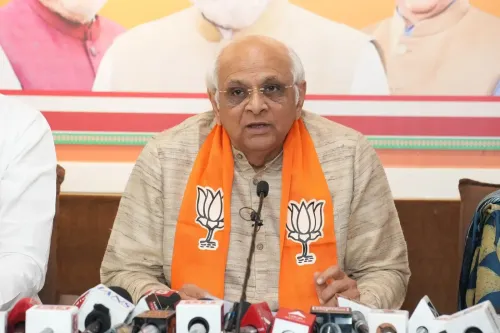
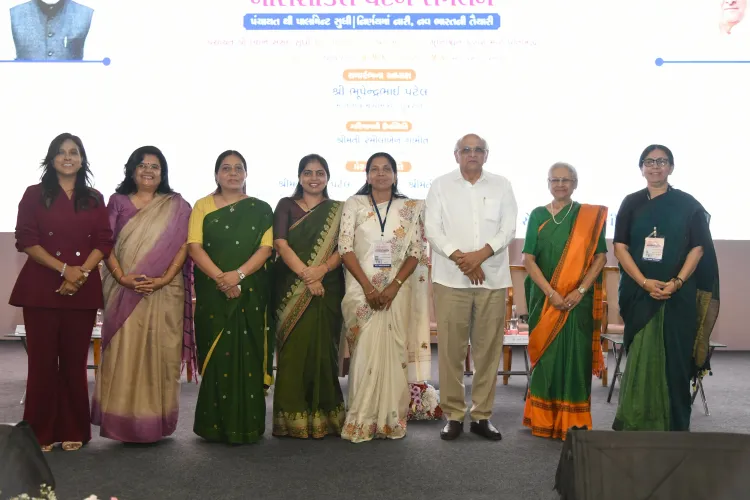
Gandhinagar, April 15 (NationPress) The anticipated rollout of the 'Nari Shakti Vandan Adhiniyam', which allocates 33 percent reservation for women in both Parliament and state legislatures, took center stage at a state-level conference in Gandhinagar on Wednesday. Gujarat's Chief Minister Bhupendra Patel emphasized its vital role in enhancing democratic engagement and promoting women-led development.
In his address regarding the bill, Patel asserted that this legislation would guarantee structured representation of women from state assemblies all the way to Parliament, labeling it a transformative step in the evolution of democracy in India.
“Implementing this bill will mark a significant milestone in our journey towards a developed India, propelled by women’s active participation,” he stated.
He also noted that a greater representation of women in decision-making roles would elevate the quality of governance.
“The influential presence of women in policy-making will foster improved sensitivity, transparency, and balance within the governance framework,” he added.
Reflecting on the passage of the legislation earlier in 2023, the Chief Minister hailed it as a pivotal moment in the annals of parliamentary history.
“The Nari Shakti Vandan Adhiniyam transcends mere reservation; it is a historic document symbolizing a revolutionary shift in our political landscape,” he remarked, highlighting its embodiment of a long-lasting change in representation.
Patel acknowledged the Prime Minister’s vision, which has continuously aimed at ensuring women’s involvement in public spheres from the grassroots level to the top.
“The Prime Minister is committed to providing women with the necessary opportunities to engage in public life, ranging from Panchayats to Parliament,” he stated.
He also pointed out Gujarat’s prior initiative of implementing 50 percent reservation for women in Panchayati Raj institutions, which he claimed had fortified local governance and boosted grassroots engagement.
Discussing the impact of national welfare programs, Patel mentioned how self-help groups have significantly empowered women economically.
“Hundreds of thousands of sisters have achieved self-reliance through these groups, establishing themselves as micro-entrepreneurs,” he expressed.
He further referenced various schemes such as the Pradhan Mantri Jan Arogya Yojana (PMJAY), Ujjwala Yojana, Namo Drone Didi initiative, and Lakhpati Didi program, asserting that these efforts have enhanced healthcare accessibility, livelihoods, and financial independence for women.
As a result of these welfare measures, approximately 25 crore individuals have been lifted out of poverty.
“Guided by the principle of Sabka Saath, Sabka Vikas, Sabka Prayas, women will play a crucial role in realizing the vision of a developed India by 2047,” Patel concluded.
Gandhinagar Mayor Mira Patel highlighted that women’s involvement in governance and development has notably expanded across various sectors.
“Women are actively engaged in education, health, industry, services, startups, and governance, significantly contributing to the overall advancement of the state,” she remarked, asserting that the reservation law would further enhance their representation in legislative frameworks.
Padma Shri awardee Ramilaben Gamit emphasized the transformative power of women’s empowerment in rural communities.
“When women receive proper opportunities and encouragement, they can instigate revolutionary changes in society,” she noted, sharing her experience of establishing 162 self-help groups that equip women with skills in tailoring, masonry, beauty services, and waste management, thereby enhancing their financial independence.
Gandhinagar North MLA Rita Patel reiterated that women’s participation in public life is vital for inclusive growth.
“The role of women in societal development is indispensable,” she asserted, acknowledging Gujarat’s ongoing commitment to enhancing women’s access to education, health, and employment opportunities.
Usha Jaiswal, Chairperson of the FICCI Women Organisation in Ahmedabad, pointed out that women entrepreneurs in India are increasingly emerging as key leaders and innovators.
“Women are transcending mere participation to assume leadership roles, showcasing their potential to compete on a global scale,” she remarked.
Point of View
The passage of the 'Nari Shakti Vandan Adhiniyam' is a significant advancement for women's rights in India. The legislation not only seeks to enhance women's representation in governance but also aims to foster a more inclusive political landscape, reflecting a commitment to equitable participation in democracy.
NationPress
16 Oct 2026
Frequently Asked Questions
What is the 'Nari Shakti Vandan Adhiniyam'?
The 'Nari Shakti Vandan Adhiniyam' is a proposed law that provides for 33% reservation for women in Parliament and state legislatures in India.
Why is this legislation important?
This legislation is seen as a critical step towards enhancing women's representation in governance, thereby promoting inclusive democracy and women's empowerment.
When was the bill passed?
The bill was passed in 2023 and is considered a landmark moment in India's parliamentary history.
How will this impact women's participation in governance?
The bill aims to ensure structured representation of women, thereby improving the quality of governance and decision-making processes.
What other initiatives support women's empowerment in Gujarat?
Gujarat has previously implemented a 50% reservation for women in Panchayati Raj institutions and has various welfare programs aimed at economic empowerment of women.