Haryana CMO backs CatchTheRain drive for monsoon water conservation
Synopsis
The Chief Minister's Office of Haryana on 8 July 2026 urged citizens to adopt rainwater harvesting at homes, societies and workplaces under the national CatchTheRain campaign, and to desilt ponds and reservoirs to maximise monsoon water storage in a state facing chronic groundwater stress.
Key Takeaways
The CMO Haryana officially backed the #CatchTheRain campaign on 8 July 2026 , ahead of peak southwest monsoon weeks.
Citizens are urged to install rainwater harvesting systems at every home, housing society and workplace across the state.
Desilting and cleaning of ponds and reservoirs is highlighted as a key step to maximise storage capacity this season.
Haryana has mandatory rainwater harvesting in new buildings above 100 sq yards under bye-laws amended in 2013-14 .
The CatchTheRain campaign is part of the national Jal Shakti Abhiyan launched in 2019 , covering water conservation and groundwater recharge.
Groundwater table data from the Central Ground Water Board post- September 2026 will indicate whether this season's efforts yield measurable recharge.
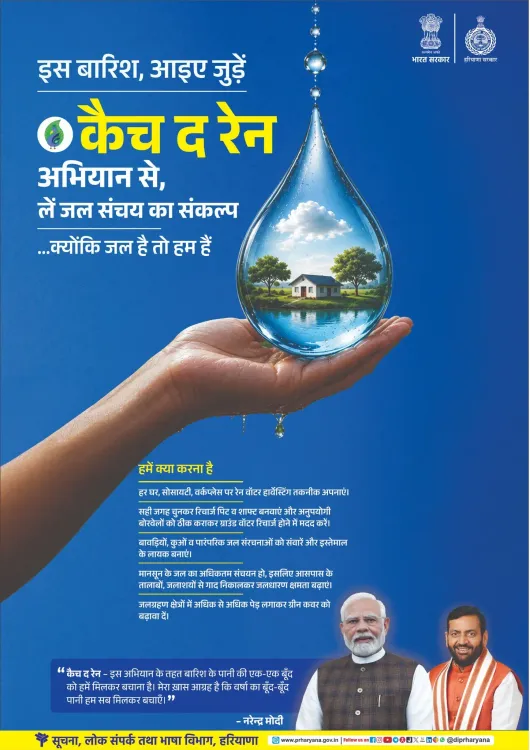
The Chief Minister's Office of Haryana on Wednesday, 8 July 2026, called on residents across the state to join the #CatchTheRain campaign, urging every household, housing society and workplace to adopt rainwater harvesting as the southwest monsoon intensifies.
The post, shared from the official CMO Haryana account, carries the message: 'इस मानसून, हर बूंद बने भविष्य की सुरक्षा!' ('This monsoon, let every drop become the security of our future!'). It calls on citizens to pledge water conservation, install rainwater harvesting systems and undertake desilting and cleaning of ponds and reservoirs to maximise storage of rainfall. The post closes with the rallying phrase 'जल है तो हम हैं' — 'If there is water, there is life.'
Context
Haryana is among India's most groundwater-stressed states. Decades of intensive paddy cultivation in the Kharif season have drawn down aquifers across several districts, with the Central Ground Water Board classifying a significant share of the state's blocks as 'over-exploited.' Each monsoon season therefore carries added urgency: it is the primary window for natural groundwater recharge and surface storage. The #CatchTheRain campaign is a national initiative under the Jal Shakti Abhiyan, the Government of India's flagship water conservation programme launched in 2019. The campaign focuses on building rainwater harvesting structures, creating pre-monsoon awareness and desilting community water bodies before the rains arrive, so that storage capacity is ready when it is needed most.Policy Backdrop
Haryana has layered several policy instruments over the past decade to address its water crisis. The state amended building bye-laws in 2013-14 to make rainwater harvesting systems mandatory in new constructions above 100 square yards. In 2020, the Atal Bhujal Yojana was rolled out in seven Haryana districts, channelling central funds into community-led groundwater management. A year later, the state launched Mera Pani Meri Virasat, offering cash incentives to farmers willing to shift away from water-intensive paddy to less thirsty crops. The current CMO appeal sits within this longer arc — moving from regulatory mandates and financial incentives toward broad public mobilisation, asking urban residents and institutions to treat rainwater as a resource rather than runoff.Stakeholders and Impact
The call to action targets three distinct groups. Urban households and housing societies are asked to install or activate rooftop rainwater harvesting systems. Workplaces and commercial establishments are included explicitly, widening the ask beyond the domestic sphere. Municipal bodies and local communities are implicitly tasked with the desilting and cleaning of ponds and reservoirs — an intervention that directly expands the storage capacity of traditional water bodies before peak monsoon weeks. For farmers, who remain the largest consumers of groundwater in Haryana, improved surface storage and aquifer recharge during the monsoon can reduce dependence on tube wells in the subsequent Rabi season, lowering both energy costs and long-term depletion risk.What's Next
The effectiveness of this year's campaign will ultimately be measured by the number of rainwater harvesting structures commissioned during the 2026 monsoon and by groundwater table readings that the Central Ground Water Board typically publishes after September. Sustained compliance with building bye-laws and active community participation in desilting drives will determine whether the season's rainfall translates into lasting aquifer recovery. For a state where water scarcity shapes both agricultural output and urban planning, the monsoon window is not merely a seasonal event — it is a critical annual opportunity that policymakers and citizens cannot afford to miss.Point of View
Where top-down regulatory mandates are increasingly paired with citizen-facing awareness drives to close the compliance gap. Whether this year's push moves beyond social media reach into measurable on-ground action will depend on follow-through from municipal bodies and district administrations in the weeks ahead.
NationPress
8 Jul 2026
Frequently Asked Questions
What is the CatchTheRain campaign in Haryana?
CatchTheRain is a national rainwater harvesting and conservation campaign under the Jal Shakti Abhiyan, which the Haryana government has actively promoted each monsoon season to boost groundwater recharge and surface water storage across the state.
Is rainwater harvesting mandatory in Haryana?
Yes. Haryana amended its building bye-laws in 2013-14 to make rainwater harvesting systems compulsory for new constructions on plots above 100 square yards, though public awareness drives continue to encourage wider voluntary adoption.
What is the Jal Shakti Abhiyan?
The Jal Shakti Abhiyan is a Government of India initiative launched in 2019 that focuses on water conservation, groundwater recharge and rainwater harvesting across water-stressed districts, with CatchTheRain as one of its key components.
Why is water conservation especially important in Haryana?
Haryana has some of India's most over-exploited groundwater blocks, driven largely by water-intensive paddy cultivation. The monsoon season is the primary window for natural recharge, making conservation efforts during this period critical for long-term water security.
What is the Mera Pani Meri Virasat scheme in Haryana?
Mera Pani Meri Virasat is a Haryana state scheme launched in 2021 that offers financial incentives to farmers who shift from water-intensive paddy to less water-demanding crops, aiming to reduce pressure on the state's depleting groundwater reserves.