HP CM Office Claims Historic Win on Kishau Dam Project
Synopsis
The Chief Minister's Office of Himachal Pradesh declared a historic success on the Kishau Dam project on 14 July 2026, reaffirming the state's commitment to protecting its rights and dignity in inter-state water and hydropower negotiations with Uttarakhand.
Key Takeaways
The Chief Minister's Office of Himachal Pradesh announced a 'historic success' on the Kishau Dam project on 14 July 2026 .
The Kishau Dam is a proposed multi-purpose project on the Tons River , a Yamuna tributary, jointly involving Himachal Pradesh and Uttarakhand .
Inter-state negotiations over the project have been ongoing since the 2000s under Yamuna basin water-sharing frameworks.
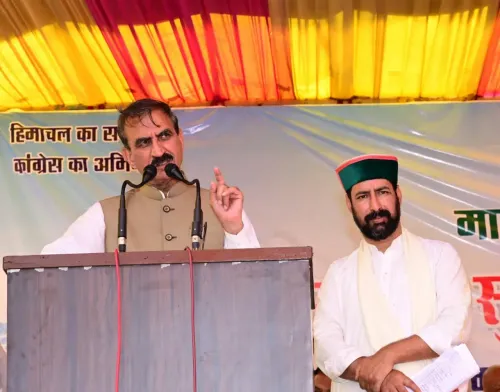
CM Sukhvinder Singh Sukhu has consistently asserted Himachal Pradesh's rights over water and hydropower resources since taking office in December 2022 .
The state has maintained it will never compromise on its rights, self-respect, or entitlements in trans-boundary resource negotiations.
Formal project agreements or a joint steering committee announcement are expected to detail the nature of the breakthrough.
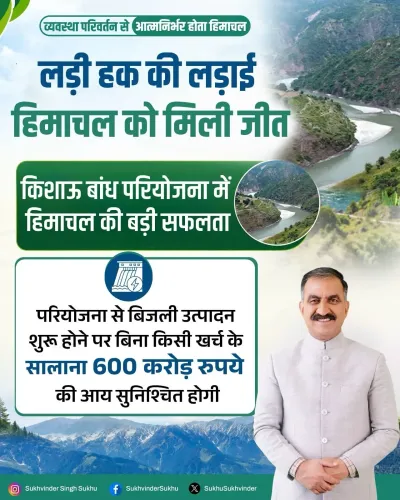
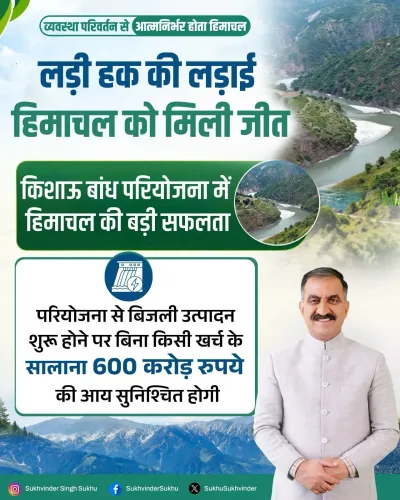
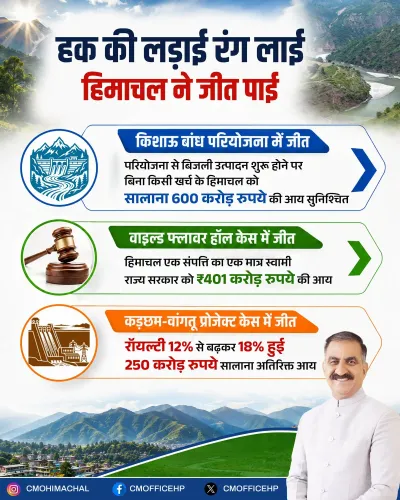
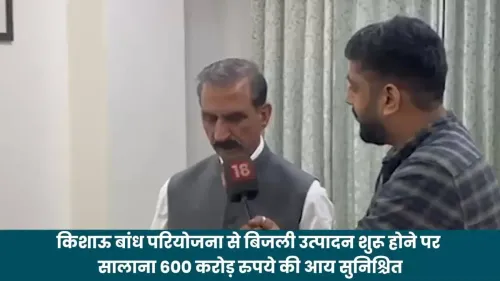
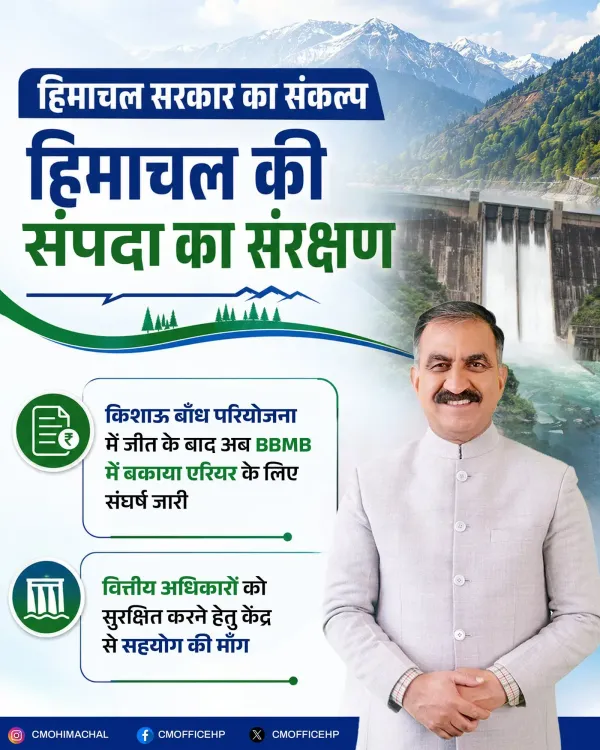
The Chief Minister's Office of Himachal Pradesh announced on Tuesday, 14 July 2026, that the state has achieved a historic breakthrough in the long-pending Kishau Dam project, reaffirming that protecting the interests, dignity, and rights of Himachal Pradesh's people remains the government's foremost responsibility.
The post, shared from the official CMO handle, stated in Hindi: 'हिमाचल के लोगों के हितों की रक्षा करना हमारा सर्वोच्च दायित्व है' ('Protecting the interests of Himachal's people is our supreme duty'), adding that the state has never compromised — and will never compromise — on its rights, self-respect, and entitlements. It described the recent development on the Kishau Dam as a 'historic success.'
Context
The Kishau Dam is a proposed multi-purpose hydropower and water-storage project on the Tons River, a tributary of the Yamuna, located along the border of Himachal Pradesh and Uttarakhand. Negotiations over the project have continued since the 2000s under the broader framework of Yamuna basin water-sharing arrangements between the two states and the Centre.
The project has long been caught in inter-state disputes over benefit-sharing — specifically over how hydropower generation, water allocation, and submergence compensation would be divided between the two states. Himachal Pradesh has consistently pushed for a formula that it considers equitable given the extent of its land and communities affected.
Policy Backdrop
Chief Minister Sukhvinder Singh Sukhu, who has led the state since December 2022, has made assertion of Himachal Pradesh's resource rights a recurring theme of his administration. His government has repeatedly flagged concerns over what it describes as inadequate benefit-sharing in trans-boundary Himalayan river projects.
Himachal Pradesh governments across political cycles have maintained similar stances in hydropower and irrigation negotiations with neighbouring states and the Centre. The Kishau project represents one of the most significant such flashpoints, given its scale and the populations on both sides of the Himachal–Uttarakhand border that stand to be affected by submergence and resettlement.
Stakeholders and Impact
The primary stakeholders include residents of the Tons River valley in both Himachal Pradesh and Uttarakhand, who face displacement and resettlement questions, as well as downstream communities that would benefit from irrigation and flood moderation. Hydropower developers and the central government, which plays a coordinating role in inter-state water disputes, are also directly involved.
A favourable resolution for Himachal Pradesh on benefit-sharing terms could mean greater revenue from power generation and stronger compensation frameworks for affected families. The state has historically argued that it bears a disproportionate environmental and social cost in such projects while benefits accrue elsewhere.
What's Next
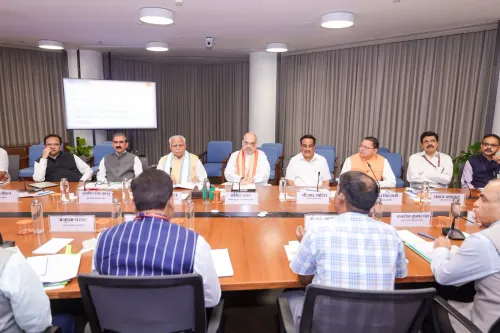
Observers will watch for the release of formal project agreements or benefit-sharing formulas that substantiate the 'historic success' claimed by the CMO. Any scheduled meetings of the joint steering committee between Himachal Pradesh and Uttarakhand, or a formal announcement from the Union Ministry of Jal Shakti, would clarify the precise nature and scope of this breakthrough.
If the claimed success translates into a signed inter-state compact or a revised benefit-sharing arrangement, it could set a precedent for how Himalayan states negotiate resource rights in future trans-boundary infrastructure projects.
Point of View
And any tangible gain on Kishau would be a significant political dividend for a government navigating a difficult fiscal environment. The emphasis on never having compromised, and never intending to, also positions the ruling party ahead of the state's ongoing political competition. Until formal documents are made public, however, the announcement remains a declaration of intent as much as a confirmed outcome.
NationPress
14 Jul 2026
Frequently Asked Questions
What is the Kishau Dam project?
The Kishau Dam is a proposed multi-purpose hydropower and water-storage project on the Tons River, a tributary of the Yamuna, situated along the border of Himachal Pradesh and Uttarakhand. It has been under inter-state negotiation since the 2000s.
What historic success did Himachal Pradesh announce on Kishau Dam?
The Chief Minister's Office of Himachal Pradesh announced on 14 July 2026 that the state achieved a historic success on the Kishau Dam project, though the precise nature of the breakthrough — such as a signed agreement or revised benefit-sharing formula — has not yet been detailed in public documents.
Why is the Kishau Dam disputed between Himachal Pradesh and Uttarakhand?
The dispute centres on benefit-sharing: how hydropower revenue, water allocation, and submergence compensation are divided between the two states. Himachal Pradesh argues it bears a disproportionate social and environmental cost as the upstream state while benefits flow elsewhere.
Who is the Chief Minister of Himachal Pradesh in 2026?
Sukhvinder Singh Sukhu has been the Chief Minister of Himachal Pradesh since December 2022 and has consistently prioritised asserting the state's rights over water and hydropower resources.
What happens next after Himachal Pradesh's Kishau Dam announcement?
Observers expect the release of formal project agreements or benefit-sharing formulas, and possibly a scheduled meeting of the joint Himachal Pradesh–Uttarakhand steering committee or a statement from the Union Ministry of Jal Shakti to confirm the details of the claimed breakthrough.