HP CM Office Hails Jal Shakti Dept's Legal Compendium

Synopsis
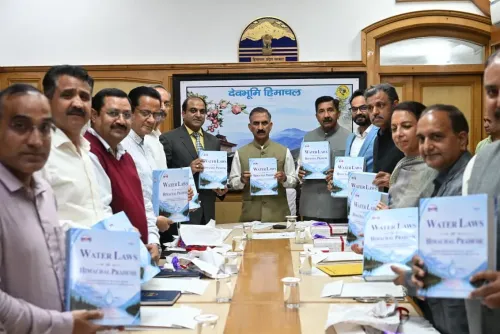
The Chief Minister's Office of Himachal Pradesh has praised the Jal Shakti Department for producing a consolidated reference compendium covering legal, technical and administrative provisions for the state's water sector, calling it a valuable resource for officers, engineers, contractors and citizens.
Key Takeaways
The Chief Minister's Office of Himachal Pradesh publicly commended the Jal Shakti Department on 9 July 2026 for its new reference compendium.
The compendium consolidates legal, technical and administrative provisions developed over years into a single volume.
The CMO identified four target user groups: government officers, engineers, contractors and ordinary citizens .
The initiative aligns with the National Water Policy 2012 emphasis on consolidating water governance frameworks.
Distribution to field offices and potential training programmes are the next expected steps.
Himachal Pradesh's Himalayan terrain and multi-layered regulatory environment make such consolidation especially significant for field implementation.
The Chief Minister's Office of Himachal Pradesh on Thursday, 9 July 2026 praised the Jal Shakti Department for compiling a comprehensive reference volume that consolidates years of legal, technical, and administrative provisions governing the state's water sector into a single resource.
Posting on X, the CMO described the effort as commendable, saying the department had prepared 'a useful reference compendium by bringing together legal, technical and administrative provisions developed over the years at one place.' The post noted that the compilation would serve as 'an important reference book for officers, engineers, contractors and ordinary citizens.'
Context
The Jal Shakti Department of Himachal Pradesh is the nodal state agency responsible for drinking water supply, irrigation, flood control, and water regulation in a terrain characterised by fragile Himalayan ecology. Governing water use in such a geography demands adherence to a layered web of state statutes, central directives, and site-specific engineering standards — a complexity that has historically made field implementation uneven. The reference compendium appears designed to address precisely that gap: by assembling dispersed legal and procedural texts into one accessible volume, the department aims to reduce ambiguity for practitioners at every level of the water administration chain.Policy Backdrop
India's National Water Policy 2012 explicitly called for the consolidation of legal and technical frameworks to strengthen water governance across states. Himachal Pradesh, as an upper-riparian Himalayan state, sits at the intersection of multiple regulatory regimes — state irrigation acts, central drinking-water scheme guidelines, environmental clearance norms, and procurement rules for infrastructure contracts. Indian states have periodically issued consolidated departmental manuals to reduce procedural ambiguity in line departments. In the water sector, such consolidation is especially significant because field engineers and contractors often operate in remote areas with limited access to legal counsel or administrative support. A single authoritative compendium can meaningfully improve compliance and reduce litigation.Stakeholders and Impact
The CMO's post specifically identified four beneficiary groups: government officers, engineers, contractors, and ordinary citizens. Each group engages with the water administration differently — officers for policy implementation, engineers for technical decision-making on projects, contractors for tendering and execution norms, and citizens for understanding their rights and entitlements under state water schemes. For a state that implements large centrally sponsored water programmes alongside its own infrastructure pipeline, having a unified reference reduces the risk of procedural errors that can delay projects or trigger audit objections. The compendium is also expected to be of value to new entrants in the department, shortening the learning curve for officers posted to field roles.What's Next
The immediate priority will be the distribution of the compendium to field offices, sub-divisional units, and contractor associations across Himachal Pradesh. Subsequent steps could include structured orientation programmes for engineers and junior officers to familiarise them with the volume's contents and structure. The compendium's long-term utility will depend on how regularly it is updated to reflect amendments in law, changes in central scheme guidelines, and evolving technical standards. The CMO's public endorsement signals political backing for the initiative, which may accelerate its rollout and adoption across the department's extensive field network.Point of View
But it signals a deliberate push by the Himachal Pradesh government to strengthen administrative capacity in a sector that underpins both rural livelihoods and large infrastructure spending. Water governance in Himalayan states is particularly litigation-prone, and a unified legal reference can reduce the procedural disputes that slow project execution. The move fits a broader pattern of Indian state governments investing in knowledge-management tools to improve delivery of centrally sponsored schemes. Whether the compendium translates into measurable field outcomes will depend on how systematically it is embedded into training and audit processes within the Jal Shakti Department.
NationPress
9 Jul 2026
Frequently Asked Questions
What is the Jal Shakti Department compendium in Himachal Pradesh?
The Jal Shakti Department of Himachal Pradesh has prepared a consolidated reference book that brings together the legal, technical and administrative provisions governing the state's water sector into a single volume, intended for use by officers, engineers, contractors and citizens.
Why did the HP CMO praise the Jal Shakti Department?
The Chief Minister's Office of Himachal Pradesh praised the Jal Shakti Department on 9 July 2026 for compiling years of dispersed legal and technical provisions into one accessible reference compendium, calling the effort commendable and useful for all water sector stakeholders.
Who will benefit from the Himachal Pradesh water sector reference book?
The compendium is intended for government officers, engineers, contractors and ordinary citizens who interact with Himachal Pradesh's water administration, helping each group navigate legal, technical and procedural requirements more easily.
How does this compendium relate to India's National Water Policy?
India's National Water Policy 2012 emphasised consolidating legal and technical frameworks for water governance. The Jal Shakti Department's compendium aligns with that directive by unifying state and central provisions relevant to Himachal Pradesh's water sector.
What are the next steps after the Jal Shakti Department released the compendium?
The expected next steps include distributing the compendium to field offices and sub-divisional units across Himachal Pradesh, followed by possible orientation programmes for engineers and officers, and periodic updates to reflect changes in law and central scheme guidelines.