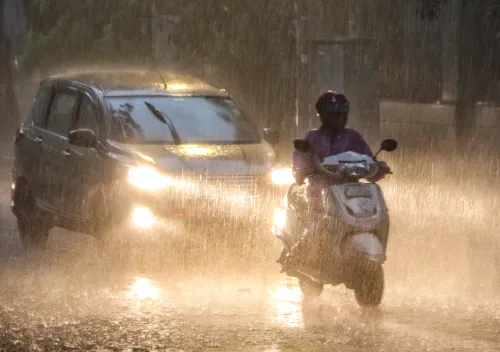
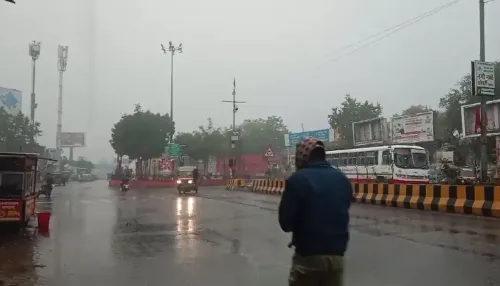
Rajasthan monsoon weak for a week, IMD forecasts dry spell till July 20

Synopsis
The Southwest Monsoon has gone quiet over Rajasthan — and the IMD says it could stay that way for a week. With a delayed onset already seven days behind schedule, the state now waits on a Bay of Bengal low-pressure system expected around 20 July to revive rainfall. For kharif farmers, the timing of that revival is everything.
Key Takeaways
The IMD has forecast predominantly dry weather across Rajasthan for the next seven days due to weak monsoon circulation.
Phalodi recorded the highest maximum temperature at 41°C ; Ajmer logged the lowest minimum at 24.9°C .
Isolated light showers expected in Bikaner, Sri Ganganagar, Hanumangarh , and Churu on 14–15 July ; Udaipur division may see scattered rain on 16–17 July .
A low-pressure system over the Bay of Bengal around 20 July could revive monsoon activity across the state.
The monsoon reached Rajasthan on 2 July 2026 — seven days late — the eighth such July onset in 27 years.
Rajasthan's long-term seasonal rainfall average is 435.6 mm ; the all-time record is 844.2 mm set in 1917 .
The Southwest Monsoon has weakened significantly across Rajasthan, with the India Meteorological Department (IMD) forecasting predominantly dry conditions for most of the state over the next seven days. The Jaipur Meteorological Centre confirmed that weather remained largely dry during the past 24 hours, even as gusty winds swept through isolated pockets of the state.
District-wise Forecast
Western Rajasthan — covering the Jodhpur and Bikaner divisions — is expected to remain dry for the full seven-day period. In eastern Rajasthan, dry conditions are likely to persist for the next five to six days, though isolated light showers are forecast for Bikaner, Sri Ganganagar, Hanumangarh, Churu, and adjoining areas on 14 and 15 July. Parts of the Udaipur division may receive scattered rainfall on 16 and 17 July.
Temperature and Wind Conditions
Phalodi recorded the state's highest maximum temperature at 41 degrees Celsius, while Ajmer logged the lowest minimum at 24.9 degrees Celsius. Gusty, dust-laden winds blowing at 30–40 kmph are expected across the Jodhpur and Bikaner divisions over the next two to three days, adding to the harsh conditions.
Why the Monsoon Has Weakened
According to the IMD, the dry spell stems from a weak monsoon circulation combined with the absence of any active upper-air weather systems. While the Southwest Monsoon has technically covered Rajasthan, the atmospheric dynamics needed to generate widespread rainfall are currently not in place. The Jaipur Meteorological Centre expects this weak phase to persist for approximately another week.
Monsoon Revival Expected Around July 20
Meteorologists indicate that a fresh low-pressure system is likely to develop over the Bay of Bengal around 20 July. Once the system intensifies and moves inland, it could revive monsoon activity across several districts of Rajasthan, delivering much-needed relief from heat and humidity. The anticipated revival would also benefit the ongoing kharif cropping season, which depends heavily on timely monsoon rains.
Historical Context
The Southwest Monsoon arrived in Rajasthan on 2 July 2026 — seven days later than its normal onset date. This marks the eighth time in 27 years that the monsoon has entered the state in July; the previous occasion with a 2 July onset was in 2019. According to long-term IMD records spanning 1901–2025, Rajasthan's wettest monsoon on record was in 1917, when the state received 844.2 mm of rainfall — about 94% above the seasonal normal. The 2025 monsoon season ranked as the second wettest on record, delivering 715.9 mm. Rajasthan's long-term seasonal average stands at 435.6 mm. The current dry spell, coming so early in the season, underscores how uneven monsoon distribution can be even in above-normal years.
Point of View
And a two-week rainfall gap at the start of the season can compress the sowing window in ways that are difficult to recover from. The Bay of Bengal low-pressure system expected around 20 July offers hope, but low-pressure systems at this stage of the season are notoriously unpredictable in their inland track. The IMD's record on Rajasthan monsoon revival timing, while improving, still carries meaningful uncertainty — and state agriculture departments should be treating this as a contingency planning moment, not a waiting game.
NationPress
14 Jul 2026
Frequently Asked Questions
Why is there no heavy rain in Rajasthan this week?
The IMD attributes the dry spell to a weakened monsoon circulation and the absence of active upper-air weather systems over the region. Although the Southwest Monsoon has covered Rajasthan, the atmospheric conditions required for widespread rainfall are currently not present.
When will monsoon rains revive in Rajasthan?
Meteorologists expect a fresh low-pressure system to develop over the Bay of Bengal around 20 July 2026. If it intensifies and moves inland, it could revive monsoon activity across several districts of Rajasthan, though the exact timing and track remain uncertain.
Which parts of Rajasthan may get some rain before 20 July?
Isolated light showers are forecast for Bikaner, Sri Ganganagar, Hanumangarh, Churu, and nearby areas on 14 and 15 July. Parts of the Udaipur division may also receive scattered rainfall on 16 and 17 July.
When did the monsoon arrive in Rajasthan in 2026?
The Southwest Monsoon reached Rajasthan on 2 July 2026, seven days later than its normal onset date. This is the eighth time in 27 years that the monsoon has entered the state in July; the last time it arrived on 2 July was in 2019.
What is Rajasthan's historical monsoon rainfall record?
According to IMD records covering 1901–2025, Rajasthan's wettest monsoon season was in 1917, when the state received 844.2 mm of rainfall — about 94% above the seasonal normal. The 2025 season ranked second wettest with 715.9 mm, against a long-term average of 435.6 mm.