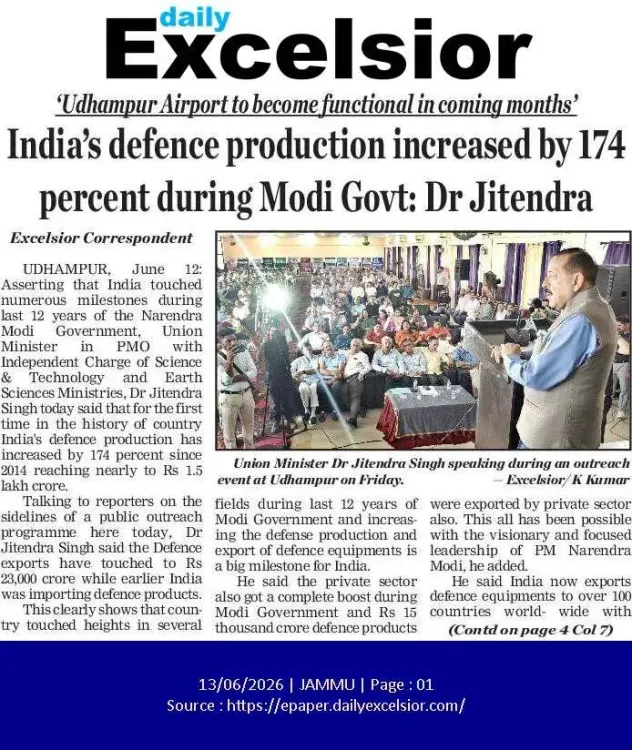
Dr. Jitendra Singh: India's defence output up 174% under Modi
Synopsis
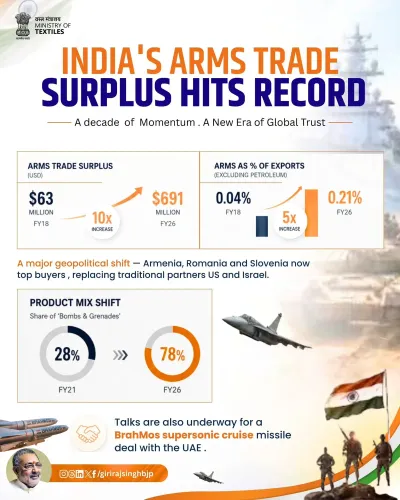
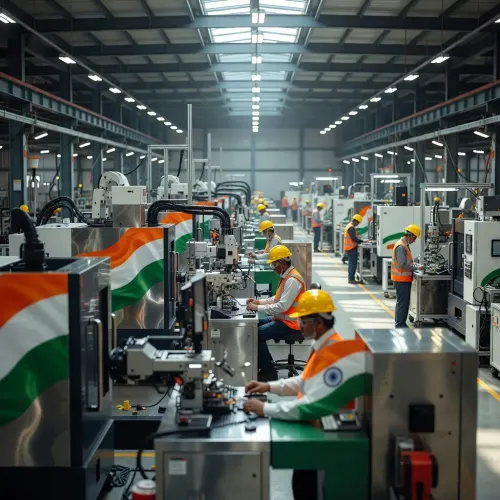
Union Minister Dr. Jitendra Singh cited a 174 per cent rise in India's defence production under the Modi government while marking 12 years of the administration, underlining a decade-long push for indigenisation through Make in India and Atmanirbhar Bharat policies.
Key Takeaways
Jitendra Singh shared a report on 13 June 2026 citing a 174 per cent rise in India's defence production under the Modi government .
The post was part of the #12YearsOfSeva campaign marking a decade-plus of the Modi administration.
India's defence indigenisation push spans Make in India (2014) , the Defence Procurement Procedure 2016 , and the Atmanirbhar Bharat package of 2020 .
The Atmanirbhar Bharat initiative set a production target of Rs 1.75 lakh crore by 2025 and banned imports of over 101 defence items .
FDI in the defence sector was raised to 74 per cent under the automatic route in 2020 to attract private and foreign investment.
Future policy milestones to watch include Defence Budget 2027-28 allocations and announcements at Aero India and DefExpo .
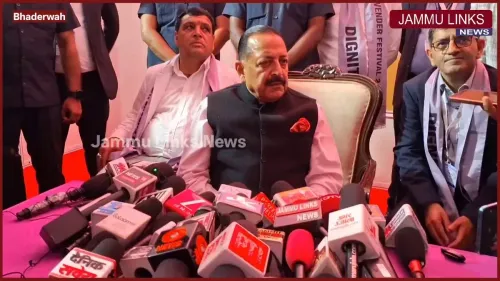
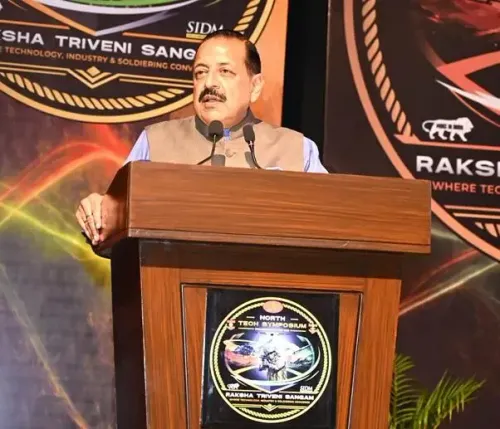
Union Science and Technology Minister Dr. Jitendra Singh on Saturday, 13 June 2026 shared a report highlighting that India's defence production has risen by 174 per cent during the Modi government, marking the occasion with the hashtag #12YearsOfSeva and referencing his Udhampur constituency.
Context
The minister shared the report as part of a broader social media campaign commemorating 12 years of the Narendra Modi-led government at the Centre. The post cites a 174 per cent increase in defence production as a headline achievement of the administration, framing it as a measure of economic and strategic self-reliance.
Dr. Jitendra Singh represents the Udhampur constituency in Jammu and Kashmir and holds independent charge of the Ministry of Science and Technology and the Ministry of Earth Sciences, in addition to his role as Minister of State in the Prime Minister's Office.
Policy Backdrop
The reported growth sits within a sustained policy push that began with the launch of Make in India in September 2014, which identified defence as one of 25 priority manufacturing sectors and progressively eased foreign direct investment norms. The Defence Procurement Procedure 2016 introduced the 'Buy (Indian-IDDM)' category, giving preference to indigenously designed and manufactured equipment.
The Atmanirbhar Bharat package, announced in May 2020, sharpened these ambitions by setting a target of Rs 1.75 lakh crore in defence production by 2025 and issuing successive negative import lists that banned procurement of over 101 defence items from abroad. The FDI ceiling in the sector was simultaneously raised to 74 per cent under the automatic route to attract private and foreign capital.
These measures collectively accelerated both public-sector defence undertakings and private-sector participation, expanding the domestic industrial base and reducing import dependence over the past decade.
Stakeholders and Impact
The beneficiaries of the production surge span defence public sector undertakings, a growing cohort of private defence manufacturers, and the three wings of the Indian Armed Forces, which have progressively sourced more equipment from domestic suppliers. The corporatisation of ordnance factories and the earmarking of capital budgets for indigenous procurement have further deepened private-sector involvement.
For Jammu and Kashmir, the broader Atmanirbhar Bharat and Make in India narratives carry additional resonance, as defence-sector growth is often cited alongside regional development arguments by elected representatives from the Union Territory.
What's Next
Analysts will watch the Defence Budget 2027-28 allocations closely, particularly the share earmarked for indigenous research and development and capital procurement from domestic sources. Major defence exhibitions such as Aero India and DefExpo are expected to serve as platforms for announcing fresh negative-list expansions and export agreements that could further test the durability of the production growth trajectory.
Point of View
Using a defence-production milestone to reinforce the Modi government's Atmanirbhar Bharat narrative ahead of what are likely to be intensifying political cycles. The 174 per cent growth figure, if verified, would represent one of the most cited data points in the government's case for strategic self-reliance. By amplifying it from his Udhampur platform, Singh also signals to his constituency and to Jammu and Kashmir at large that national security investments translate into regional pride and political capital. The post fits a broader pattern in which BJP ministers use sector-specific data to build a cumulative narrative of transformative governance across 12 years.
NationPress
29 Jul 2026
Frequently Asked Questions
By how much has India's defence production increased under the Modi government?
According to a report shared by Union Minister Dr. Jitendra Singh, India's defence production has increased by 174 per cent during the Modi government.
What is the Atmanirbhar Bharat defence production target?
The Atmanirbhar Bharat package announced in May 2020 set a target of Rs 1.75 lakh crore in defence production by 2025 and banned imports of over 101 defence items.
What is Make in India's role in defence manufacturing?
Make in India , launched in September 2014 , identified defence as a priority sector, eased FDI norms, and introduced procurement categories favouring indigenously designed and manufactured equipment.
Who is Dr. Jitendra Singh and which constituency does he represent?
Dr. Jitendra Singh is the Union Minister of State (Independent Charge) for Science and Technology and Earth Sciences, and also MoS in the Prime Minister's Office. He represents the Udhampur constituency in Jammu and Kashmir.
What is the significance of the #12YearsOfSeva hashtag?
The #12YearsOfSeva hashtag marks 12 years of the Narendra Modi -led government at the Centre, used by BJP leaders to highlight policy achievements since 2014 .