Giriraj Singh Flags 15% Export Rise, $215.91 Bn in Apr-Aug
Synopsis
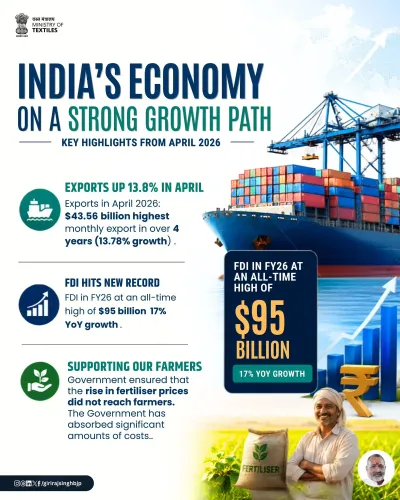
Union Textiles Minister Giriraj Singh highlighted official trade data on September 30, 2026, showing India's merchandise exports grew 15% year-on-year to $215.91 billion in April-August 2026, citing rising production capacity and stronger global market acceptance amid challenging global trade conditions.
Key Takeaways
India's merchandise exports rose 15% year-on-year in the first five months of FY 2026-27 .
Total goods shipments between April and August 2026 reached $215.91 billion , according to data cited by the minister.
Union Textiles Minister Giriraj Singh attributed the growth to rising domestic production capacity and stronger acceptance in global markets.
India's Foreign Trade Policy 2023-28 targets $2 trillion in total exports by 2030 , making sustained double-digit merchandise growth strategically significant.
PLI schemes launched from 2020 onward are widely credited as the structural driver behind the capacity expansion underpinning the export surge.
Full FY 2026-27 figures and any Union Budget updates to PLI support will be the next key data points to watch.
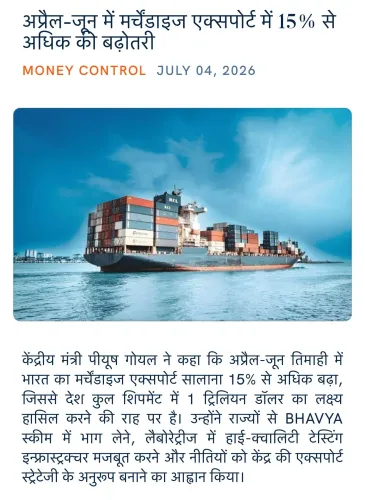
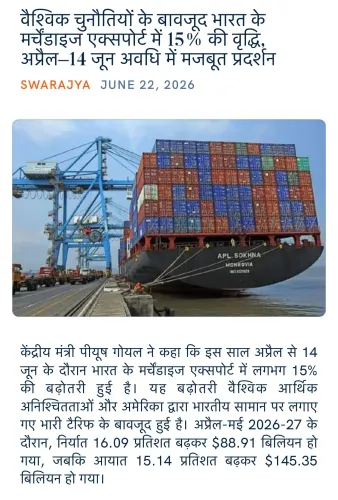
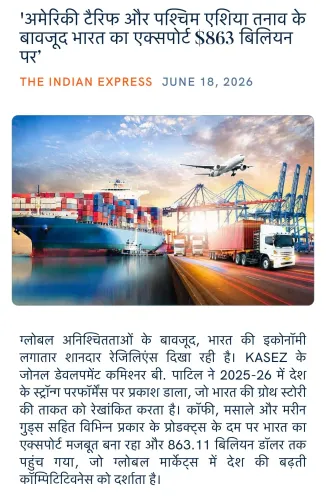
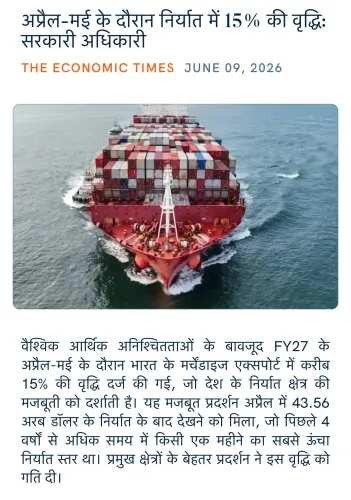
Even as global trade routes buckle under geopolitical pressure and supply-chain stress, India's merchandise exports are pushing back — hard. Union Textiles Minister Giriraj Singh on Wednesday, September 30, 2026, cited official trade data showing a 15% year-on-year jump in goods exports during the first five months of FY 2026-27, with shipments totalling $215.91 billion between April and August 2026.
Posting in Hindi on X, Singh wrote: 'वैश्विक व्यापार की चुनौतीपूर्ण परिस्थितियों के बीच भारत के निर्यात ने अपनी मजबूती दिखाई है' — 'Amid the challenging conditions of global trade, India's exports have demonstrated their strength.' He framed the numbers as evidence of the country's 'growing production capacity and strengthening acceptance in global markets.'
What $215.91 Billion in Five Months Actually Signals
A 15% growth rate in a single half-year window, against a backdrop of slowing global demand and volatile freight markets, is not routine. It suggests that India's export basket — historically skewed toward engineering goods, pharmaceuticals, and textiles — is finding buyers even as rivals scramble. For context, India's Foreign Trade Policy 2023-28 set an ambitious target of reaching $2 trillion in total exports by 2030; a sustained double-digit clip in merchandise alone moves that needle meaningfully.
The trajectory has a structural engine behind it. The Production Linked Incentive (PLI) schemes, rolled out from 2020 onward across more than a dozen sectors, were explicitly designed to expand domestic manufacturing capacity and make Indian goods price-competitive on world markets. Early signals suggest those investments are now converting into shipment volumes — precisely the sequencing policymakers intended.
Textiles Minister's Stake in the Export Story
Singh's amplification of these figures is not incidental. As the minister overseeing textiles — one of India's largest export-earning sectors and a massive employer — he has a direct policy stake in demonstrating that manufacturing incentives are translating into global orders. Textiles and apparel have faced stiff competition from Bangladesh and Vietnam; a broad merchandise export surge provides political and policy cover for the sector's ongoing restructuring.
The data also lands at a moment when India is actively negotiating trade agreements with key partners. Strong export numbers strengthen New Delhi's hand at the table, signalling that Indian industry can scale supply reliably — a prerequisite for any serious bilateral deal.
What the Full-Year Picture Will Reveal
Five months is a strong sample, but the real test arrives when the complete FY 2026-27 figures are tallied. Seasonal demand cycles, a potential slowdown in Western consumer markets, and any fresh disruption to shipping lanes could all moderate the pace. Analysts will also watch whether the next Union Budget extends or deepens PLI support — the policy lever most directly credited with the capacity surge Singh is celebrating.
For now, the numbers give the government a clean, data-backed talking point: when the world's trade winds turned rough, India's exporters leaned in.
Point of View
If it holds through the full fiscal year, would represent a significant validation of the PLI framework, which has faced scrutiny over its fiscal cost. Singh's framing also serves a sectoral purpose: as textiles minister, he benefits from a broad export-surge story that can absorb the sector's own structural challenges. The timing — mid-way through FY 2026-27 — positions the government to claim momentum before year-end audits complicate the picture.
NationPress
30 Sept 2026
Frequently Asked Questions
How much did India's exports grow in April-August 2026?
India's merchandise exports grew by 15% year-on-year in April-August 2026, reaching a total of $215.91 billion, according to data cited by Union Textiles Minister Giriraj Singh.
What is India's export target under the Foreign Trade Policy 2023-28?
India's Foreign Trade Policy 2023-28 targets total exports of $2 trillion by 2030, encompassing both goods and services, with a focus on diversification and market access.
What are PLI schemes and how do they help India's exports?
Production Linked Incentive (PLI) schemes, launched from 2020 onward across multiple sectors, provide financial incentives to manufacturers who hit production targets, aiming to boost domestic capacity and make Indian goods competitive in global markets.
Why did Giriraj Singh comment on India's export figures?
As Union Textiles Minister and a senior BJP leader, Giriraj Singh highlighted the export data to underscore the government's economic performance narrative, particularly the impact of manufacturing incentives on India's trade competitiveness.
When will India's full FY 2026-27 export data be available?
Complete FY 2026-27 export figures will be available after the fiscal year ends in March 2027, with monthly data releases providing interim updates; any Union Budget announcements could also revise trade policy targets.