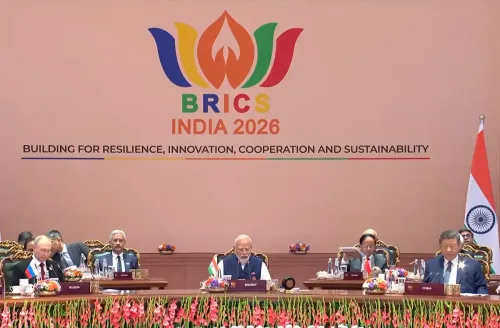
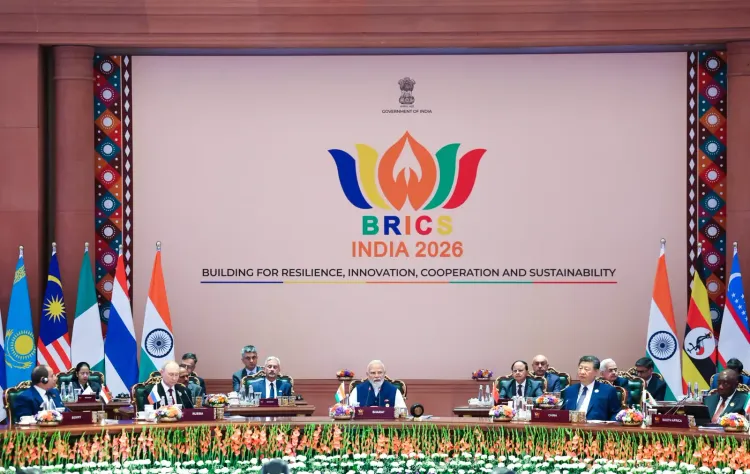
India's 2026 BRICS Presidency advances Global South development agenda
Synopsis
India's 2026 BRICS chairmanship has reframed the bloc's agenda around tangible development tools — UPI as a global DPI model, NDB financing for ground-level projects, and a push for MSME credit access. The presidency's real test is whether these contributions outlast the rotating chair and embed themselves as durable BRICS institutions.
Key Takeaways
India's 2026 BRICS presidency has prioritised the development concerns of the Global South , pushing them to the centre of global governance discussions.
UPI and Aadhaar -anchored India Stack have been presented as replicable models of digital public infrastructure for developing nations.
UPI-based payment services are now operational in France , Sri Lanka , Mauritius , and the UAE .
The New Development Bank (NDB) , founded by BRICS in 2015 , has financed projects including the Madhya Pradesh Major District Roads Project in India.
India's presidency has advocated for MSME access to development finance and local-currency financing to broaden economic participation.
Health, agriculture, sustainability, and innovation have also been placed on the BRICS agenda under India's chairmanship.
India's 2026 BRICS presidency has made a substantive contribution to the development agenda of the Global South, successfully pushing for the concerns of developing nations to be treated as central — rather than peripheral — to global governance, according to a new report. The assessment underscores how New Delhi has leveraged its chairmanship to bring concrete, experience-backed proposals to the bloc's table.
Digital Public Infrastructure as a Model
A standout contribution from India's presidency has been its promotion of digital public infrastructure (DPI) as a development tool. Over the past decade, India has built a digital ecosystem — anchored by Aadhaar, UPI, and the broader India Stack — that has transformed how millions of citizens access payments, banking, and public services.
UPI, which originated as a domestic payment infrastructure, has since become a global reference point for accessible and interoperable digital finance. Its international footprint now spans countries including France, Sri Lanka, Mauritius, and the UAE. According to the report, India's experience offers developing nations a working model of how digital public systems can be built around everyday economic activity rather than institutional prestige. As the report observes, 'The initiative is significant because it moves the conversation from technology as a marker of national prestige to technology as a means of expanding economic participation.'
Development Finance and the NDB's Role
Finance is another arena where India's BRICS engagement carries wider significance for the developing world. The core challenge for many low- and middle-income countries, the report notes, is not merely a shortage of investment — it is the prohibitive cost of accessing it and the structural difficulty of securing funds for projects without immediate commercial returns.
The New Development Bank (NDB), established by BRICS in 2015 and headquartered in Shanghai, was designed to address precisely this gap. Unlike the World Bank and the International Monetary Fund (IMF) — the traditional Bretton Woods institutions — the NDB's founding members committed equal initial capital, giving the institution a more equitable voting structure.
India has been among the NDB's principal beneficiaries. Financing from the bank has supported projects such as the Madhya Pradesh Major District Roads Project, approved to improve road connectivity and transport infrastructure — illustrating how the bank's mandate extends beyond financial reform rhetoric to ground-level development needs.
MSMEs, Local Currency and Expanding Access
India's presidency has also pushed for a BRICS financial agenda that goes beyond large, state-backed infrastructure. According to the report, 'India's emphasis on MSMEs, investment cooperation and local-currency financing is relevant here. Small businesses are often more exposed to credit constraints and currency volatility than large corporations. Easier access to finance could make a difference to employment, entrepreneurship and local economic activity.'
This framing seeks to broaden the bloc's financial architecture so that smaller economic actors — not just sovereign borrowers — can benefit, potentially creating wider employment and income opportunities in the developing world.
Broader Agenda: Health, Agriculture and Sustainability
Beyond finance and digital infrastructure, India's BRICS presidency has sought to place health, agriculture, sustainability, and innovation on the bloc's agenda — areas the report identifies as closely tied to societal resilience across the Global South. The multi-pronged approach signals an effort to make the BRICS platform relevant to a wider spectrum of development challenges rather than limiting it to macroeconomic or geopolitical concerns.
As India's presidency draws to a close, the question of whether these contributions translate into durable institutional shifts — particularly in development finance and digital cooperation — will define the long-term legacy of its 2026 chairmanship.
Point of View
But noise and legacy are different things. UPI's internationalisation is real, but its adoption in partner countries remains thin and commercially driven — not yet the public-good template India presents it as. The NDB remains a useful but marginal supplement to Bretton Woods, not a structural alternative; its capital base is a fraction of the World Bank's lending capacity. The MSME financing push is the most consequential and least-covered part of this presidency — if local-currency lending frameworks actually emerge, they could matter far more to poor households than any summit communiqué. The test of India's 2026 chairmanship is not what it put on the agenda, but what it leaves behind in institutional form.
NationPress
14 Sept 2026
Frequently Asked Questions
What has India achieved through its 2026 BRICS presidency?
India's 2026 BRICS presidency has advanced the development agenda of the Global South by promoting digital public infrastructure, development finance reform, and MSME credit access as practical priorities for the bloc. According to a new report, India successfully pushed for developing-country concerns to be treated as central to global governance rather than secondary issues.
How has India's digital infrastructure experience influenced BRICS?
India has used its Aadhaar, UPI, and India Stack ecosystem as a reference model for developing nations seeking to build inclusive digital public systems. UPI's internationalisation — with services now live in France, Sri Lanka, Mauritius, and the UAE — has made it a global benchmark for interoperable, accessible digital payments.
What is the New Development Bank and why does it matter?
The New Development Bank (NDB) is a multilateral development institution established by BRICS in 2015 and headquartered in Shanghai, created to finance infrastructure and sustainable development in member countries. Unlike the World Bank and IMF, its founding members committed equal initial capital, giving it a more equitable structure; India has been one of its principal beneficiaries, with projects such as the Madhya Pradesh Major District Roads Project backed by NDB financing.
What is India's push on MSME financing within BRICS?
India has advocated for extending BRICS financial mechanisms beyond large state-backed infrastructure to include small and medium enterprises (MSMEs), which are more vulnerable to credit constraints and currency volatility. The presidency has pushed for local-currency financing and investment cooperation frameworks that could improve access to capital for smaller businesses across the Global South.
What other areas has India placed on the BRICS agenda in 2026?
Beyond digital infrastructure and finance, India's presidency has sought to elevate health, agriculture, sustainability, and innovation as core BRICS priorities. The report identifies these areas as central to societal resilience in developing countries, reflecting a broader effort to make the BRICS platform relevant beyond macroeconomic and geopolitical concerns.