Jharkhand CMO: State Achieves Power Self-Reliance
Synopsis
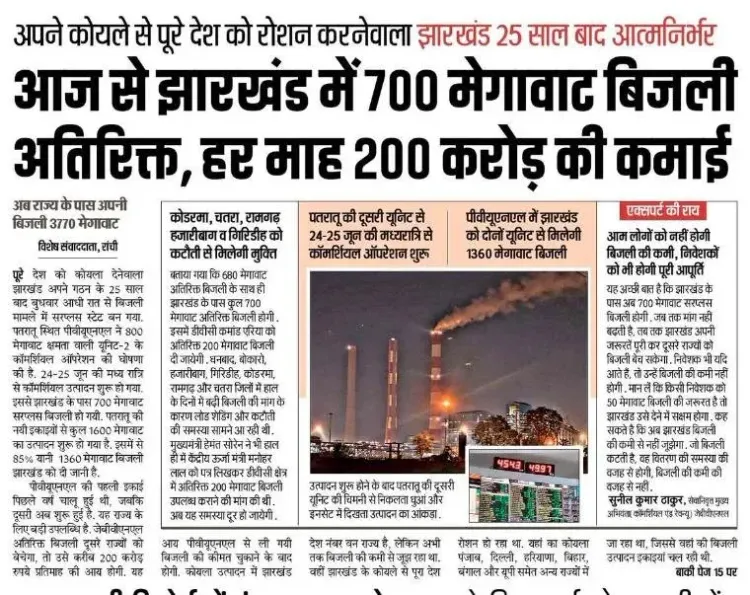
The Jharkhand Chief Minister's Office announced on June 25, 2026, that the state has achieved self-reliance in electricity generation. Institutional reforms under CM Hemant Soren are being implemented to ensure uninterrupted power supply to every household in the state.
Key Takeaways
The Jharkhand CMO declared the state self-reliant in electricity production on June 25, 2026 .
Chief Minister Hemant Soren is leading institutional structural reforms in the power sector.
The stated goal is to ensure smooth, uninterrupted electricity supply to every household in Jharkhand .
Jharkhand 's coal-rich base has historically made it a contributor to eastern India's thermal power capacity.
The reforms build on the foundation laid by the Centre's UDAY scheme launched in 2015 .
State budget allocations and regulatory filings on generation and distribution performance will be key indicators to watch.
The Chief Minister's Office of Jharkhand declared on Thursday, June 25, 2026, that the state has achieved self-reliance in electricity generation and that institutional reforms are under way under Chief Minister Hemant Soren to ensure uninterrupted power supply to every household.
Context
The post, shared in Hindi by the official Jharkhand CMO account, states: 'Bijli utpad mein Jharkhand bana aatmanirbhar' ('Jharkhand has become self-reliant in electricity production'). It further notes that institutional structural reforms are being carried out under the leadership of Chief Minister Hemant Soren to ensure electricity reaches every home smoothly.
Jharkhand, an eastern Indian state rich in coal reserves, has historically contributed to the thermal power pool of the region. The announcement signals a shift from dependence on power purchased from external sources to meeting demand through in-state generation capacity.
Policy Backdrop
Jharkhand participated in the Centre's Ujwal DISCOM Assurance Yojana (UDAY), launched in 2015, aimed at restructuring the finances and operations of state power distribution companies. That programme set the foundation for distribution-side improvements that states across India have continued to build upon.
The current round of institutional reforms referenced by the CMO fits a broader national pattern in which states are strengthening both generation capacity and distribution infrastructure to reduce aggregate technical and commercial losses and improve supply reliability. Central government schemes continue to incentivise such improvements at the state level.
Stakeholders and Impact
The primary beneficiaries of these reforms are rural households across Jharkhand, many of which have historically experienced irregular or absent electricity supply. Reliable power access has direct implications for livelihoods, education, and health services in underserved communities.
State power distribution companies are the key institutional actors responsible for last-mile delivery. Reforms targeting their operational and financial structures are intended to reduce supply disruptions and improve billing and collection efficiency, ultimately making the distribution system more sustainable.
What's Next
Attention will now turn to the state budget allocations for power sector projects and any regulatory filings that detail generation capacity additions or distribution performance metrics. The government is expected to outline specific targets and timelines as part of its broader energy roadmap.
Consistent follow-through on institutional reforms — including metering, feeder separation, and DISCOM accountability — will determine whether the stated goal of uninterrupted supply to every household translates into measurable improvement on the ground.
Point of View
Framing the announcement around 'aatmanirbharta' — a term the Centre has championed nationally — positions the JMM-led administration as aligned with mainstream development rhetoric while asserting state-level achievement. The emphasis on institutional reform rather than mere capacity addition suggests a more structural approach, though the proof will lie in measurable distribution outcomes. Sustained improvement in rural electrification quality could be a decisive factor in the state's political landscape ahead of future electoral cycles.
NationPress
24 Sept 2026
Frequently Asked Questions
Has Jharkhand become self-reliant in electricity production?
The Jharkhand Chief Minister's Office announced on June 25, 2026, that the state has achieved self-reliance in electricity production, though specific capacity figures have not been detailed in the official post.
What power sector reforms is CM Hemant Soren implementing in Jharkhand?
The CMO stated that institutional structural reforms are being carried out under CM Hemant Soren's leadership to ensure uninterrupted electricity supply to every household, though specific measures were not itemised in the announcement.
What is the UDAY scheme and how does it relate to Jharkhand?
The Ujwal DISCOM Assurance Yojana (UDAY), launched by the central government in 2015, aimed to restructure state power distribution company finances. Jharkhand participated in the scheme, which laid the groundwork for ongoing distribution reforms.
Why is Jharkhand well-placed for electricity self-reliance?
Jharkhand has substantial coal reserves that have historically supported thermal power generation capacity, positioning the state as a contributor to eastern India's power pool and giving it a natural resource base for in-state production.
Who benefits from Jharkhand's electricity reforms?
Rural households across Jharkhand are the primary beneficiaries, as improved generation and distribution infrastructure aims to bring reliable, uninterrupted power to homes that have historically faced irregular supply.