Jitendra Singh: NE India's science infra grew 10 years
Synopsis
Union Minister Dr. Jitendra Singh, speaking from Shillong, detailed how NER's weather radars grew from 2 to 13, seismological observatories from 84 to 171, and NECTAR's STEM labs have reached over 25,000 students across five northeastern states in collaboration with IIT Kanpur.
Key Takeaways
Before 2014, the entire North Eastern Region had only 2 weather radars ; the count now stands at 13 .
Seismological observatories in the NER have grown from 84 to 171 since 2014.
Lightning detection stations — absent in the region before 2014 — have been established in Meghalaya and Tripura .
NECTAR's STEM initiative , in collaboration with IIT Kanpur , has set up laboratories in five northeastern states .
Over 25,000 students , particularly in remote areas, have benefited from NECTAR's experiential learning programmes covering robotics, AI, coding, and 3D printing.
The push is framed as 'mainstreaming' NER youth into India's national startup and innovation ecosystem.
Union Science and Technology Minister Dr. Jitendra Singh on Tuesday, 14 July 2026, highlighted a decade-long expansion of scientific infrastructure across the North Eastern Region (NER), citing sharp increases in weather radars, seismological observatories, and new lightning detection stations, while also drawing attention to STEM outreach programmes that have reached over 25,000 students in remote areas.
Context
Speaking from Shillong, Dr. Singh underscored a striking pre- and post-2014 contrast in earth-observation infrastructure. Before 2014, the entire North East had only two weather radars — including just one in Meghalaya — despite the state's Cherrapunji town holding the record for the world's highest rainfall. That count has since risen to 13 weather radars across the region.
The minister also noted that the number of seismological observatories has grown from 84 before 2014 to 171 at present. Specialised lightning detection stations, which had no presence in the region earlier, have now been established in Meghalaya and Tripura.
Policy Backdrop
The North Eastern Region has long been recognised as strategically sensitive and geographically distinct, yet chronically underserved in scientific and technological investment. India's reorientation toward the region gained formal momentum when the Look East Policy was relaunched as the Act East Policy in 2014, with explicit emphasis on connectivity and development in the NER.
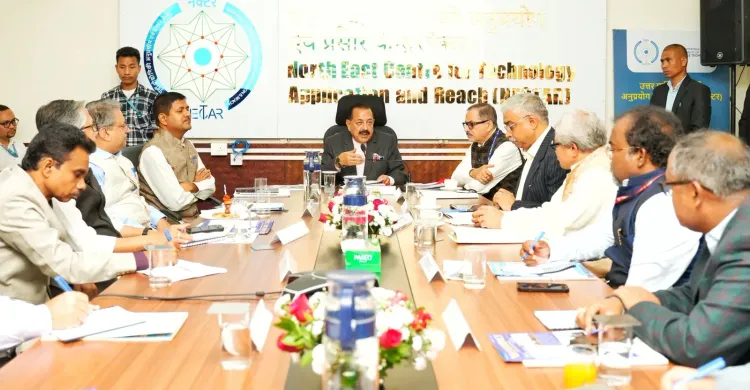
NECTAR — the North East Centre for Technology Application and Research — was established in 2012 under the Ministry of Science and Technology to address these technology gaps. Its mandate covers technology deployment, innovation promotion, and now, structured STEM education outreach across the eight northeastern states.
Stakeholders and Impact
NECTAR's STEM Education initiative promotes experiential learning through robotics, coding, artificial intelligence, 3D printing, and innovation-based activities among school students. The programme has set up STEM laboratories across five North Eastern States in collaboration with IIT Kanpur, benefiting over 25,000 students, particularly those in remote and interior areas.
The minister framed this outreach explicitly as 'mainstreaming' NER youth into national startup and innovation ecosystems — connecting a historically isolated region to opportunities available elsewhere in the country. For students in areas with limited access to quality science education, the IIT Kanpur-backed labs represent a direct bridge to national-level learning standards.
What's Next
The broader pattern points toward continued rollout of NECTAR STEM laboratories in the remaining northeastern states, as well as potential new allocations for NER-focused earth-observation projects. Policymakers and stakeholders will watch the forthcoming Science and Technology budget and parliamentary standing-committee deliberations for signals on the next phase of NER scientific investment.
With extreme weather events intensifying across the subcontinent and the northeast remaining seismically active, the expansion of monitoring infrastructure carries implications not just for scientific research, but for disaster preparedness and public safety across a region of considerable strategic importance.
Point of View
A region the ruling dispensation has consistently positioned as a beneficiary of the Act East Policy. The pairing of hard earth-observation data (radars, observatories) with a softer STEM outreach narrative is calculated: it speaks simultaneously to strategic preparedness and inclusive development, two pillars of the BJP's northeastern electoral pitch. The IIT Kanpur collaboration lends institutional credibility to the NECTAR programme and signals that national premier institutes are being consciously extended into the periphery. Whether the momentum translates into sustained budget allocations beyond the current political cycle remains the central question for observers tracking NER science policy.
NationPress
14 Oct 2026
Frequently Asked Questions
How many weather radars does northeast India have now compared to before 2014?
The North Eastern Region had only 2 weather radars before 2014, including just one in Meghalaya. That number has since grown to 13, according to Union Minister Dr. Jitendra Singh.
What is NECTAR and what does it do in northeast India?
NECTAR, or the North East Centre for Technology Application and Research, was established in 2012 under the Ministry of Science and Technology. It promotes technology deployment and runs a STEM Education initiative in collaboration with IIT Kanpur, setting up experiential learning labs across northeastern states.
How many students have benefited from NECTAR STEM labs in the northeast?
Over 25,000 students, particularly in remote and interior areas, have benefited from NECTAR's STEM laboratories set up across five North Eastern States in collaboration with IIT Kanpur.
Which states in northeast India now have lightning detection stations?
Lightning detection stations, which did not exist in the region earlier, have been established in Meghalaya and Tripura, as highlighted by Minister Dr. Jitendra Singh.
How have seismological observatories in northeast India changed since 2014?
The number of seismological observatories in the North Eastern Region has increased from 84 before 2014 to 171 at present, reflecting a significant expansion of earthquake-monitoring capacity in a seismically active zone.