Jitendra Singh pitches 'BRICS Space Economy' at Bengaluru HOSA meet
Synopsis
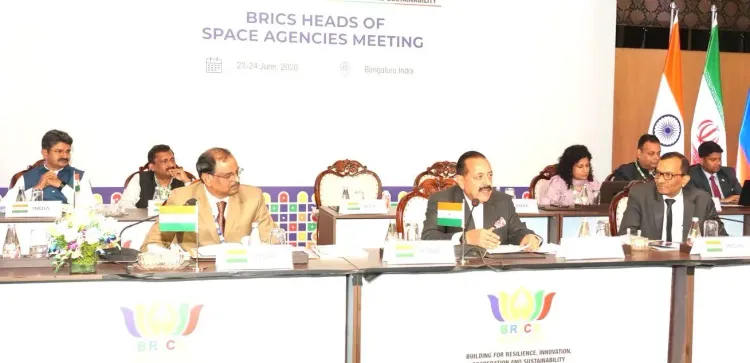
Union Science and Technology Minister Dr. Jitendra Singh addressed the BRICS 2026 Heads of Space Agencies meeting in Bengaluru on 24 June, calling for a collective 'BRICS Space Economy' and highlighting India's post-2020 space liberalisation as a model for multilateral cooperation among the ten-nation bloc.
Key Takeaways
Jitendra Singh addressed the BRICS 2026 HOSA meeting in Bengaluru on 24 June 2026 , attended by space agency heads from 10 nations .
He proposed pitching the 'BRICS Space Economy' as the next frontier of global growth through collective action.
The BRICS Remote Sensing Satellite Constellation was cited as proof that collaborative space applications among member states are already delivering results.
India's space sector was liberalised in 2020 under PM Narendra Modi , with IN-SPACe established as a single-window regulator for private players.
The expanded BRICS grouping now includes Brazil, China, Egypt, Ethiopia, Indonesia, Iran, Russia, South Africa, UAE and India , broadening the potential scientific base for space cooperation.
Singh positioned India as 'one of the world's most dynamic and rapidly expanding space ecosystems,' offering its reform model as a template for BRICS-wide growth.
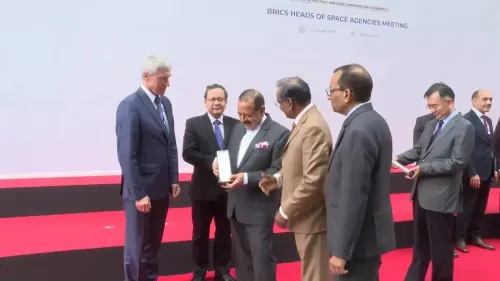
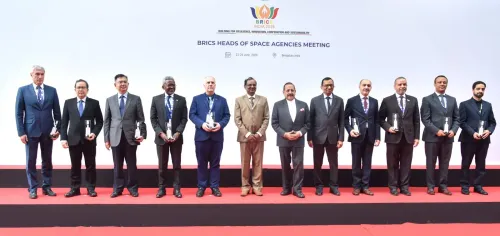
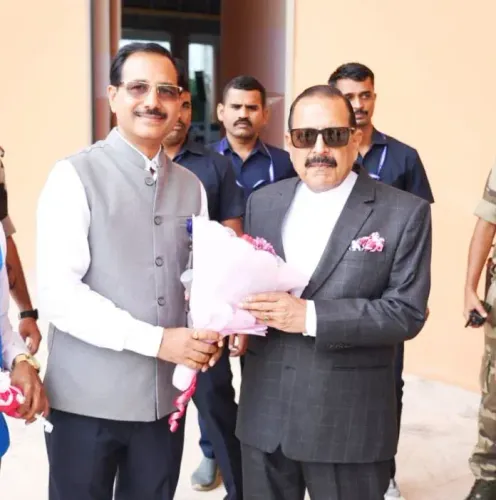
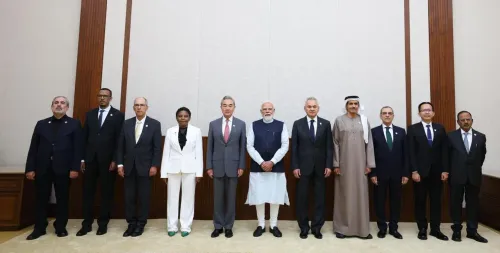
Union Science and Technology Minister Dr. Jitendra Singh on Wednesday, 24 June 2026, addressed the BRICS 2026 Heads of Space Agencies (HOSA) meeting in Bengaluru, calling on member nations to collectively build a 'BRICS Space Economy' as the next frontier of global growth. The meeting was attended by heads of space agencies and senior officials from Brazil, China, Egypt, Ethiopia, Indonesia, Iran, Russia, South Africa, the United Arab Emirates and India (ISRO).
Context
Speaking at the high-level gathering, Dr. Singh declared: 'It's time to pitch the BRICS Space Economy as the next frontier of global growth through collective action among the BRICS member nations to unlock new opportunities in innovation, investment, entrepreneurship and sustainable development.' He argued that BRICS countries collectively possess the scale, scientific capabilities, technological strengths and industrial capacity to emerge as a major force in the rapidly expanding global space economy.
The minister also highlighted the BRICS Remote Sensing Satellite Constellation, describing it as having 'already demonstrated the value of collaborative space applications through satellite data sharing among member countries.' He underscored that the future of the space economy 'will not be shaped by nations working in isolation' but by 'partnerships, shared innovation and collective ambition.'
Policy Backdrop
India liberalised its space sector in 2020 under Prime Minister Narendra Modi, allowing private companies to undertake end-to-end space activities and establishing IN-SPACe as a single-window regulator. NewSpace India Limited (NSIL), incorporated in 2019, was tasked with commercialising ISRO technologies and facilitating industry participation.
Dr. Singh explicitly credited PM Modi's reforms, stating that 'a series of transformative reforms have opened unprecedented opportunities for private industry, startups, academia and global partnerships, thus making India one of the world's most dynamic and rapidly expanding space ecosystems.' This domestic liberalisation now forms the template India is projecting onto the BRICS multilateral stage.
The BRICS grouping itself has expanded beyond its original five members — Brazil, Russia, India, China and South Africa — to include Egypt, Ethiopia, Indonesia, Iran and the UAE, significantly enlarging the combined scientific and industrial base available for space cooperation.
Stakeholders and Impact
The push for a BRICS Space Economy has direct implications for Indian space startups and private industry, which have grown rapidly under the post-2020 regulatory framework. A multilateral BRICS platform could open new export markets, joint-venture opportunities and shared infrastructure for these firms.
For the broader grouping, the proposal mirrors wider efforts by emerging economies to build alternative technology supply chains in a domain currently dominated by NASA, the European Space Agency (ESA) and large commercial American firms. Pooling remote-sensing data and satellite capabilities across ten nations could reduce individual member states' dependence on proprietary Western platforms.
Academia and research institutions across BRICS nations stand to benefit from enhanced data-sharing arrangements, particularly for applications such as disaster management, agriculture monitoring and climate observation — areas where the Remote Sensing Satellite Constellation has already shown early results.
What's Next
The HOSA meeting is expected to feed into broader BRICS 2026 deliberations on science and technology cooperation. Observers will watch for follow-up technical meetings on expanding the constellation's coverage and any new IN-SPACe authorisations for private Indian missions that could serve as demonstration cases for the BRICS partnership model.
If the 'BRICS Space Economy' framework gains traction, it could reshape investment flows and innovation partnerships across the ten-nation bloc, positioning the grouping as a credible counterweight to existing Western-led space commerce ecosystems.
Point of View
Using the expanded BRICS platform as a vehicle to project Indian soft power in a domain long dominated by Western agencies. By framing the 'BRICS Space Economy' as a collective growth frontier, New Delhi is simultaneously positioning itself as a rule-setter rather than a rule-taker in emerging multilateral space governance. The emphasis on startups, private industry and academia signals that India sees commercial space diplomacy as inseparable from its broader economic statecraft. This aligns with a wider pattern of the Modi government leveraging multilateral forums — from G20 to BRICS — to embed India's domestic reform narrative into global policy conversations.
NationPress
23 Sept 2026
Frequently Asked Questions
What is the BRICS HOSA meeting and what happened at the 2026 edition?
The BRICS Heads of Space Agencies (HOSA) meeting is a high-level forum where space agency chiefs and senior officials from BRICS member nations discuss cooperation in space. At the 2026 edition held in Bengaluru on 24 June, Union Minister Dr. Jitendra Singh proposed building a collective 'BRICS Space Economy' and highlighted India's domestic space reforms as a model for the bloc.
What is the BRICS Remote Sensing Satellite Constellation?
The BRICS Remote Sensing Satellite Constellation is a joint satellite project among BRICS member states that enables sharing of satellite imagery and data for applications such as disaster management, agriculture monitoring and resource mapping. Dr. Jitendra Singh cited it at the 2026 HOSA meeting as proof that collaborative space applications among member countries are already delivering value.
How has India reformed its space sector under PM Modi?
India liberalised its space sector in 2020 under Prime Minister Narendra Modi, allowing private companies to undertake end-to-end space activities for the first time. IN-SPACe was established as a single-window regulator, and NewSpace India Limited (NSIL) was set up to commercialise ISRO technologies, collectively enabling startups, academia and private industry to participate in the national space programme.
Which countries are part of BRICS in 2026?
As of 2026, BRICS comprises ten nations: Brazil, Russia, India, China, South Africa — the original five members — plus Egypt, Ethiopia, Indonesia, Iran and the United Arab Emirates, which joined as part of the grouping's expansion.
What is IN-SPACe and what role does it play in India's space sector?
IN-SPACe, or the Indian National Space Promotion and Authorisation Centre, is a single-window regulatory body established in 2020 to promote and authorise space activities by non-governmental Indian entities. It acts as an interface between ISRO and private players, enabling startups and industry to access launch infrastructure and technical expertise.