Joshi Highlights 80% Solar Tariff Drop, India No. 2 Market
Synopsis
Union Minister Pralhad Joshi on June 9, 2026, highlighted an 80 per cent drop in solar tariffs and India's rise to the world's second-largest solar market in 2025, crediting PM Modi's energy policies as part of the BJP's #12YearsOfSeva campaign.
Key Takeaways
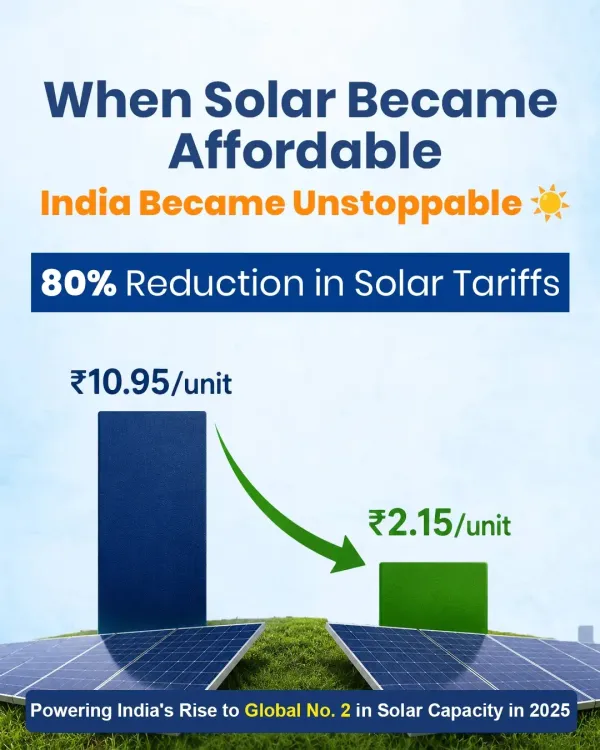
Pralhad Joshi claims solar tariffs have fallen by 80 per cent under the Modi government, making solar power more affordable and competitive.
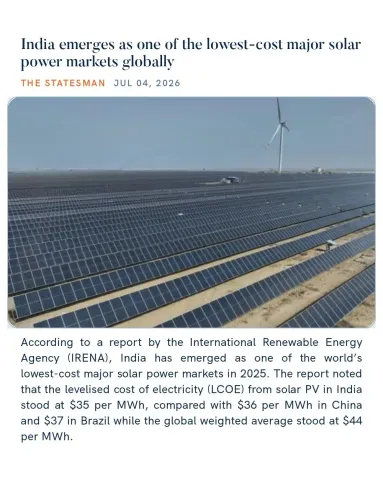
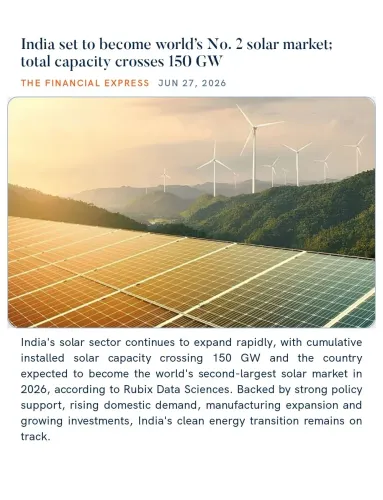
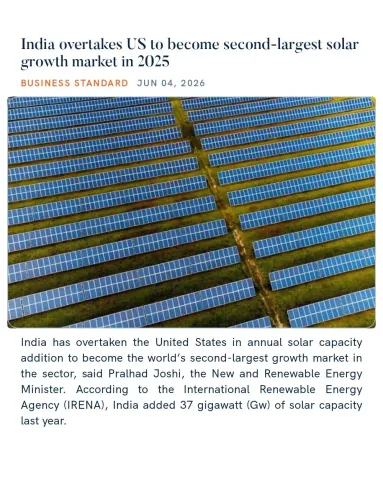
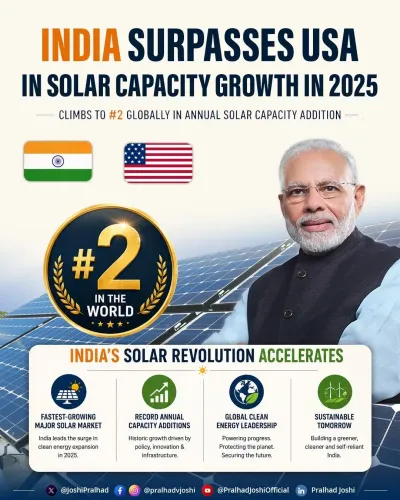
India is described as the world's second-largest solar market in 2025 , a ranking attributed to sustained central policy support.
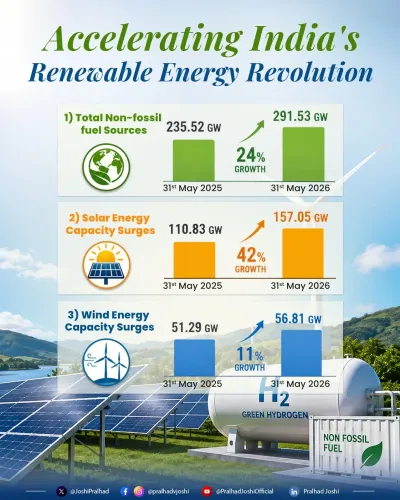
India's solar policy lineage runs from the Jawaharlal Nehru National Solar Mission (2010) through successive upward revisions to a current target of 500 GW non-fossil fuel capacity by 2030 .
Government tools including reverse auctions, viability gap funding , and PLI schemes for domestic module manufacturing have underpinned the tariff decline.
The post is part of the BJP's #12YearsOfSeva campaign marking twelve years of the party-led central government.
The International Solar Alliance , co-founded by India and France in 2015, reinforces India's role as a global solar leader.
Union Minister of New and Renewable Energy Pralhad Joshi on Tuesday, June 9, 2026, credited the Modi government's solar energy policies for an 80 per cent reduction in solar tariffs and India's rise to the position of the world's second-largest solar market in 2025, marking the occasion of the ruling party's #12YearsOfSeva campaign.
Context
In his post on X, Joshi stated: 'A remarkable 80% reduction in solar tariffs has made solar power more accessible, competitive and transformative.' He attributed this progress to 'the leadership of Hon'ble PM Shri Narendra Modi Ji,' framing the milestone as part of India's broader journey 'towards energy security, sustainability and self-reliance.'
The post coincides with the BJP's #12YearsOfSeva campaign, a communications exercise marking twelve years of the party-led central government, under which various ministers have been highlighting sectoral achievements since May 2026.
Policy Backdrop
India's solar ambition has roots in the Jawaharlal Nehru National Solar Mission, launched in 2010 with an initial target of 20 GW of solar capacity by 2022, later revised upward to 100 GW. The target was further scaled during the 2015 Paris climate negotiations, when India announced a goal of 175 GW of renewable energy by 2022, including 100 GW from solar.
At COP26 in 2021, India committed to 500 GW of non-fossil fuel capacity by 2030 and net-zero emissions by 2070. To support these targets, the central government deployed reverse auctions, viability gap funding, and payment security mechanisms — tools that successive tender rounds have used to compress the cost of solar power procurement. Production Linked Incentive (PLI) schemes for domestic solar module manufacturing have run alongside these demand-side interventions to reduce import dependence.
India is also a founding member of the International Solar Alliance, a treaty-based body launched jointly by India and France in 2015 to accelerate solar deployment across member nations, reinforcing New Delhi's positioning as a global solar leader.
Stakeholders and Impact
The tariff decline, if sustained at the scale claimed, carries tangible consequences for solar developers, electricity distribution companies, and ultimately end consumers, including rural households that have historically borne the brunt of energy poverty. Lower procurement costs reduce the subsidy burden on state utilities and can translate into more competitive retail tariffs over time.
Domestic manufacturers stand to benefit from the government's parallel push for Made-in-India solar modules, which seeks to shift the supply chain away from import dependence — a strategic as much as an economic objective given the geopolitical sensitivities around solar component sourcing.
What's Next
The Ministry of New and Renewable Energy is expected to release updated capacity and tariff data as part of progress reporting against the 2030 non-fossil fuel target of 500 GW. New solar park tenders and the next round of PLI disbursements will be closely watched by the sector as indicators of whether the tariff and capacity trajectory can be sustained through the remainder of the decade.
With India now positioning itself as the world's second-largest solar market, the government faces the twin challenge of maintaining installation momentum while ensuring grid stability — a test that will define the credibility of its clean-energy commitments heading into the next global climate stocktake.
Point of View
Using a striking tariff-reduction figure to anchor a broader claim of energy-sector transformation under PM Modi. The framing of India as the world's second-largest solar market in 2025 is a significant assertion that, if borne out by independent data, would mark a decisive shift in the global clean-energy order. The emphasis on 'self-reliance' alongside sustainability signals that the government is fusing its energy-security and Atmanirbhar Bharat messaging into a single electoral and diplomatic argument. As India approaches the 2030 non-fossil fuel deadline, such ministerial communications will increasingly serve as benchmarks against which actual capacity additions are measured.
NationPress
24 Oct 2026
Frequently Asked Questions
Why have solar tariffs fallen so much in India?
Solar tariffs in India have declined sharply over the past decade due to government-driven reverse auctions that force competitive bidding, viability gap funding that de-risks projects, and a global fall in the cost of solar panels. Central policy under successive governments has used these tools to scale capacity and compress procurement costs.
Is India really the world's second-largest solar market?
Union Minister Pralhad Joshi claimed in June 2026 that India became the world's second-largest solar market in 2025. The government has consistently cited rapid capacity additions and falling tariffs as evidence of this rise, though independent verification of the exact ranking requires cross-checking with global energy agency data.
What is India's solar energy target for 2030?
India has committed to achieving 500 GW of non-fossil fuel electricity capacity by 2030 , a pledge made at the COP26 climate summit in Glasgow in 2021. Solar is expected to contribute the largest share of this target.
What is the Jawaharlal Nehru National Solar Mission?
The Jawaharlal Nehru National Solar Mission is a central government scheme launched in 2010 to deploy grid-connected and off-grid solar power. Its initial target of 20 GW by 2022 was later revised to 100 GW, forming the foundation of India's utility-scale solar expansion.
What is the BJP's #12YearsOfSeva campaign?
#12YearsOfSeva is a BJP communications campaign marking twelve years of the party-led central government. Various Union ministers have used the hashtag to highlight sectoral achievements across infrastructure, energy, welfare, and other policy areas.