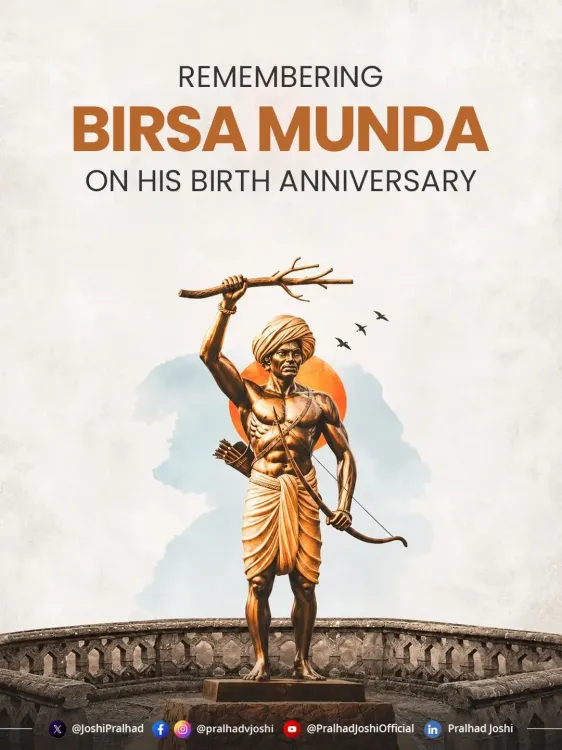
Pralhad Joshi Pays Tribute to Birsa Munda on Birth Anniversary
Synopsis
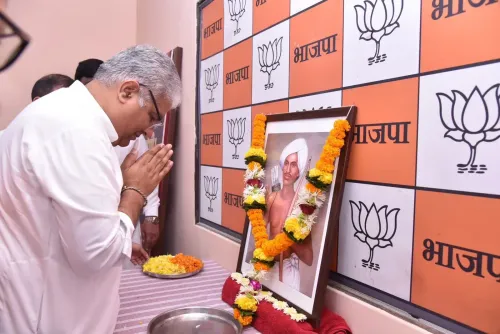
On Janjatiya Gaurav Diwas, Union Minister Pralhad Joshi honoured Bhagwan Birsa Munda — the Adivasi icon who led the Ulgulan against British rule — saluting his sacrifice for tribal rights, culture and identity in a bilingual English-Kannada post.
Key Takeaways
15 November marks the birth anniversary of Bhagwan Birsa Munda , observed nationally as Janjatiya Gaurav Diwas since 2021.
Union Minister Pralhad Joshi paid tribute in both English and Kannada, reaching Karnataka's Adivasi and broader audiences.
Birsa Munda ( 1875–1900 ) led the Ulgulan movement in present-day Jharkhand against British land-dispossession policies.
His movement directly influenced the Chota Nagpur Tenancy Act of 1908 , a landmark tribal land-protection law.
The government instituted Janjatiya Gaurav Diwas in 2021 to mainstream Adivasi contributions to India's freedom struggle.
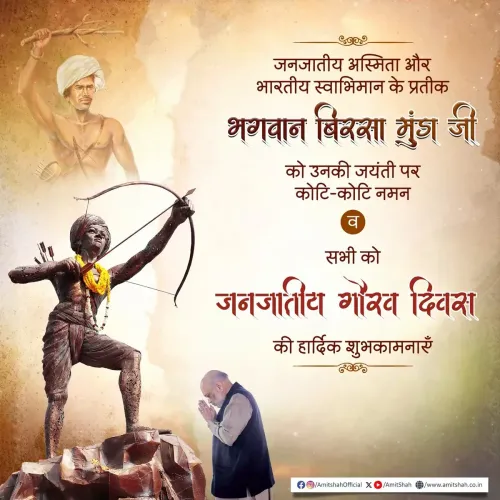
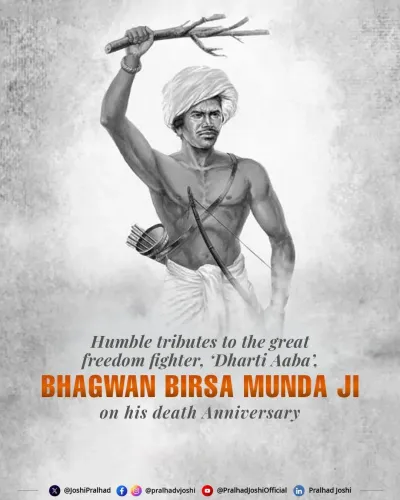
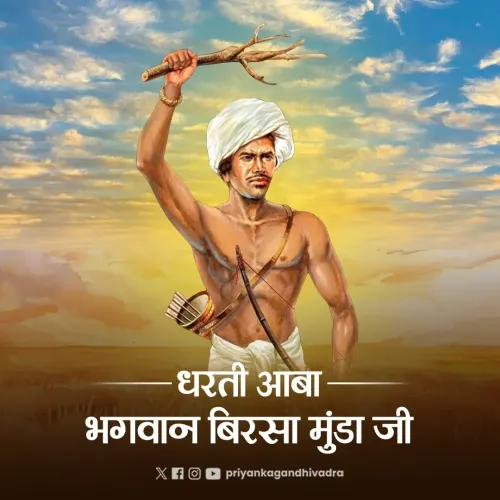
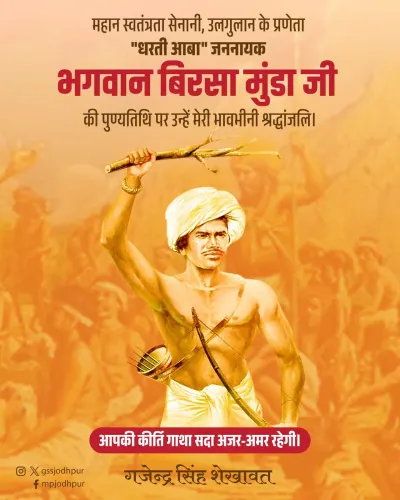
On Janjatiya Gaurav Diwas, 15 November, Union Consumer Affairs Minister Pralhad Joshi paid tribute to Bhagwan Birsa Munda — the Adivasi icon revered as Dharti Aaba, or Father of the Earth — calling his courage, sacrifice, and fight for tribal rights 'an enduring inspiration for the nation.'
Joshi posted in both English and Kannada, reaching out directly to Karnataka's Kannada-speaking audience with the message that Birsa Munda's struggle — 'ಆದಿವಾಸಿ ಸಮುದಾಯದ ಸ್ವಾಭಿಮಾನ, ಹಕ್ಕು ಮತ್ತು ಸ್ವಾತಂತ್ರ್ಯ ಹೋರಾಟದ ಪ್ರತೀಕ' [symbol of the Adivasi community's self-respect, rights and freedom struggle] — remains eternally memorable in Indian history.
Who was Dharti Aaba Bhagwan Birsa Munda?
Birsa Munda was born on 15 November 1875 in present-day Jharkhand and died in captivity in 1900, aged just 25. In that brief life, he led the Ulgulan — the Great Tumult — a fierce movement of the Munda tribal people against British land-dispossession policies and the feudal system that had stripped Adivasi communities of ancestral forests and farmlands.
He is remembered not only as a freedom fighter but as a spiritual leader who galvanised an entire community around the twin demands of self-rule and cultural identity. His defiance forced the British colonial administration to enact the Chota Nagpur Tenancy Act of 1908, a landmark land-protection law that bore the direct imprint of his movement.
Janjatiya Gaurav Diwas: how 15 November became a national occasion
In 2021, the Government of India formally instituted Janjatiya Gaurav Diwas on 15 November — Birsa Munda's birth date — to honour tribal freedom fighters and their contributions to India's anti-colonial struggle. The observance marked a deliberate expansion of the national historical narrative to foreground Adivasi participation in the independence movement, a chapter that had long remained at the margins of mainstream textbooks and commemorations.
Every year since, the day has seen central and state-level programmes spotlighting tribal welfare and cultural heritage. The government's sustained emphasis on this occasion reflects a broader political and policy effort to draw Adivasi communities more centrally into the story of modern India.
Joshi's bilingual tribute — anchored in Kannada for his home state — underscores how the memory of Birsa Munda has travelled far beyond Jharkhand, becoming a symbol that resonates with tribal and non-tribal Indians alike. The minister wrote that Birsa Munda's 'sacrifice, bravery and unwavering resolve remain an inspiration even today.'
A young man who defied an empire and died before he turned 26 — his story, 126 years on, still commands a national day of remembrance. That is the measure of the legend.
Point of View
Signalling the current government's deliberate effort to reframe India's freedom-struggle narrative around tribal contributions that were historically underrepresented. For BJP leaders like Joshi, tributes to Birsa Munda carry both genuine historical weight and clear political outreach to Adivasi constituencies spread across Jharkhand, Odisha, Chhattisgarh, and beyond. Joshi's choice to post in Kannada alongside English reflects a localisation strategy that connects a pan-India symbol to Karnataka's own tribal communities. As tribal welfare and land-rights policy remain live debates, the memory of Birsa Munda is not just commemorative — it is politically and legislatively resonant.
NationPress
15 Nov 2026
Frequently Asked Questions
Who is Bhagwan Birsa Munda?
Bhagwan Birsa Munda (1875–1900) was a Munda tribal leader from present-day Jharkhand who led the Ulgulan movement against British land-dispossession and for Adivasi rights, self-rule, and cultural identity. He is revered as Dharti Aaba, meaning Father of the Earth.
What is Janjatiya Gaurav Diwas?
Janjatiya Gaurav Diwas is a national day observed on 15 November — Birsa Munda's birth anniversary — instituted by the Government of India in 2021 to honour tribal freedom fighters and their contributions to India's anti-colonial struggle.
Why is Birsa Munda called Dharti Aaba?
Birsa Munda is called Dharti Aaba, or Father of the Earth, because of his role as a spiritual and political leader who fought to protect Adivasi land, forests, and cultural identity from British colonial encroachment.
What was the Ulgulan movement?
The Ulgulan, meaning Great Tumult, was an armed uprising led by Birsa Munda in the late 1890s against the British land-tenure system and feudal landlords who had displaced Munda tribal communities from their ancestral lands in Jharkhand.
What did Pralhad Joshi say on Birsa Munda's birth anniversary?
Union Minister Pralhad Joshi called Birsa Munda's courage, sacrifice, and fight for tribal rights 'an enduring inspiration for the nation,' posting in both English and Kannada to mark Janjatiya Gaurav Diwas on 15 November 2026.