Karnataka CM's Office asserts state's outsized role in Namma Metro
Synopsis
The Chief Minister's Office of Karnataka declared on 11 November 2026 that the state's role in Namma Metro spans land acquisition, daily operations, loan repayment and financial support — asserting Karnataka as the primary backbone of Bengaluru's metro network, not merely a construction contributor.
Key Takeaways
Karnataka's CMO posted on 11 November 2026 asserting the state's comprehensive role in Namma Metro , covering land acquisition, operations, loan repayment and financial support.
BMRCL is jointly owned by the Government of India and Government of Karnataka , but the state has historically been the primary contributor on the ground.
Namma Metro Phase 1 received Union Cabinet approval in 2006 and commenced services in 2011 , with Karnataka providing land and equity from the outset.
Phase 2 , sanctioned in 2014 , extended Karnataka's financial commitments further, including multilateral loan guarantees.
The post signals Karnataka's intent to establish a public record of its fiscal stake ahead of expected debates over Phase 3 and suburban rail integration.
The hashtag #IdhuNammaMetro frames the network as a state achievement for Bengaluru commuters and Karnataka taxpayers alike.
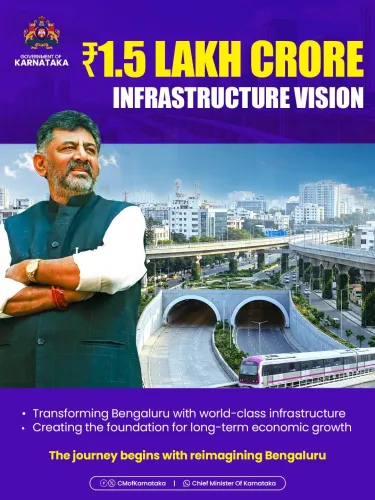
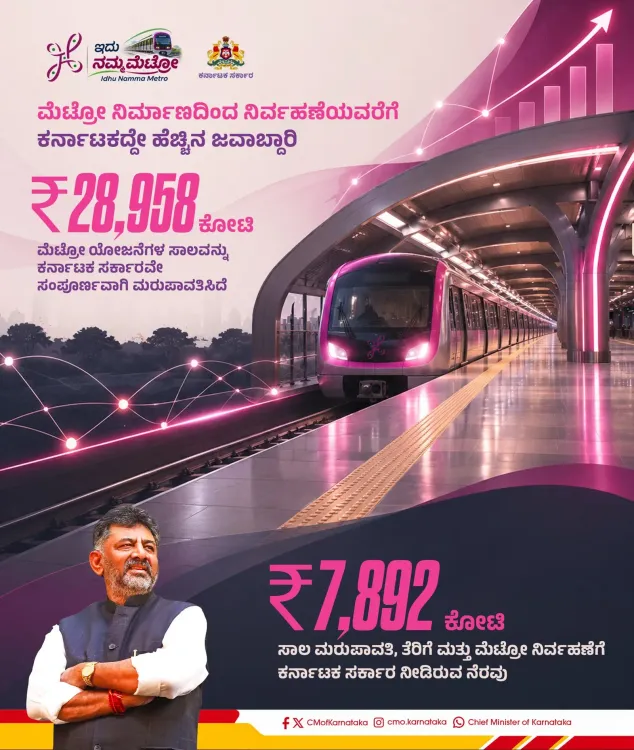
Every station, every tunnel, every kilometre of track that Bengaluru's commuters ride daily carries a bill that the Government of Karnataka has been paying — quietly, consistently, and in full view of anyone who reads the balance sheets. On Wednesday, 11 November 2026, the Chief Minister's Office of Karnataka made that fiscal reality loudly explicit, pushing back against any narrative that reduces the state's role in Namma Metro to a mere construction partner.
The post, shared in Kannada and English under the hashtag #IdhuNammaMetro ('This is our Metro'), draws a sweeping arc: 'From land acquisition and operations to loan repayment and financial support, we continue to shoulder the responsibility of building and sustaining Bengaluru's Metro network.' The framing is deliberate — a point-by-point assertion of ownership at a time when credit for urban infrastructure is a live political currency.
From empty plots to daily footfall: Karnataka's end-to-end stake
The Bangalore Metro Rail Corporation Limited (BMRCL) is a special-purpose vehicle jointly owned by the Government of India and the Government of Karnataka. But joint ownership has never meant equal lifting. Namma Metro Phase 1, which received Union Cabinet clearance in 2006 and began commercial operations in 2011, required the state to provide land, equity contributions, and viability-gap support — the unglamorous groundwork that makes shovels possible before a single photo-op occurs.
Phase 2, sanctioned in 2014, deepened that financial commitment. Land acquisition in a dense, rapidly appreciating city like Bengaluru is neither cheap nor fast; the state has consistently served as the primary guarantor navigating both the legal machinery and the compensation bills. Loan repayment obligations — typically drawn from multilateral lenders — flow through state guarantees, meaning Karnataka's credit rating and fiscal discipline directly underwrite every foreign-currency borrowing the project carries.
Why the CMO chose to say this, and why now
Indian urban-infrastructure politics has a familiar pattern: the Centre announces, inaugurates, and claims; the state acquires land, runs operations, and repays debt. The Karnataka government's post is a pointed interruption of that pattern. By cataloguing each layer — acquisition, operations, loan repayment, financial support — it is building a public ledger, one social-media post at a time, ahead of what observers expect will be discussions around Phase 3 alignment and suburban rail integration.
The hashtag #ಇದುನಮ್ಮಮೆಟ್ರೋ ('This is our Metro') is also a message to Bengaluru's millions of daily commuters: the network they depend on is a state achievement as much as a national one. For Karnataka taxpayers footing equity injections and guaranteeing debt, that is not spin — it is arithmetic.
The next chapter in that arithmetic — whether Phase 3 corridor decisions or suburban rail budget lines — will test whether the Centre matches the state's ownership claims with proportional funding. Karnataka has already told the country which side of the ledger it occupies.
Point of View
Operations, debt — the state is pre-empting any narrative that reduces it to a junior partner in a nationally branded project. This mirrors a broader pattern across Indian states that bear disproportionate metro costs while Central agencies capture inauguration optics. The timing, likely ahead of Phase 3 alignment talks, suggests Karnataka is laying groundwork to demand commensurate Central co-financing in future tranches.
NationPress
11 Nov 2026
Frequently Asked Questions
What is Karnataka's role in Namma Metro?
Karnataka is a co-owner of BMRCL and bears responsibility for land acquisition, day-to-day operations, loan repayment guarantees, and direct financial support — making the state the primary backbone of the Bengaluru metro network beyond just funding construction.
Who owns Namma Metro (BMRCL)?
BMRCL is a special-purpose vehicle jointly owned by the Government of India and the Government of Karnataka, though the state government provides the bulk of land, equity, and operational guarantees.
When did Namma Metro Phase 1 start?
Namma Metro Phase 1 received Union Cabinet approval in 2006 and commenced commercial operations in 2011, making it one of India's pioneering modern metro corridors.
What is Namma Metro Phase 2?
Phase 2 of Namma Metro was sanctioned in 2014, expanding the Bengaluru metro network with additional corridors and requiring further financial commitments from Karnataka, including multilateral loan guarantees.
What does #IdhuNammaMetro mean?
#IdhuNammaMetro is a Kannada hashtag meaning 'This is our Metro', used by Karnataka's CMO to assert the state's ownership and central role in building and sustaining Bengaluru's metro rail network.