Punjab CMO Announces ₹100.65 Cr Canal Irrigation Push
Synopsis
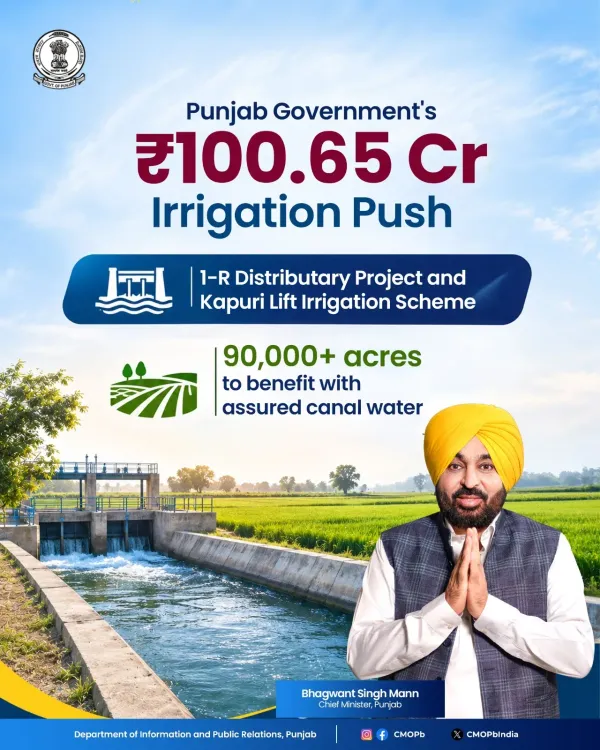
The Chief Minister's Office of Punjab announced two canal irrigation projects totalling ₹100.65 crore — a ₹64.11 crore lining of the 1-R Distributary System and a ₹36.54 crore Kapuri Lift Irrigation Scheme — to bring assured surface water to over 90,000 acres and ease the state's acute groundwater crisis.
Key Takeaways
Punjab CMO announced two canal irrigation initiatives on 11 November 2026 worth a combined ₹100.65 crore .
The ₹64.11 crore concrete lining project targets the 1-R Distributary System to eliminate seepage losses in existing canals.
The ₹36.54 crore Kapuri Lift Irrigation Scheme will deliver surface water to areas beyond the reach of gravity-fed canals.
Together, the projects aim to provide assured surface-water irrigation to over 90,000 acres of agricultural land.
The initiatives are designed to reduce farmers' reliance on tubewells and slow the depletion of Punjab's rapidly falling water table.
The projects continue a policy lineage stretching back to the 1990s and align with the central government's PMKSY framework.
Punjab's farmlands are drinking from borrowed time — and the state government just moved to change that. The Chief Minister's Office of Punjab announced on Wednesday, 11 November 2026, two major canal irrigation initiatives worth a combined ₹100.65 crore, designed to deliver assured surface-water irrigation to over 90,000 acres of agricultural land and pull farmers back from their dangerous dependence on rapidly depleting groundwater.
Two schemes, one urgent mission: surface water over tubewells
The package breaks into two distinct projects. The first is a ₹64.11 crore concrete lining project for the 1-R Distributary System — a canal network where unlined earthen channels have long been haemorrhaging water through seepage before it ever reaches a field. Lining those channels in concrete is the most direct way to squeeze more irrigation out of every cubic metre of water released upstream.
The second is the ₹36.54 crore Kapuri Lift Irrigation Scheme, designed to push surface water into command areas that gravity-fed canals simply cannot reach. Together, the two projects reflect a dual strategy: fix what leaks, and extend where the network never went.
Why Punjab's groundwater crisis makes this consequential
Punjab sits at the epicentre of India's groundwater emergency. Decades of intensive rice-wheat cultivation — the backbone of the Green Revolution that made India food-secure — have driven tubewell extraction to unsustainable depths across large swathes of the state. Studies of Punjab's water table have shown alarming rates of decline in key agricultural districts, putting the long-term viability of the state's farming economy at risk.
The logic of canal lining is well-established: restored and lined distributaries can substitute directly for tubewell hours, cutting electricity consumption and slowing aquifer depletion simultaneously. Chief Minister Bhagwant Mann's Aam Aadmi Party government has framed this announcement as part of a broader commitment to restoring and modernising Punjab's legacy canal infrastructure — a network fed principally by the Bhakra and Sirhind systems built in the post-independence decades.
A decades-long repair job, now accelerated
Punjab governments have periodically undertaken canal rehabilitation works since the 1990s, and the state has drawn on the central government's Pradhan Mantri Krishi Sinchayee Yojana (PMKSY) — launched in 2015 — to fund assured irrigation expansion. The current projects continue that lineage but arrive at a moment when the groundwater crisis has become impossible to defer.
The 1-R Distributary System lining project addresses seepage losses that rob farmers of water mid-channel. The Kapuri Lift Irrigation Scheme adds a powered pumping dimension, bringing surface water to terrain where topography previously made canal delivery uneconomical. Both projects, once tendered and executed, would shift those 90,000-plus acres from tubewell dependency toward a more stable surface-water supply — reducing input costs for farmers and buying critical time for the aquifer to stabilise.
The real test, as always with infrastructure, lies in delivery: timelines, tender outcomes, and whether water actually flows to the last acre when the next kharif season demands it.
Point of View
And visible irrigation projects carry electoral weight ahead of future assembly cycles. The dual-project design — lining existing channels and extending lift irrigation — mirrors the PMKSY playbook, suggesting the state is positioning for continued central co-funding. The deeper question is whether ₹100 crore, spread across two schemes, moves the needle meaningfully on a groundwater crisis that demands sustained, decade-long investment at a far larger scale.
NationPress
11 Nov 2026
Frequently Asked Questions
What are the two Punjab canal irrigation projects announced in November 2026?
The two projects are a ₹64.11 crore concrete lining of the 1-R Distributary System and a ₹36.54 crore Kapuri Lift Irrigation Scheme, together worth ₹100.65 crore and covering over 90,000 acres.
What is the Kapuri Lift Irrigation Scheme in Punjab?
The Kapuri Lift Irrigation Scheme is a ₹36.54 crore project that uses pumped lifting to deliver surface canal water to agricultural areas that gravity-fed channels cannot reach, reducing those farmers' dependence on tubewells.
Why is Punjab facing a groundwater crisis?
Decades of intensive rice-wheat cultivation since the Green Revolution have driven excessive tubewell extraction across Punjab, causing water tables to fall at alarming rates in many agricultural districts.
What is canal lining and why does it help farmers?
Canal lining involves coating earthen channels with concrete to prevent water seepage, ensuring more water reaches farmland; it lowers irrigation costs for farmers and reduces the need for energy-intensive groundwater pumping.
How does the Punjab irrigation announcement relate to PMKSY?
The projects align with the central government's Pradhan Mantri Krishi Sinchayee Yojana (PMKSY), launched in 2015, which funds assured irrigation coverage — a framework Punjab has used to rehabilitate its canal network over the past decade.