Kejriwal hails Punjab's move to regularise 65,000 contract workers
Synopsis
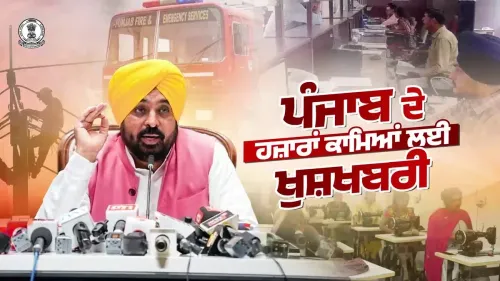
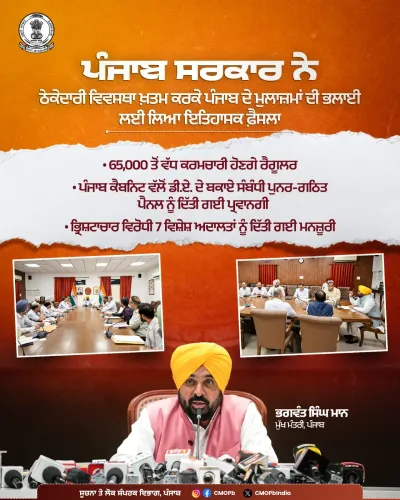
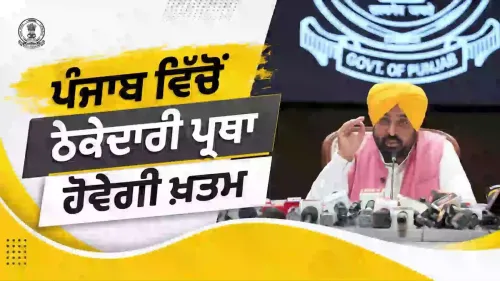
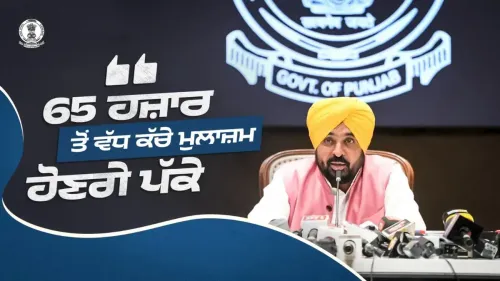
AAP convenor Arvind Kejriwal on 30 May 2026 hailed the Punjab government's decision to regularise 65,000 contractual and outsourced employees, calling it a historic national first. Chief Minister Bhagwant Mann's move fulfils a key 2022 manifesto promise to end the contractual system in state departments.
Key Takeaways
The Punjab AAP government has decided to regularise approximately 65,000 contractual and outsourced state employees.
Kejriwal described the move as 'historic' and claimed it is the first such statewide regularisation decision in India.
The decision fulfils a core promise from AAP 's 2022 Punjab election manifesto to abolish the contractual employment system.
Regularisation will give affected workers access to fixed pay scales, job security, pension benefits, and other service protections.
Punjab CM Bhagwant Mann was specifically credited by Kejriwal for taking the decision.
Implementation details — including timelines, funding, and potential legal challenges — are yet to be made public.
AAP convenor Arvind Kejriwal on Saturday, 30 May 2026 praised the Punjab government's decision to regularise approximately 65,000 contractual and outsourced state employees, calling it a historic first in the country and the beginning of a new life for tens of thousands of families.
Context
Posting in Hindi on X, Kejriwal said the Aam Aadmi Party government in Punjab had decided to end the contractual system — ठेकेदारी प्रथा — and permanently absorb 65,000 temporary and outsourced workers into regular service. 'This decision is historic and has been taken for the first time in the country,' he wrote, adding that it was 'not just a decision but the beginning of a new life for all these families, where they will get full rights and dignity.'
He extended congratulations to all the affected employees and to Punjab Chief Minister Bhagwant Mann for taking what he described as a landmark step.
Policy Backdrop
AAP's 2022 Punjab election manifesto had explicitly promised to end ad-hoc and contractual employment in state departments and regularise affected workers — a commitment that distinguished the party from the preceding Congress and Shiromani Akali Dal regimes, both of which had expanded outsourcing in public services over the previous two decades.
The Delhi AAP government had earlier issued multiple orders between 2015 and 2022 regularising contractual teachers, sanitation workers, and other staff in municipal and state bodies, establishing a template that the Punjab government appears to be building upon at a larger scale.
Stakeholders and Impact
The workers covered by the decision span a wide range of public-service categories — from sanitation and health to administrative support — who have long been employed through third-party contractors at lower wages and without the job security, pension entitlements, or service protections available to regular government employees.
For these 65,000 workers and their families, regularisation typically means access to fixed pay scales, provident fund contributions, medical benefits, and protection against arbitrary dismissal. Labour welfare groups across India have cited such measures as a benchmark for states grappling with the proliferation of contractual public employment.
What's Next
Attention will now turn to the operational details: the timeline for issuing appointment orders, the funding arrangements required to absorb 65,000 additional regular employees into Punjab's fiscal framework, and any legal challenges that may arise from existing permanent staff or contractors. The state's fiscal position and the pace of implementation will determine whether the announcement translates into ground-level change within the current budget cycle.
If executed fully, the move could intensify pressure on other state governments — including those run by rival parties — to address the large backlog of contractual workers in their own departments, making labour regularisation a sharper electoral issue ahead of assembly polls in several states.
Point of View
Converting a manifesto promise into a governing action that directly touches the livelihoods of tens of thousands of families. By framing it as a national first, the party is staking out a distinctive identity on labour welfare at a time when contractual employment in public services remains a live grievance across most Indian states. The move also reinforces the AAP model of governance-as-welfare — a narrative Kejriwal has consistently used to differentiate the party from established regional and national rivals. Whether the fiscal and administrative machinery of Punjab can deliver full implementation without dilution will be the real test of the claim's credibility.
NationPress
16 Oct 2026
Frequently Asked Questions
What is the Punjab government's decision about contractual employees?
The Punjab AAP government has decided to regularise approximately 65,000 contractual and outsourced state employees, effectively ending the contractual employment system in state departments.
Why did Kejriwal call this decision historic?
Kejriwal called it historic because he claimed it is the first time any state government in India has taken a decision to regularise such a large number of contractual and outsourced public-sector workers in one go.
Who is Bhagwant Mann and what is his role in this decision?
Bhagwant Mann is the Chief Minister of Punjab and the head of the AAP state government that took this decision. Kejriwal specifically congratulated him for implementing the regularisation measure.
What benefits will regularised Punjab employees receive?
Workers who are regularised typically gain access to fixed government pay scales, provident fund contributions, medical benefits, pension entitlements, and protection against arbitrary dismissal — rights not available under contractual or outsourced arrangements.
Was regularising contractual workers part of AAP's Punjab election promise?
Yes. AAP 's 2022 Punjab election manifesto explicitly promised to end the contractual employment system and regularise ad-hoc and outsourced government workers, making this decision a fulfilment of a pre-election commitment.