Kishan Reddy Launches AAROH Report, Signs GIZ Pact on Mine Closure

Synopsis
Union Coal Minister G. Kishan Reddy released the AAROH mine closure report in New Delhi on 22 July 2026, signed an implementation agreement with Germany's GIZ for scientific mine closure cooperation, and inaugurated Coal NEER plants that convert mine discharge into drinking water.
Key Takeaways
AAROH — India's first Annual Report on Mine Closure — was released in New Delhi on 22 July 2026 by Union Coal and Mines Minister G.
An Implementation Agreement was signed between the Ministry of Coal and Germany's GIZ to advance scientific mine closure, mine repurposing, and capacity building.
Coal NEER plants were inaugurated to convert treated mine discharge into safe drinking water, operating under the government's 'Waste to Wealth' vision.
The initiative aims to create sustainable livelihood opportunities for communities in coal mining-affected districts .
India's mine closure guidelines date to 2009 , with the Sustainable Development Cell established in 2020 to deepen environmental compliance in the sector.
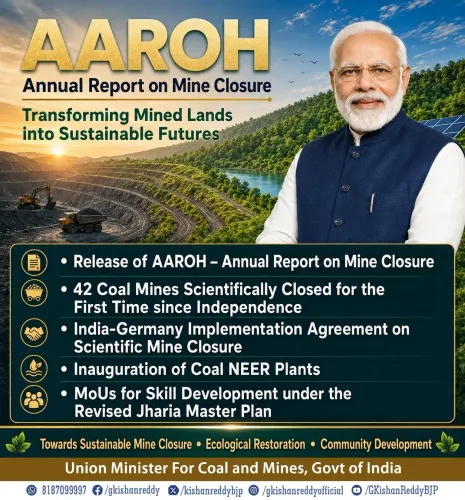
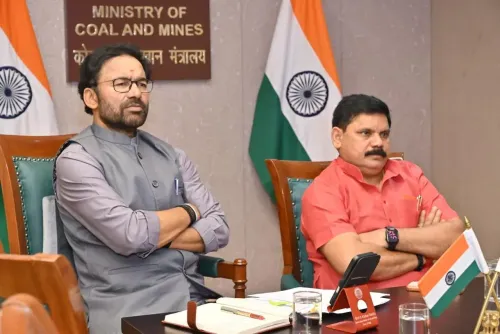
Union Coal and Mines Minister G. Kishan Reddy released AAROH — the Annual Report on Mine Closure in New Delhi on Wednesday, 22 July 2026, describing it as a significant milestone in India's pursuit of responsible and scientific mine closure. The event also saw the signing of an Implementation Agreement between the Ministry of Coal and Germany's GIZ (Deutsche Gesellschaft für Internationale Zusammenarbeit), and the inauguration of Coal NEER plants that convert treated mine discharge into drinking water.
Context
Reddy released the AAROH report and witnessed the signing of the India-Germany agreement at a single event in the capital, underscoring the government's intent to consolidate its mine closure agenda on multiple fronts simultaneously. In his post on X, the Minister said he was 'delighted to witness the signing of the Implementation Agreement,' which he said would 'strengthen cooperation in scientific mine closure, mine repurposing, capacity building and adoption of global best practices.'
The inauguration of Coal NEER plants was framed under the government's 'Waste to Wealth' vision, with Reddy noting that the initiative also aims to create 'sustainable livelihood opportunities for local communities' in mining-affected areas.
Policy Backdrop
India's regulatory framework for mine closure has been evolving for nearly two decades. The Ministry of Coal first formalised mine closure guidelines in 2009, mandating scientific reclamation and specifying post-closure land use norms. Those guidelines were revised in subsequent years as the scale of environmental liabilities from legacy coal extraction became more apparent.
The Ministry established a Sustainable Development Cell in 2020 to mainstream environmental and social safeguards across coal mining operations. International technical partnerships — particularly with European agencies experienced in managing post-industrial landscapes — have since formed a key pillar of India's capacity-building strategy for mine reclamation.
GIZ, Germany's principal development cooperation agency, has previously supported sustainability projects in India's extractive and energy sectors, bringing European standards for land reclamation and water management to the country's coal belt regions.
Stakeholders and Impact
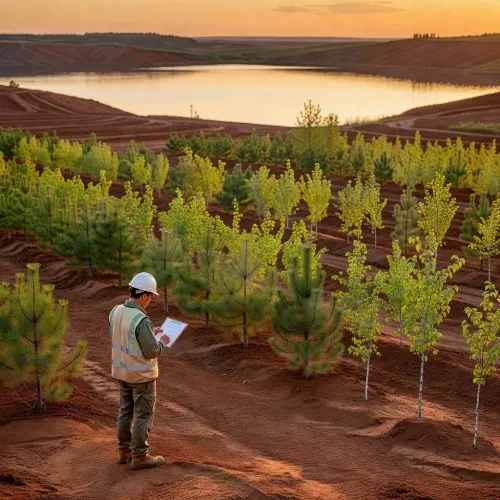
The agreement with GIZ is expected to benefit coal mining communities concentrated in states such as Jharkhand, Chhattisgarh, Odisha and Telangana, where legacy mine sites have long posed environmental and public health challenges. The technical cooperation covers mine repurposing — converting exhausted pits into productive land uses — alongside capacity building for engineers and regulators.
The Coal NEER initiative addresses a specific and acute problem in mining districts: contaminated or treated mine water that is currently discharged as waste. By converting this discharge into safe drinking water, the scheme targets both environmental remediation and the water security needs of local populations who live adjacent to active or closed mines.
What's Next
Attention will now turn to the rollout timelines and funding commitments for additional Coal NEER plants beyond those inaugurated on 22 July, as well as the specific deliverables and milestones embedded in the GIZ Implementation Agreement. Parliamentary scrutiny and state-level follow-through in coal-bearing states will determine how quickly the scientific mine closure framework translates from policy into ground-level action. The AAROH report itself is expected to serve as an annual accountability mechanism, tracking progress across mine sites nationwide.
Point of View
The GIZ agreement signing, and the Coal NEER inauguration at a single event signals that the Ministry of Coal is deliberately packaging its environmental credentials ahead of what is likely to be intensified scrutiny of India's coal sector in international climate forums. The GIZ partnership lends institutional credibility to India's mine closure ambitions by anchoring them to European technical standards, a move that could ease diplomatic friction over coal dependency. Coal NEER is politically astute as well — converting a visible pollution problem into a public health benefit gives the government a tangible, community-level win in constituencies that have historically borne the costs of extraction. Cumulatively, these steps suggest a ministry trying to reframe coal governance from a liability into a managed transition narrative.
NationPress
23 Jul 2026
Frequently Asked Questions
What is the AAROH report released by the Ministry of Coal?
AAROH is India's Annual Report on Mine Closure, released by Union Coal and Mines Minister G. Kishan Reddy in New Delhi on 22 July 2026. It is intended to serve as an annual accountability document tracking progress on scientific and sustainable mine closure across coal sites in India.
What is the India-GIZ mine closure agreement about?
The Implementation Agreement signed between the Ministry of Coal and Germany's GIZ (Deutsche Gesellschaft für Internationale Zusammenarbeit) on 22 July 2026 covers technical cooperation on scientific mine closure, mine repurposing, capacity building for Indian officials and engineers, and the adoption of global best practices in land reclamation.
What is Coal NEER and how does it work?
Coal NEER is a Ministry of Coal initiative that treats discharge water from mine operations and converts it into safe drinking water. It operates under the government's 'Waste to Wealth' vision and is also designed to generate livelihood opportunities for communities living near mining areas.
When did India first introduce mine closure guidelines?
The Ministry of Coal first formalised mine closure guidelines in 2009, mandating scientific reclamation and specifying post-closure land use. The guidelines were revised in subsequent years, and a Sustainable Development Cell was established in 2020 to mainstream environmental safeguards across coal operations.
Which states will benefit from the GIZ mine closure cooperation?
Coal mining communities in states such as Jharkhand, Chhattisgarh, Odisha and Telangana — where legacy mine sites pose significant environmental and public health challenges — are among the primary beneficiaries expected from the India-GIZ technical cooperation agreement.