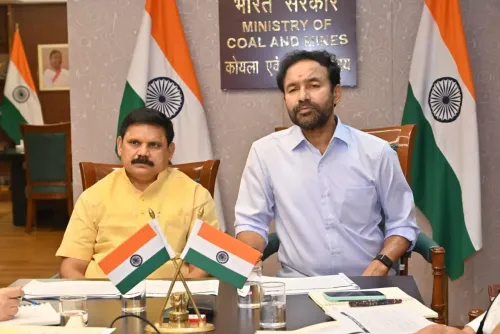
Kishan Reddy Reviews Coal India Performance in Kolkata

Synopsis
Union Coal and Mines Minister G. Kishan Reddy held a performance review of Coal India Limited and its subsidiaries in Kolkata on 29 September, directing senior officials to improve production, dispatch, and operational efficiency in line with PM Modi's energy-security vision.
Key Takeaways
Kishan Reddy conducted a performance review of Coal India Limited (CIL) and its subsidiaries in Kolkata on 29 September 2026 .
The review covered coal production volumes, dispatch figures, and progress against targets across CIL subsidiaries.
The minister set clear priorities to improve operational efficiency and drive higher productivity at every subsidiary.
Coal India Limited is a Maharatna PSU and India's largest domestic coal producer, critical to base-load electricity generation.
The government has pushed coal sector reforms since 2020 , including commercial mining auctions, to reduce import dependence under the Atmanirbhar Bharat framework.
CIL's next quarterly production and dispatch data will be the key indicator of whether today's directives translate into results.
Coal production, dispatch targets, and subsidiary efficiency — Union Coal and Mines Minister G. Kishan Reddy flew into Kolkata on Tuesday, 29 September 2026 for a high-level performance review of Coal India Limited (CIL), India's largest coal producer, sitting across the table from the company's senior leadership to demand better numbers.
What the Kolkata review covered
The minister took stock of coal production volumes, dispatch figures, and progress against set targets across CIL's multiple subsidiaries. The meeting produced clear directives: lift operational efficiency, strengthen production and dispatch pipelines, and push productivity higher across every subsidiary in the group. Reddy described the session on X as a reaffirmation of the government's commitment to 'a stronger and more resilient coal sector.'
Coal India Limited is a Maharatna public sector undertaking and the backbone of India's domestic coal supply, feeding the power utilities that keep the lights on for over a billion people. Its subsidiaries span some of India's most coal-rich states, and their combined output shapes the country's electricity economics more directly than almost any other single organisation.
The Atmanirbhar Bharat energy link
Reddy explicitly tied the review to Prime Minister Narendra Modi's vision of an Atmanirbhar Bharat — a self-reliant India — with energy security at its core. That framing is not new: since 2020, the central government has pushed coal sector reforms including commercial mining auctions, designed to expand domestic output and reduce the costly dependence on imported coal. Each ministerial review of CIL performance is, in effect, a checkpoint on that larger national ambition.
India still sources the overwhelming majority of its electricity from coal-fired plants. Even as renewable capacity grows at pace, the grid's base-load dependency on coal means any slip in CIL's production or dispatch schedule ripples quickly into power tariffs and industrial output. The pressure on the company — and on the minister overseeing it — is structural, not seasonal.
What comes next for CIL subsidiaries
The immediate watch point is CIL's next quarterly production and dispatch data release, which will show whether the priorities set in Kolkata translate into measurable movement. The Ministry of Coal has signalled it will track subsidiary-level performance closely, which suggests follow-up directives could be on the way if the numbers disappoint.
For a government staking its energy-security narrative on domestic coal, today's review is less a formality and more a course-correction session — held in the very city where CIL is headquartered, with senior officials in the room and a public commitment on the record.
Point of View
But the Kolkata meeting signals the government is treating production discipline as a priority heading into what is typically a high-demand period for power utilities. Reddy's explicit invocation of the Atmanirbhar Bharat framework anchors operational management within a broader political narrative — keeping domestic coal output high enough to justify the government's stance against expanding coal imports. With renewable capacity growing, the pressure to demonstrate that coal PSUs remain efficient and reform-responsive is also about defending the sector's continued centrality in the national energy mix. The follow-up on subsidiary-level targets will reveal how much teeth this review actually had.
NationPress
29 Sept 2026
Frequently Asked Questions
Why did G. Kishan Reddy visit Kolkata for a Coal India review?
Kolkata is the headquarters of Coal India Limited, India's largest coal producer. Kishan Reddy, as Union Coal and Mines Minister, visited on 29 September 2026 to review production, dispatch, and performance targets with the company's senior officials directly.
What is Coal India Limited and why does it matter?
Coal India Limited is a Maharatna public sector undertaking and India's largest domestic coal producer. Its output directly supplies the power utilities that generate the majority of India's electricity, making its production and dispatch performance critical to the country's energy security.
What is the connection between Coal India and Atmanirbhar Bharat?
The government has linked raising Coal India's domestic output to the Atmanirbhar Bharat goal of a self-reliant India. Higher domestic production reduces dependence on expensive coal imports, directly supporting energy security — a goal underscored again at the September 2026 Kolkata review.
What reforms has the government introduced in India's coal sector?
Since 2020, the government has introduced coal sector reforms including commercial mining auctions, opening the sector to private players to expand domestic output and reduce import reliance alongside Coal India's own production push.
What should we watch after Kishan Reddy's Coal India review?
The key indicator will be Coal India's next quarterly production and dispatch data release, which will show whether the efficiency directives set at the Kolkata meeting have had a measurable impact on subsidiary performance.