Kishan Reddy Thanks PM Modi for Raising Telangana Rice Quota
Synopsis
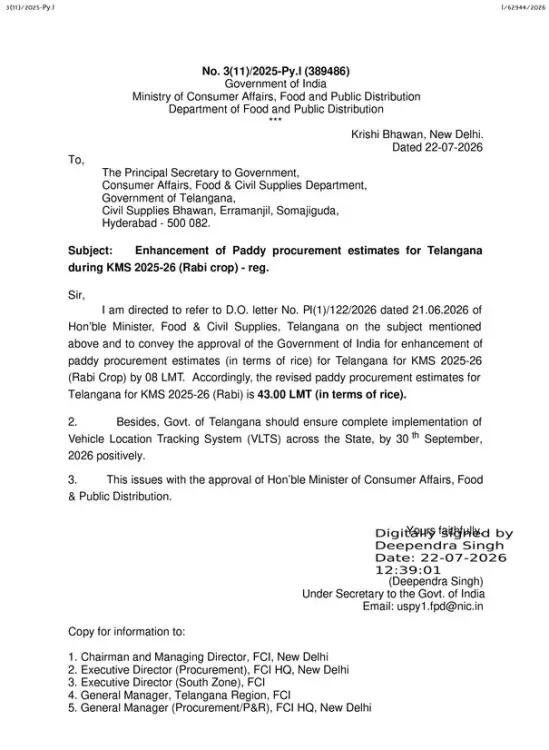
The Centre has raised Telangana's Kharif rice procurement ceiling by 8 lakh metric tonnes to 43 lakh MT, allowing an additional 12 lakh MT of paddy to be purchased from farmers. Union Minister G. Kishan Reddy credited a BJP delegation's 8 July meeting with Minister Pralhad Joshi for the swift decision.
Key Takeaways
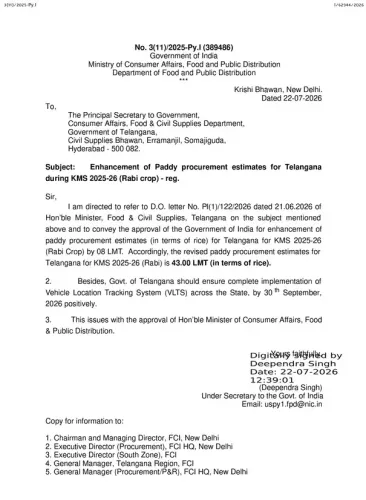
The Centre raised Telangana's Kharif rice procurement ceiling from 35 lakh metric tonnes to 43 lakh metric tonnes , an increase of 8 lakh MT .
The revision enables procurement agencies to purchase an additional 12 lakh metric tonnes of paddy directly from Telangana farmers at MSP.
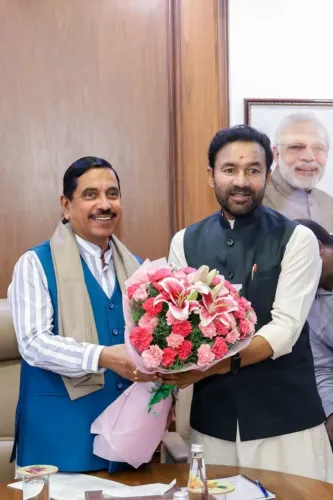
A delegation of BJP MPs, MLAs, and MLCs from Telangana met Union Minister Pralhad Joshi on 8 July to request the ceiling hike.
Kishan Reddy publicly thanked PM Narendra Modi and Pralhad Joshi on behalf of Telangana's people.
Kishan Reddy urged the Telangana state government to promptly deliver rice already committed to the FCI under prior agreements.
The move is expected to benefit both paddy farmers through assured MSP purchases and PDS beneficiaries through sustained rice supply.
Union Coal and Mines Minister G. Kishan Reddy, who also serves as BJP Telangana state president, on Wednesday, 22 July 2026, publicly thanked Prime Minister Narendra Modi and Union Minister for Consumer Affairs, Food and Public Distribution Pralhad Joshi after the Centre raised Telangana's Kharif Marketing Season rice procurement ceiling from 35 lakh metric tonnes to 43 lakh metric tonnes — an increase of 8 lakh metric tonnes.
Context
Posting in Telugu on 22 July 2026, Kishan Reddy conveyed the gratitude of Telangana's people for the revised procurement limit. He stated that the enhancement would enable the purchase of an additional 12 lakh metric tonnes of paddy directly from farmers, providing significant relief to the state's agricultural community. The post was directed at @narendramodi, @JoshiPralhad, @PMOIndia, and @fooddeptgoi.
Reddy noted that on 8 July, a delegation comprising BJP MPs, MLAs, and MLCs from Telangana met Union Minister Pralhad Joshi specifically to request an upward revision of the rice procurement ceiling. He credited Joshi's swift response for the outcome.
Policy Backdrop
Rice procurement in India operates under the Decentralised Procurement Scheme, introduced in 1997, which allows states to procure grain on behalf of the Food Corporation of India (FCI) for the central pool and local public distribution system needs. Telangana is one of the country's major Kharif rice producers and a consistent contributor to the FCI central pool.
Central ministries periodically revise state-wise procurement ceilings in response to representations from producing states, a mechanism designed to prevent distress sales by farmers and to maintain adequate national foodgrain stocks. Successive Kharif seasons have seen Telangana's limits revised upward as the state's paddy output has grown.
Stakeholders and Impact
Telangana's paddy farmers stand to be the most direct beneficiaries of the revised ceiling. With the enhanced limit, procurement agencies can legally purchase a larger volume at the government-declared Minimum Support Price, reducing the risk of farmers being forced into distress sales in open markets at below-MSP rates.
Beneficiaries of the Public Distribution System (PDS) — commonly known as the ration system — are also stakeholders, as higher central procurement sustains the supply of subsidised rice through fair-price shops. Kishan Reddy, in the same post, called on the Telangana state government to expedite the handover of rice already committed to the FCI under existing agreements, so that the supply chain for farmers and the PDS is not disrupted.
What's Next
Attention will now shift to actual paddy arrivals at Telangana mandis and whether the state government moves swiftly to fulfil its pending rice delivery obligations to the FCI as Kishan Reddy has urged. The pace of procurement against the revised ceiling over the coming weeks will determine how much of the additional benefit reaches farmers on the ground.
Any further ceiling revisions ahead of the Rabi marketing season will be closely watched, particularly if paddy output in Telangana continues on an upward trajectory. The episode also underscores the role of state-level BJP representatives in channelling farmer welfare demands directly to Union ministers for rapid administrative action.
Point of View
But the speed of the response — from a 8 July delegation meeting to a public announcement by 22 July — is notable. For the BJP, which is in opposition in Telangana, the episode is a visible demonstration that its state-level legislators can deliver tangible outcomes for farmers by leveraging access to Union ministers, a narrative the party will likely amplify ahead of future electoral cycles. The concurrent request to the Congress-led state government to expedite pending FCI rice deliveries adds a pointed political dimension, implicitly framing the state administration as a potential bottleneck in a Centre-driven farmer welfare measure.
NationPress
22 Jul 2026
Frequently Asked Questions
By how much has the Centre increased Telangana's rice procurement limit?
The Centre has increased Telangana's Kharif Marketing Season rice procurement ceiling by 8 lakh metric tonnes , raising it from 35 lakh MT to 43 lakh MT .
What is the benefit of the increased rice procurement limit for Telangana farmers?
The revised ceiling allows procurement agencies to purchase an additional 12 lakh metric tonnes of paddy directly from Telangana farmers at the government's Minimum Support Price, reducing the risk of distress sales.
Who requested the increase in Telangana's rice procurement quota?
A delegation of BJP MPs, MLAs, and MLCs from Telangana, coordinated by state BJP president G. Kishan Reddy , met Union Minister Pralhad Joshi on 8 July to formally request the hike.
What is the Decentralised Procurement Scheme and how does it relate to this decision?
The Decentralised Procurement Scheme , introduced in 1997 , allows states to procure rice on behalf of the Food Corporation of India (FCI) for the central pool and local PDS needs. State-wise ceilings under this scheme are periodically revised, as has now been done for Telangana.
What did Kishan Reddy ask the Telangana state government to do?
Kishan Reddy urged the Telangana state government to expedite the delivery of rice already committed to the FCI under existing agreements, so that both farmers and the public distribution system benefit without delay.