Maharashtra CMO Vows Permanent Drought-Free State
Synopsis
The Chief Minister's Office of Maharashtra on 1 July 2026 declared the government's intent to make the state permanently drought-free, reinforcing a long-standing policy focus on structural water conservation over short-term drought relief, with Marathwada and Vidarbha farmers as the primary beneficiaries.
Key Takeaways
The Chief Minister's Office of Maharashtra posted on 1 July 2026 declaring intent to make Maharashtra permanently drought-free .
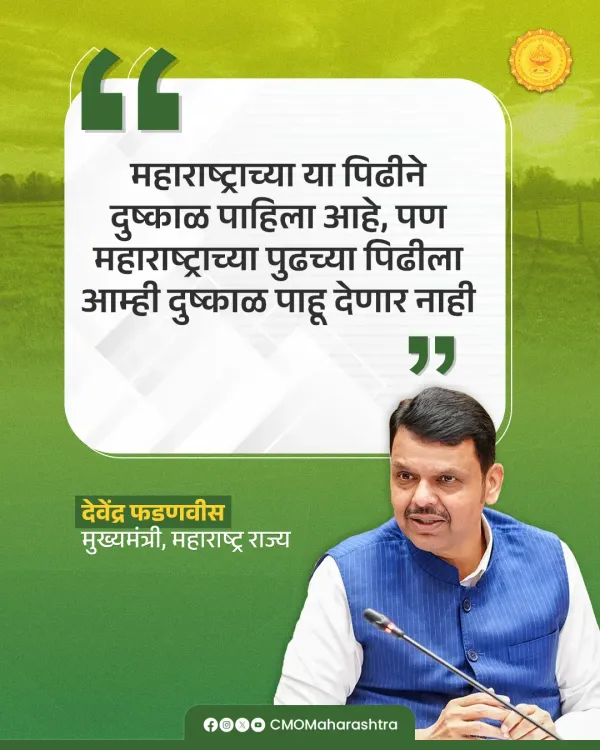
The statement, in Marathi, reads: 'We want to make Maharashtra permanently free of drought' — framing water security as a structural goal, not a relief measure.
Marathwada and Vidarbha are the most drought-prone regions in Maharashtra, with agriculture and rural livelihoods most at risk.
The Jalyukt Shivar Abhiyan , launched in 2015 , remains the state's flagship water-conservation programme, focusing on desilting water bodies and building check dams.
The announcement aligns with the onset of the 2026 monsoon season , when water-conservation works are typically reviewed and expanded.
Budget allocations and physical targets in upcoming state documents will be the key indicators of how this commitment is operationalised.
The Chief Minister's Office of Maharashtra on Wednesday, 1 July 2026 declared the government's resolve to make Maharashtra permanently drought-free, posting on X with the hashtags #Maharashtra and #WaterConservation.
Context
The post, written in Marathi, states: 'Maharashtrala kayamsvarupi dushkalamukta karayache ahe' — 'We want to make Maharashtra permanently free of drought.' The declaration signals that the state government is framing water security not as a crisis-response measure but as a structural, long-term policy goal. The statement comes at the onset of the 2026 monsoon season, a period when water-conservation works are typically reviewed and accelerated.
Policy Backdrop
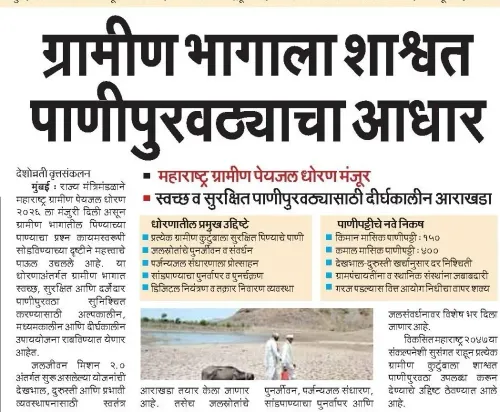
Maharashtra has a history of severe drought, particularly in the Marathwada and Vidarbha regions, where erratic rainfall and depleted groundwater have repeatedly devastated agricultural communities. In 2015, the state launched the Jalyukt Shivar Abhiyan, a flagship water-conservation programme aimed at desilting water bodies, constructing check dams, and creating decentralised storage structures to make villages drought-free. Successive administrations have layered this scheme with central government initiatives such as the Pradhan Mantri Krishi Sinchayee Yojana, reflecting a cross-party consensus on the urgency of water security.
The current declaration continues this lineage, emphasising permanence over piecemeal relief. Maharashtra governments have historically distinguished between drought relief — providing short-term compensation to affected farmers — and drought mitigation, which involves structural investment in water infrastructure. The CMO's language leans firmly toward the latter.
Stakeholders and Impact
Farmers and rural households in drought-prone districts stand to benefit most directly from any sustained push toward permanent water security. Marathwada, comprising districts such as Aurangabad (Chhatrapati Sambhajinagar), Latur, and Osmanabad (Dharashiv), has historically recorded the sharpest agricultural distress during drought years, including crop failures and farmer suicides. Vidarbha, another chronically water-stressed region, faces similar challenges with cotton and soybean cultivation dependent on monsoon reliability.
Water conservation works — check dams, farm ponds, watershed development, and canal lining — directly expand irrigation access and recharge groundwater tables, reducing dependence on erratic rainfall. For rural women, who bear a disproportionate burden of water-fetching in water-scarce villages, improved local water availability translates into significant quality-of-life gains.
What's Next
The key markers to watch will be the state government's budget allocations for water-conservation infrastructure in the upcoming fiscal cycle and the physical targets set for new watershed and check-dam works ahead of and during the 2026 monsoon. Monsoon preparedness reports from the state's water resources department will indicate how the declared ambition is being translated into on-ground action. A durable shift from reactive drought relief to proactive drought elimination would require sustained multi-year investment, inter-departmental coordination, and convergence with central government water schemes — all of which will become clearer in the months ahead.
Point of View
Suggesting continuity with earlier policy architecture even as political configurations in the state have shifted. For a state where agrarian distress in Marathwada and Vidarbha has long been a politically charged issue, such declarations carry both policy weight and electoral resonance. The real test, as with all such announcements, will lie in the budget lines and implementation timelines that follow.
NationPress
1 Jul 2026
Frequently Asked Questions
What did the Maharashtra CMO announce on 1 July 2026?
The Chief Minister's Office of Maharashtra declared on 1 July 2026 that the government intends to make Maharashtra permanently free of drought, signalling a long-term structural approach to water security rather than short-term relief.
What is Jalyukt Shivar Abhiyan?
Jalyukt Shivar Abhiyan is a Maharashtra state water-conservation programme launched in 2015. It focuses on desilting water bodies, constructing check dams, and building decentralised water-storage structures to make villages drought-free.
Which regions of Maharashtra are most affected by drought?
The Marathwada and Vidarbha regions are the most chronically drought-prone parts of Maharashtra, with districts such as Latur, Osmanabad (Dharashiv), and Chhatrapati Sambhajinagar recording severe agricultural distress during dry years.
How does Maharashtra plan to become drought-free?
Maharashtra has historically combined state schemes like Jalyukt Shivar Abhiyan with central programmes such as Pradhan Mantri Krishi Sinchayee Yojana, focusing on watershed development, check dams, farm ponds, and canal infrastructure to expand irrigation and recharge groundwater.
Who benefits most from Maharashtra's water conservation push?
Farmers and rural households in drought-prone Marathwada and Vidarbha benefit most, gaining more reliable irrigation access and reduced dependence on erratic monsoon rainfall. Rural women also benefit significantly as improved local water availability reduces the burden of water-fetching.