Meghalaya CM unveils 50 KW solar plant at Shillong school under CM Solar Mission
Synopsis
Meghalaya is quietly building one of India's most ambitious school-based solar grids. With 1.5 MW already across 700 schools and 1,300 more queued, Conrad Sangma's CM Solar Mission is pairing generation with battery storage and net metering — a template that could turn classrooms into mini power producers for surrounding communities.
Key Takeaways
Sangma inaugurated a 50 KW solar PV plant at St.
Mary's Higher Secondary School , Shillong on 2 June .
The ₹50 lakh project is implemented by MNREDA with battery backup for outage resilience.
Expected savings: 6,000 units/month , ₹40,000/month , nearly ₹5 lakh annually .
Over 1.5 MW already installed across nearly 700 schools ; 1,300 more in the pipeline.
Net metering integration planned to feed surplus power back to the grid.
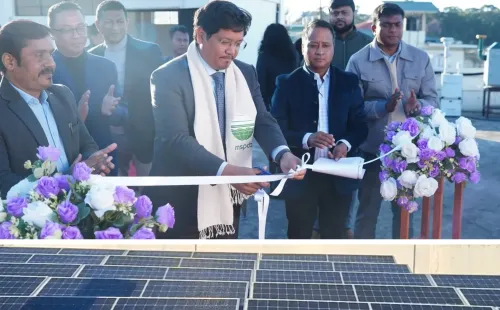
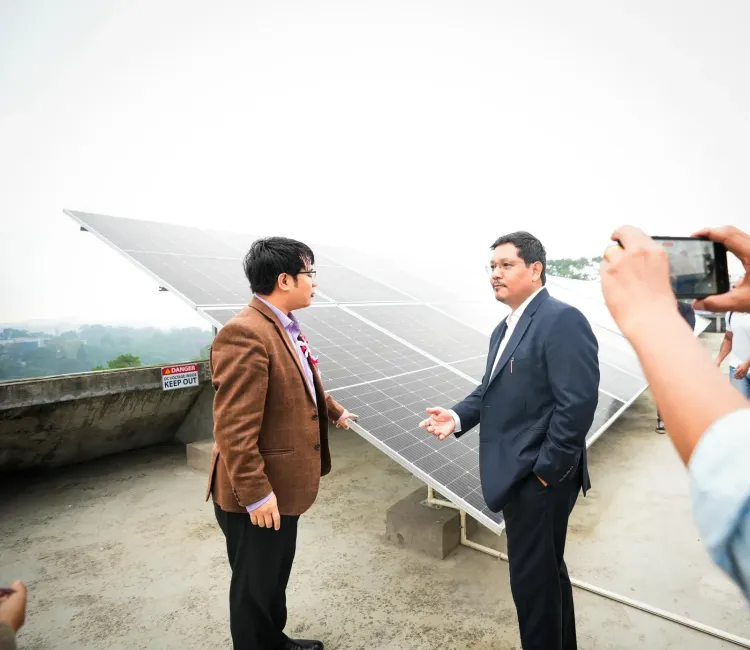
Meghalaya Chief Minister Conrad K. Sangma on Tuesday, 2 June inaugurated a 50 KW Solar Photovoltaic (PV) Plant at St. Mary's Higher Secondary School in Shillong, declaring that renewable energy is ‘no longer just an idea but the need of the hour'. The installation, executed under the state government's Chief Minister's Solar Mission, ranks among the largest solar projects in any educational institution in Meghalaya.
Key Features of the Project
Implemented by the Meghalaya New and Renewable Energy Development Agency (MNREDA), the ₹50 lakh system comes with battery backup to ensure uninterrupted power even during prolonged rain spells or grid disruptions — a critical design choice for a state where monsoon outages are routine.
According to Sangma, the plant is expected to save close to 6,000 units of electricity every month, cutting the school's power bill by roughly ₹40,000 a month and nearly ₹5 lakh annually.
What the Chief Minister Said
Addressing the gathering, Sangma said the deepening impact of climate change on livelihoods makes it imperative for governments and communities to actively adopt clean and sustainable energy. ‘Renewable energy is no longer just an idea — it is the need of the hour,' the Chief Minister said, adding that technology alone cannot solve problems unless converted into practical, sustainable solutions for people.
Scale of the CM Solar Mission
Sangma noted that the government has moved beyond standalone solar panels to end-to-end renewable systems integrating battery storage and inverter support. Over 1.5 MW of solar capacity has already been commissioned across nearly 700 schools in Meghalaya, with rollout in another 1,300 schools set to begin shortly.
Net Metering and Innovation Push
The Chief Minister announced plans to integrate school-based solar plants with net metering, allowing surplus electricity to flow back into the grid for nearby households and communities. He also flagged an upcoming statewide technology and innovation competition aimed at students and young entrepreneurs, focused on energy, healthcare, waste management, and agriculture.
What's Next
With 1,300 more schools lined up for solar deployment, the next phase will test whether Meghalaya can scale a model that combines generation, storage, and grid feedback — a template few Indian states have executed at this granularity in the schools sector.
Point of View
School operating costs, and demonstration value in one shot. The real differentiator is the pairing of storage with net metering; most state schemes stop at panels and ignore the consumption-feedback loop. The 1,300-school next phase will reveal whether MNREDA can sustain quality at scale, where most such rollouts stumble on maintenance, not installation. If executed well, this could become a replicable template for hill states with patchy grids.
NationPress
26 Sept 2026
Frequently Asked Questions
What is the Chief Minister's Solar Mission in Meghalaya?
It is a Meghalaya government initiative providing end-to-end renewable energy solutions — solar panels, battery storage, and inverter support — primarily to schools and public institutions. It is implemented by the Meghalaya New and Renewable Energy Development Agency (MNREDA).
How much will the new solar plant at St. Mary's save?
The 50 KW plant is expected to generate around 6,000 units of electricity per month, cutting the school's power bill by about ₹40,000 monthly and close to ₹5 lakh annually. It also has battery backup for outages.
How many schools in Meghalaya have solar installations so far?
Over 1.5 MW of solar capacity has been installed across nearly 700 schools in Meghalaya. Rollout in another 1,300 schools is set to begin shortly under the CM Solar Mission.
Will excess solar power from schools be shared with communities?
Yes. Chief Minister Conrad Sangma announced plans to integrate the school-based plants with net metering, allowing surplus electricity to be supplied back to the grid for households and surrounding communities.
What other initiatives did the Meghalaya CM announce?
Sangma announced an upcoming statewide technology and innovation competition aimed at students and young entrepreneurs. It will focus on practical solutions in energy, healthcare, waste management, and agriculture.