PM Modi Meets Canada's PM Carney at G7 Evian Summit
Synopsis
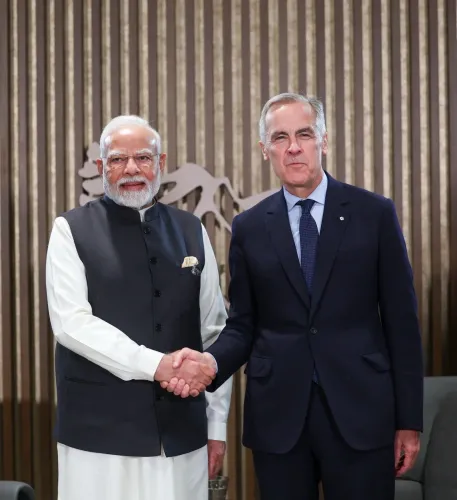
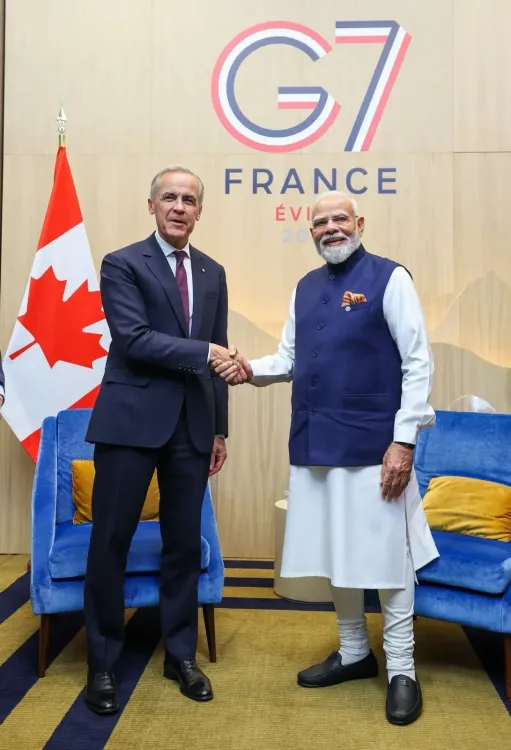
Prime Minister Narendra Modi met Canadian PM Carney on the sidelines of the Evian G7 Summit on June 16, 2026 — their fourth meeting in under a year. The leaders reviewed the full range of India-Canada relations, underscoring both governments' commitment to deepening bilateral ties across trade, diaspora, and strategic cooperation.
Key Takeaways
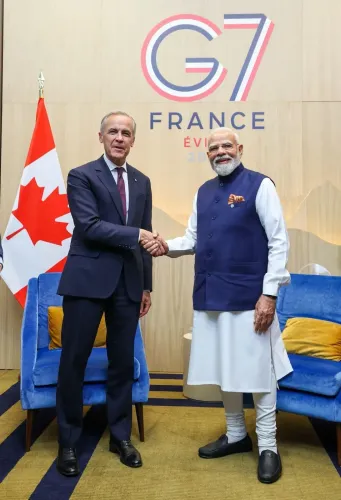
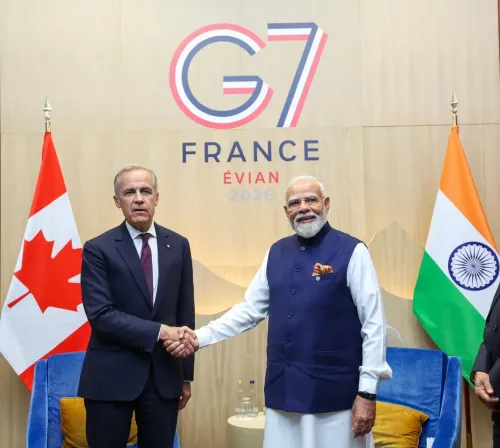
PM Modi and Canadian PM Carney met on the sidelines of the Evian G7 Summit on June 16, 2026 .
This was their fourth bilateral meeting in under a year , signalling strong diplomatic momentum.
The two leaders reviewed 'the full range of relations,' indicating a broad-spectrum discussion covering trade, diaspora, and security.
India and Canada have had a Comprehensive Economic Partnership Agreement (CEPA) negotiation process in place since 2010 .
A 2015 state visit by PM Modi to Canada had produced agreements on civil nuclear cooperation and skills development.
The meeting aligns with India 's broader strategy of intensifying engagement with G7 partners on trade, technology, and supply-chain diversification.
Prime Minister Narendra Modi met Canadian Prime Minister Carney on the sidelines of the Evian G7 Summit on Tuesday, June 16, 2026, marking their fourth bilateral meeting in under a year and signalling sustained momentum in India-Canada relations.
Posting on X after the meeting, PM Modi described the encounter as 'a delight' and noted that the frequency of meetings — four in less than twelve months — reflected 'our commitment to strong India-Canada ties.' He added that the two leaders 'reviewed the full range of relations between our nations, notably the ground covered,' indicating a broad-spectrum discussion rather than a single-issue exchange.
Context
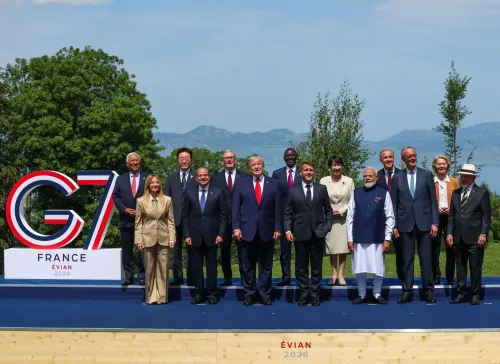
The meeting took place on the margins of the G7 Summit in Evian, France, a gathering of the world's major advanced economies. India has been a recurring invitee to G7 outreach sessions, reflecting New Delhi's growing weight in global economic and security conversations. Bilateral meetings on the sidelines of multilateral forums have become a preferred format for PM Modi to conduct high-density diplomacy with Western counterparts.
The India-Canada relationship carries significant strategic depth: a large Indian diaspora in Canada, long-standing educational and people-to-people linkages, and a shared interest in trade diversification give the partnership a broad base. The two countries launched negotiations on a Comprehensive Economic Partnership Agreement (CEPA) as far back as 2010, and a 2015 state visit by PM Modi to Canada produced accords on civil nuclear cooperation and skills development.
Policy Backdrop
India has intensified high-level engagement with G7 members as part of a broader strategy to diversify supply chains, attract investment, and deepen technology and energy partnerships. The cadence of four meetings with the Canadian side within a year suggests both governments are working to consolidate and expand bilateral ties, building on existing frameworks in trade, education, and security.
The reference in PM Modi's post to 'the ground covered' implies that earlier conversations had produced actionable outcomes that both leaders wished to review and build upon. Trade negotiators and policymakers tracking migration and skills-mobility agreements are expected to be watching the follow-through closely.
Stakeholders and Impact
The Indian diaspora in Canada — one of the largest and most economically active immigrant communities in the country — stands to benefit from any strengthening of bilateral ties, particularly in areas such as credential recognition, mobility frameworks, and consular services. Trade negotiators on both sides are monitoring whether the political momentum translates into a revival or acceleration of stalled CEPA talks.
Businesses in sectors such as technology, clean energy, and agri-commodities, where India and Canada have complementary strengths, are also stakeholders in the outcome of these high-level exchanges. Any new agreements on investment facilitation or supply-chain linkages would have tangible commercial implications.
What's Next
Observers will watch for concrete follow-up measures — whether in the form of joint statements, renewed trade-negotiation timelines, or new bilateral working groups — that give substance to the political signals exchanged at Evian. India's participation in future G7 outreach formats will also be a marker of how the relationship evolves within the broader multilateral architecture.
With four meetings now logged in under a year, the diplomatic groundwork appears solid; the test will be whether the relationship translates that personal rapport into durable institutional and economic outcomes for both nations.
Point of View
Especially given the frictions that have periodically complicated the relationship. The choice of the Evian G7 sidelines — a multilateral setting where India is an invitee rather than a member — underscores New Delhi's strategy of leveraging global forums for intensive bilateral outreach. PM Modi's public framing, emphasising 'commitment' and 'ground covered,' is calibrated to project continuity and goodwill. The real test of this diplomatic warmth will be whether it unlocks tangible deliverables: a revived CEPA timeline, expanded mobility frameworks, or new investment corridors that the large Indian diaspora in Canada and businesses on both sides can point to.
NationPress
15 Sept 2026
Frequently Asked Questions
Why did PM Modi meet Canadian PM Carney at the G7 Summit?
PM Modi met Canadian PM Carney on the sidelines of the Evian G7 Summit to review the full range of India-Canada bilateral relations. It was their fourth meeting in under a year, reflecting both governments' stated commitment to strengthening ties.
How many times have PM Modi and PM Carney met?
According to PM Modi 's post on June 16, 2026 , the Evian G7 meeting was their fourth bilateral meeting in less than a year , indicating a high tempo of diplomatic engagement.
Where is the G7 Evian Summit being held?
The G7 Summit referenced in PM Modi 's post is being held in Evian, France , where leaders of major advanced economies and invited partners are gathering for high-level discussions.
What is the state of India-Canada trade talks?
India and Canada have been negotiating a Comprehensive Economic Partnership Agreement (CEPA) since 2010 . A 2015 state visit by PM Modi also produced agreements on civil nuclear cooperation and skills development, though a final trade pact has not yet been concluded.
What is the significance of the Indian diaspora in India-Canada relations?
The Indian diaspora in Canada is one of the largest immigrant communities in the country and plays a key role in people-to-people ties. Stronger bilateral relations can benefit the diaspora through improved mobility frameworks, credential recognition, and consular services.