PM Modi: Middle Class Freed from Uncertainty Over 12 Years
Synopsis
Prime Minister Narendra Modi on June 10, 2026, said twelve years of policy reforms — spanning GST, tax relief, and digital financial inclusion — have freed India's middle class from economic uncertainties and empowered it to drive the country's growth journey with confidence.
Key Takeaways
PM Modi posted on June 10, 2026 , crediting 12 years of reforms with freeing India's middle class from economic uncertainty.
Key measures cited include the GST rollout in July 2017 , successive income-tax exemption hikes, and Jan Dhan -linked direct-benefit transfers.
The middle class — comprising several crore salaried and middle-income households — is framed as both a beneficiary and a driver of India's growth journey.
The post accompanied a video and arrives ahead of expected budgetary deliberations on fresh middle-class relief measures.
The government's narrative links formalisation, digitalisation, and tax rationalisation to a shift from 'survival concerns' to consumption and investment among middle-income families.
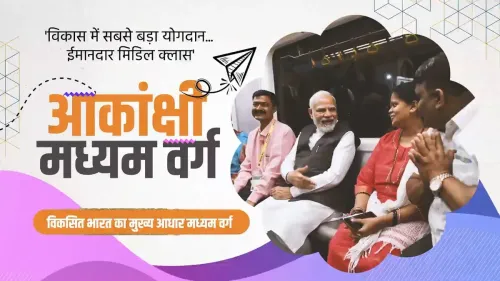
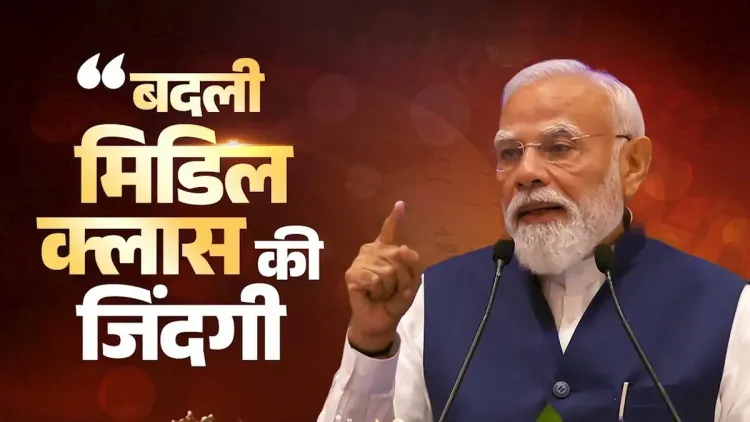
Prime Minister Narendra Modi on Wednesday, June 10, 2026, credited twelve years of policy reforms with liberating India's middle class from economic uncertainty, saying the demographic is now driving the country's growth journey with renewed confidence. The post, shared on X, accompanied a video highlighting the government's record on middle-class empowerment.
In the original Hindi, Modi wrote: 'पिछले 12 वर्षों में उठाए गए कदमों से हमारा मिडिल क्लास अनिश्चितताओं से मुक्त हो रहा है और भरपूर आत्मविश्वास के साथ देश की विकास यात्रा को भी गति देने में जुटा है।' Translated: 'The steps taken over the past 12 years are freeing our middle class from uncertainties, and with full confidence it is engaged in accelerating the country's development journey.'
Context
The post marks roughly 12 years since the BJP-led National Democratic Alliance came to power in May 2014. Since then, the central government has consistently framed its economic agenda around expanding the organised economy and reducing the compliance burden on salaried and middle-income households. The statement arrives as the government prepares for the next round of budgetary deliberations, where middle-class relief measures are expected to feature prominently.
The reference to 'uncertainties' is widely understood in the context of tax rationalisation, digital financial inclusion, and subsidy reforms that the administration has pursued across successive parliaments. Analysts note that the messaging reinforces a long-running political identity built around middle-class aspiration.
Policy Backdrop
Several landmark measures underpin the claim. The rollout of the Goods and Services Tax (GST) in July 2017 replaced a fragmented multi-layered indirect tax structure with a unified regime, reducing cascading levies on goods and services consumed by middle-income households. Successive Union Budgets from 2014 onwards raised the basic income-tax exemption limit and restructured slabs to provide incremental relief to salaried taxpayers.
The expansion of Jan Dhan accounts and direct-benefit transfers digitised subsidy delivery and curtailed leakages that had historically disadvantaged lower-middle-class families. The November 2016 demonetisation decision, though contested in its short-term impact, was framed by the government as a step toward formalising the economy and curbing black money — both concerns cited by middle-class voters. Together, these moves form the policy lineage the Prime Minister appears to be invoking.
Stakeholders and Impact
The primary beneficiaries identified in the government's narrative are salaried taxpayers and middle-income households — a demographic estimated to number several crore families across urban and semi-urban India. Greater formalisation has, in theory, expanded access to institutional credit, insurance, and social-security nets for this group.
Critics have periodically argued that rising cost of living, stagnant real wages in certain sectors, and the compliance complexity of GST have offset some of the stated gains. The government contests this view, pointing to rising consumption data and digital-payment adoption as evidence of a confident, economically active middle class.
What's Next
Attention will now turn to the forthcoming Economic Survey and Union Budget, where fresh adjustments to income-tax slabs or GST rates could signal the next phase of middle-class policy. Any legislative changes in the coming parliamentary session will be closely watched by salaried taxpayers and industry groups alike. The Prime Minister's post sets a clear political tone: the middle class is positioned not merely as a beneficiary of growth, but as an active engine of it.
Point of View
The messaging invites voters to evaluate governance as a cumulative project rather than a single-term record. The invocation of 'confidence' alongside 'development journey' signals an intent to position the middle class not as a welfare recipient but as an economic protagonist, a framing that has electoral salience in urban and semi-urban constituencies. With the next Union Budget on the horizon, the post also functions as a pre-emptive narrative frame: any fresh tax concessions will land in an audience already primed to read them as continuity, not concession.
NationPress
26 Oct 2026
Frequently Asked Questions
What did PM Modi say about the middle class on June 10 2026?
PM Modi said that steps taken over the past 12 years are freeing India's middle class from uncertainties and that the middle class is now accelerating the country's development journey with full confidence.
How has the BJP government helped the middle class since 2014?
Key measures include the GST rollout in July 2017, which reduced cascading taxes; successive income-tax exemption hikes in Union Budgets; and the expansion of Jan Dhan accounts and direct-benefit transfers that reduced subsidy leakages for lower-middle-class families.
What is GST and how does it affect the middle class?
GST, or Goods and Services Tax, was introduced in July 2017 to replace multiple central and state levies with a single unified indirect tax. It reduced cascading taxes on goods and services commonly consumed by middle-income households.
What economic reforms has Modi introduced for salaried taxpayers?
Since 2014, successive Union Budgets have raised the basic income-tax exemption limit and restructured tax slabs to provide incremental relief to salaried taxpayers, while digitisation of subsidies has reduced leakages affecting lower-middle-class families.
What comes next for India's middle class policy?
Analysts and policymakers are watching the forthcoming Economic Survey and Union Budget for potential adjustments to income-tax slabs or GST rates. Any legislative changes in the coming parliamentary session are expected to target middle-income groups.