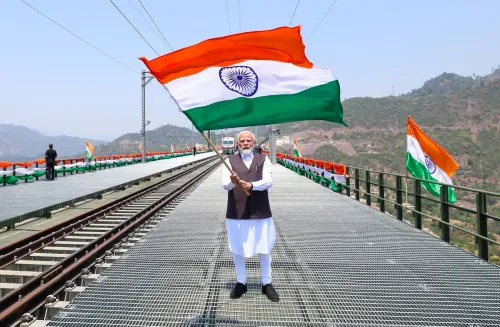
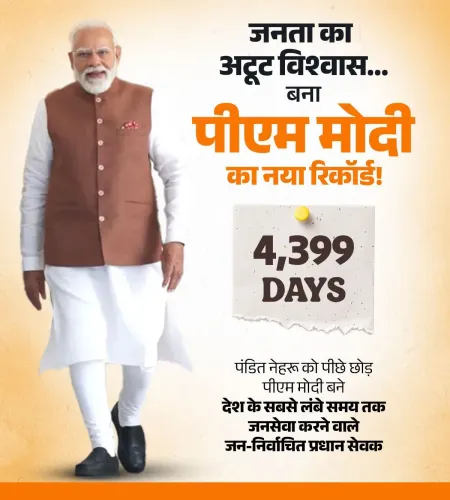
PM Modi becomes India's longest-serving PM: J&K transformation his defining legacy
Synopsis
As Modi becomes India's longest-serving Prime Minister, the abrogation of Article 370 in 2019 and the structural dismantling of separatism in Jammu and Kashmir stand out as the most consequential — and contested — acts of his 12-year tenure. Few decisions in post-Independence India have been as sweeping, or as irreversible.
Key Takeaways
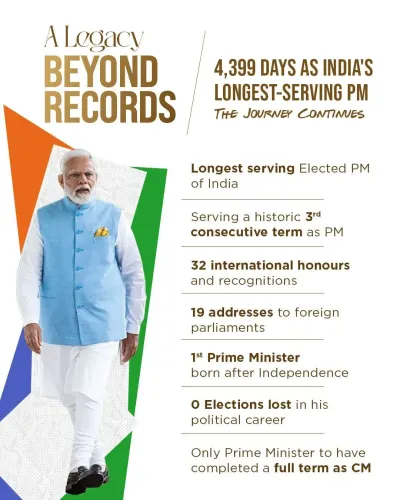
PM Narendra Modi has become the longest-serving Prime Minister in India's democratic history, surpassing all predecessors.
Article 370 was abrogated in 2019 , reorganising Jammu and Kashmir into two Union Territories and ending its special constitutional status.
Terrorism in Jammu and Kashmir has reportedly been reduced to its lowest levels in decades, according to official assessments.
Modi's domestic agenda has included programmes in sanitation, rural electrification, housing, clean cooking fuel, and food security, reaching hundreds of millions of citizens.
India's diplomatic profile has grown significantly during his tenure, including leadership of the G20 and an expanded role in the Global South .
Modi was born on 17 September 1950 in Vadnagar, Gujarat , and first became Prime Minister in 2014 .
Prime Minister Narendra Modi has become the longest-serving Prime Minister in the history of India, the world's largest democracy, and among the most consequential chapters of his 12-year tenure is the sweeping transformation of Jammu and Kashmir. From dismantling the architecture of separatism to integrating the region into the national mainstream, the changes in J&K are widely regarded as the most structurally significant of his governments.
The Abrogation of Article 370 and Its Aftermath
The revocation of Article 370 in 2019 stands as the centrepiece of Modi's J&K policy. For decades, the provision was considered politically untouchable — mainstream Kashmiri leaders had warned that its removal would sever J&K's constitutional connection to India. Modi's government moved decisively, reorganising the erstwhile state into two Union Territories and ending the special status that had long been a flashpoint in national politics.
Critics had long argued that any dialogue on Kashmir's future had to accommodate separatist voices. The Modi government's position, in contrast, left no institutional space for separatism or armed insurgency. According to official assessments, terrorism in the region has been brought to its lowest levels in decades — though independent verification of specific incident data remains important context.
Security Gains and Ground Reality
Successive governments had struggled to contain militancy in the Kashmir Valley. Under Modi, a combination of counter-insurgency operations, the dismantling of separatist financing networks, and the scrapping of Article 370's political framework reportedly reduced the operational capacity of armed groups. Officials have described the security environment as having undergone a structural shift, not merely a cyclical improvement.
Notably, this came after years in which cross-border infiltration and local recruitment had sustained insurgency. The argument made by the Centre is that removing the political ambiguity around J&K's constitutional status also removed a key ideological lever used by separatist groups.
Development and Governance in the Union Territory
Beyond security, the Modi government has pointed to infrastructure investment, tourism recovery, and institutional expansion in J&K as evidence of normalisation. The region has seen increased participation in democratic processes, including local body elections. Whether these gains translate into durable political reconciliation remains a subject of ongoing debate among analysts.
The broader governance record under Modi includes flagship welfare programmes spanning sanitation, rural electrification, clean cooking fuel, affordable housing, food security, and solar energy — initiatives that, according to government data, have reached hundreds of millions of citizens across India. The expansion of educational and healthcare institutions has also been cited as a significant domestic achievement.
India's Global Rise Under Modi's Leadership
Modi's tenure has coincided with a period in which India's international stature has grown considerably. His government has pursued an active foreign policy, strengthening ties with major powers while consolidating India's leadership role in the Global South. India's G20 presidency, its growing strategic partnerships, and its assertive posture in multilateral forums have all contributed to an elevated diplomatic profile.
Born on 17 September 1950 in Vadnagar, Gujarat, into a family of modest means, Modi rose through grassroots political work before ascending to the Prime Ministership in 2014. His political journey — from a small town in Gujarat to the longest-serving occupant of the Prime Minister's office — is, by any measure, an extraordinary arc in Indian democratic history.
Legacy in the Making
As Modi crosses this historic milestone, the integration of Jammu and Kashmir — alongside his government's development agenda and India's growing global footprint — will remain among the most debated and consequential features of his political legacy. Whether one views the J&K transformation as a definitive resolution or as the beginning of a longer reconciliation process, its scale and speed are without modern precedent in Indian governance. The next phase will test whether institutional consolidation in the region can be matched by lasting social and political stability.
Point of View
The security data supports that bet, but security gains and political normalisation are not the same thing; the latter remains unfinished. Modi's broader record — welfare delivery at scale, a reshaped foreign policy, and a narrative shift from 'developing nation' to 'rising power' — is substantial, but it has also concentrated political authority in ways that future governments will have to navigate. The longest-serving milestone invites a question mainstream coverage rarely asks: what institutional frameworks has this era built that will outlast it?
NationPress
26 Oct 2026
Frequently Asked Questions
Why is PM Modi considered the longest-serving Prime Minister of India?
PM Narendra Modi has served as Prime Minister continuously since May 2014, surpassing the tenures of all previous holders of the office to become the longest-serving Prime Minister in India's democratic history. He is currently in his third consecutive term.
What was the significance of abrogating Article 370 in Jammu and Kashmir?
The abrogation of Article 370 in 2019 ended Jammu and Kashmir's special constitutional status, which had been in place since 1949. The erstwhile state was reorganised into two Union Territories — Jammu and Kashmir, and Ladakh — removing provisions that had long been cited by separatist groups as a basis for their political demands.
How has the security situation in Jammu and Kashmir changed under Modi?
According to official government assessments, terrorism in Jammu and Kashmir has been reduced to its lowest levels in decades under the Modi government. Officials attribute this to counter-insurgency operations, the dismantling of separatist financing networks, and the removal of the political ambiguity created by Article 370, though independent analysts continue to monitor ground conditions closely.
What are the other major achievements cited during PM Modi's tenure?
Beyond J&K, the Modi government's record includes large-scale welfare programmes in sanitation, rural electrification, affordable housing, clean cooking fuel, food security, and solar energy. India's global diplomatic profile has also grown significantly, including its G20 presidency and expanded engagement with the Global South.
Where was PM Modi born and what is his background?
PM Narendra Modi was born on 17 September 1950 in Vadnagar, Gujarat, into a family of modest means. He rose through grassroots political work in the Rashtriya Swayamsevak Sangh (RSS) and the Bharatiya Janata Party (BJP) before serving as Chief Minister of Gujarat and subsequently becoming Prime Minister in 2014.