MP CM Mohan Yadav Flags UCC 2026 as Historic Step
Synopsis
The Chief Minister's Office of Madhya Pradesh announced the Uniform Civil Code 2026 on 21 July, framing it as a historic initiative for equality, justice, and good governance under CM Dr. Mohan Yadav, advancing a long-standing BJP policy commitment rooted in Article 44 of the Constitution.
Key Takeaways
The Chief Minister's Office of Madhya Pradesh announced Uniform Civil Code 2026 on 21 July 2026 .
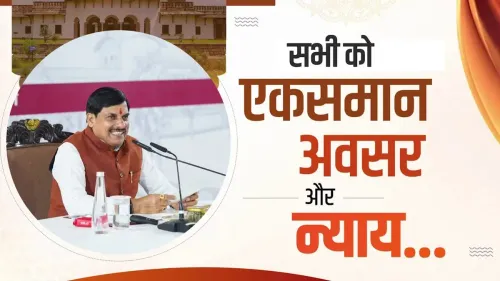
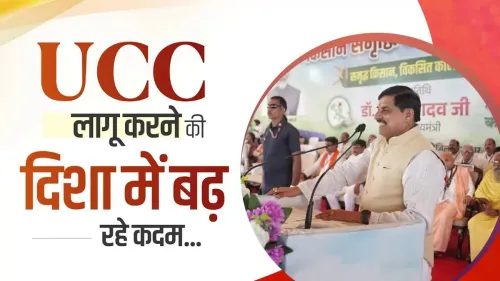
Mohan Yadav described the UCC as a 'historic initiative' toward equality, justice, and good governance.
Article 44 of the Indian Constitution has directed the State to pursue a Uniform Civil Code since 1950 .
The BJP has included UCC in its election manifestos since the 1990s ; Madhya Pradesh is among the first states to formally advance it.
Key stakeholders include women's groups , religious communities , and legal practitioners who will engage with any draft legislation.
A draft bill in the Madhya Pradesh Assembly and potential legal challenges are the immediate next steps to watch.
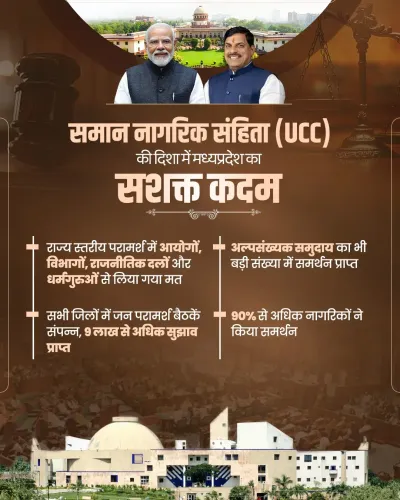
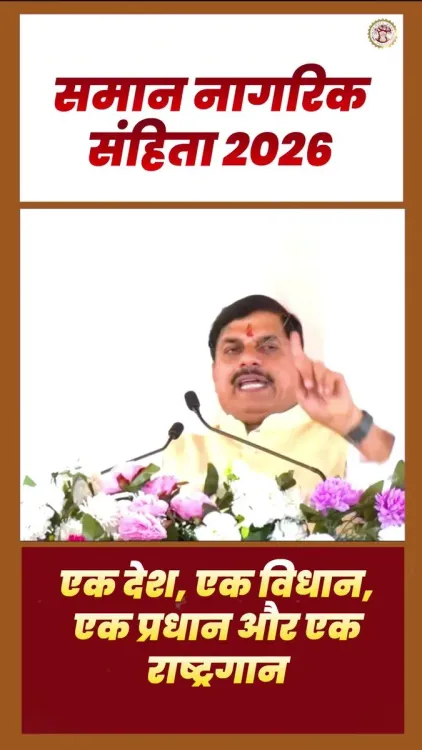
The Chief Minister's Office of Madhya Pradesh announced on Tuesday, 21 July 2026 that the state is advancing the Uniform Civil Code (UCC) 2026, describing it as a landmark initiative toward equality, justice, and good governance, in a post attributed to Chief Minister Dr. Mohan Yadav.
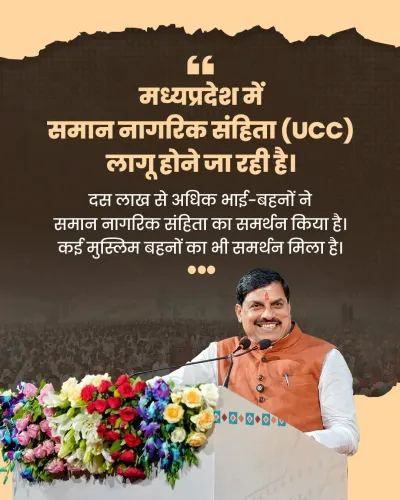
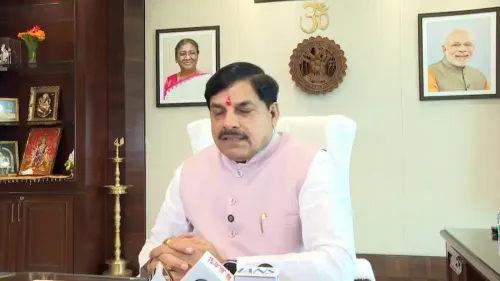
The post, shared from the official CMO handle, stated in Hindi: 'समान नागरिक संहिता 2026 — समानता, न्याय और सुशासन की दिशा में एक महत्वपूर्ण एवं ऐतिहासिक पहल' ('Uniform Civil Code 2026 — an important and historic initiative in the direction of equality, justice, and good governance'). The message was accompanied by a video and tagged directly to Dr. Mohan Yadav.
Context
Madhya Pradesh, governed by the Bharatiya Janata Party (BJP), has positioned the Uniform Civil Code as a cornerstone of its legislative agenda. The UCC proposes a single, common set of civil laws — covering marriage, divorce, inheritance, and adoption — to replace the religion-specific personal laws currently in force across India. The announcement signals that the state intends to move forward with this framework in 2026.
Dr. Mohan Yadav has served as Chief Minister since December 2023 and has consistently aligned the state's policy direction with the BJP's broader national platform on legal uniformity and social reform.
Policy Backdrop
Article 44 of the Constitution of India, adopted in 1950, places the Uniform Civil Code among the Directive Principles of State Policy, directing the State to endeavour to secure a common civil code for all citizens. The provision has remained aspirational for over seven decades, with successive governments at the Centre and in the states debating its implementation.
The 21st Law Commission of India released a consultation paper in 2018 examining reforms to family law, including aspects relevant to a Uniform Civil Code. The BJP has included UCC commitments in its election manifestos since the 1990s, making the Madhya Pradesh announcement a continuation of a long-standing party position now being translated into state-level action.
Stakeholders and Impact
The initiative is expected to draw significant attention from women's rights groups, who have historically argued that a uniform code could strengthen protections against discriminatory personal law provisions. Religious communities and civil society organisations that view personal laws as integral to cultural identity are likely to scrutinise the draft closely once it is made public.
Legal practitioners across Madhya Pradesh will be key participants in any public consultation process, given the wide-ranging implications for family courts and civil litigation in the state. The move also places Madhya Pradesh in focus as a potential model — or point of contention — for other BJP-governed states watching the legislative process unfold.
What's Next
Observers will watch closely for the introduction of a formal draft bill in the Madhya Pradesh Legislative Assembly, along with any structured public consultation or legal review process. Constitutional challenges before the courts remain a possibility, as questions around the interplay between a state-enacted UCC and Central legislative authority are yet to be fully tested in Indian jurisprudence.
The framing of UCC 2026 as a matter of 'equality, justice, and good governance' by the CMO suggests the state government intends to build a broad social consensus around the measure, even as the political and legal debates are expected to intensify in the months ahead.
Point of View
Justice, good governance' — rather than leading with its ideological lineage, a calculated framing designed to broaden appeal beyond the BJP's core base. Madhya Pradesh's move fits a discernible pattern of BJP-governed states using state-level legislation to advance agenda items that have stalled at the Centre, testing constitutional and political ground before a potential national push. The 2026 timeline gives the state government space to draft, consult, and potentially enact legislation ahead of the next electoral cycle, making the announcement as much a political signal as a legislative milestone. Whether the state can navigate the complex federal and constitutional questions around personal law reform will determine whether this becomes a template or a cautionary tale for other states.
NationPress
21 Jul 2026
Frequently Asked Questions
What is the Uniform Civil Code 2026 in Madhya Pradesh?
The Uniform Civil Code 2026 is a proposed set of common civil laws for all citizens of Madhya Pradesh, announced by the Chief Minister's Office on 21 July 2026, intended to replace religion-specific personal laws governing marriage, divorce, inheritance, and adoption.
What did CM Mohan Yadav say about UCC?
CM Dr. Mohan Yadav's office described UCC 2026 as 'an important and historic initiative in the direction of equality, justice, and good governance,' posting a video announcement on 21 July 2026.
Is Uniform Civil Code constitutional in India?
Yes. Article 44 of the Constitution of India, adopted in 1950, directs the State to endeavour to secure a Uniform Civil Code for all citizens, placing it among the Directive Principles of State Policy.
Which Indian states are implementing the Uniform Civil Code?
Madhya Pradesh has announced UCC 2026 as a formal initiative. The BJP has discussed similar measures in other states it governs, but Madhya Pradesh's announcement is among the most explicit state-level commitments made so far.
What happens next after Madhya Pradesh's UCC announcement?
The immediate next steps include the introduction of a draft bill in the Madhya Pradesh Legislative Assembly, a potential public consultation process, and possible legal challenges before the courts regarding the scope of state authority over personal law.