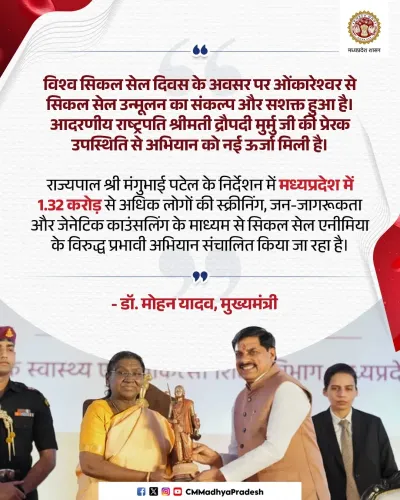
CM Mohan Yadav: MP screens 1.32 cr for sickle cell

Synopsis
On World Sickle Cell Day 2026, CM Mohan Yadav announced that Madhya Pradesh has screened more than 1.32 crore people for sickle cell disease and is working on four simultaneous fronts toward elimination, aligning with the central government's 2047 target.
Key Takeaways
The Chief Minister's Office of Madhya Pradesh made the announcement on World Sickle Cell Day, 19 June 2026 .
More than 1 crore 32 lakh people have been screened for sickle cell disease in Madhya Pradesh so far.
The state government says it is working on four simultaneous fronts for sickle cell elimination.
The drive aligns with the National Sickle Cell Anaemia Elimination Mission launched by the Centre in July 2023 , targeting elimination by 2047 .
Madhya Pradesh is among India's highest-burden states due to its large Scheduled Tribe population .
The mission combines awareness, genetic screening, counselling, and treatment linkage through the National Health Mission framework.
The Chief Minister's Office of Madhya Pradesh, on behalf of Chief Minister Mohan Yadav, announced on 19 June 2026 — World Sickle Cell Day — that the state government is simultaneously working on four fronts to eliminate sickle cell disease, with more than 1 crore 32 lakh people screened across the state so far.
Posting on the occasion of World Sickle Cell Day, the Chief Minister's Office quoted CM Mohan Yadav: 'सिकल सेल उन्मूलन के लिए राज्य सरकार एक साथ 4 मोर्चों पर काम कर रही है' ('For sickle cell elimination, the state government is working simultaneously on 4 fronts'), adding that screening has now crossed the 1.32 crore mark.
Context
World Sickle Cell Day, observed every year on 19 June, serves as a global platform to raise awareness about sickle cell disease — a hereditary blood disorder that causes red blood cells to adopt an abnormal sickle shape, impairing oxygen delivery and causing chronic pain and organ damage. In India, the disease burden falls disproportionately on Scheduled Tribe communities, particularly across central states. Madhya Pradesh is among the states with the highest prevalence of sickle cell anaemia in the country, largely because of its substantial tribal population spread across districts such as Balaghat, Mandla, Dindori and Sheopur. Mass screening drives targeting these communities have been a cornerstone of the state's public health response for several years.Policy Backdrop
The state's current push sits within the framework of the National Sickle Cell Anaemia Elimination Mission, launched by Prime Minister Narendra Modi in July 2023. The central mission targets screening of 7 crore people across 17 high-prevalence states — including Madhya Pradesh — with the goal of eliminating the disease by 2047, aligned with India's centenary of independence. The mission's decentralised model integrates four key components: community awareness, genetic screening, pre-marital and genetic counselling, and linkage to treatment and support services. State governments are responsible for implementation through their district health societies under the National Health Mission. Madhya Pradesh had also run state-specific tribal health programmes predating the 2023 central mission, which provided an existing infrastructure for the current scale-up.Stakeholders and Impact
The primary beneficiaries of the screening drive are tribal and rural communities in Madhya Pradesh, where sickle cell trait carriers and affected individuals often lack access to specialist care. Early identification through screening allows carriers to receive genetic counselling before marriage, potentially preventing the birth of children with the full disease. Frontline health workers — including ASHA workers and Anganwadi workers — are central to the ground-level implementation, conducting community outreach and facilitating sample collection in remote areas. For individuals already living with sickle cell disease, the programme's treatment-linkage component aims to connect them with hydroxyurea therapy and other supportive care available through government facilities.What's Next
With 1.32 crore people screened, the focus will shift to how effectively the state translates screening data into actionable outcomes — counselling completion rates, treatment enrolment, and reduction in new disease incidence over time. Progress reports integrated with district health society data under the National Health Mission will be a key metric for evaluating whether Madhya Pradesh is on track to meet the 2047 elimination target set by the central mission. The state's performance on this front will also serve as a benchmark for other high-prevalence states as India pushes its broader agenda of eliminating genetic disorders among its most vulnerable populations.Point of View
Reinforcing CM Mohan Yadav's positioning as an active implementer of central flagship schemes. The 1.32 crore screening figure is significant in scale, but the harder policy test lies downstream — in counselling completion and treatment enrolment rates, which are harder to publicise but more determinative of actual disease burden reduction. Madhya Pradesh's large tribal population makes it a bellwether for the National Sickle Cell Anaemia Elimination Mission; how the state converts screening numbers into measurable health outcomes will influence the central mission's credibility as the 2047 target approaches. The 'four fronts' framing, while evocative, will require granular disclosure to move from political messaging to verifiable public health progress.
NationPress
19 Sept 2026
Frequently Asked Questions
What is the sickle cell screening target for Madhya Pradesh?
Madhya Pradesh is part of the National Sickle Cell Anaemia Elimination Mission, which targets screening of 7 crore people across 17 high-prevalence states by 2047. The state has so far screened more than 1 crore 32 lakh people.
What is World Sickle Cell Day and when is it observed?
World Sickle Cell Day is observed every year on 19 June to raise global and national awareness about sickle cell disease, a hereditary blood disorder that is particularly prevalent among tribal communities in central India.
What is the National Sickle Cell Anaemia Elimination Mission?
The National Sickle Cell Anaemia Elimination Mission was launched by Prime Minister Narendra Modi in July 2023. It aims to screen 7 crore people across 17 states and eliminate sickle cell disease in India by 2047.
Why is sickle cell disease so common in Madhya Pradesh?
Sickle cell disease is highly prevalent in Madhya Pradesh because of the state's large Scheduled Tribe population, which has a historically higher genetic carrier rate for the disorder compared to the general population.
What are the four fronts CM Mohan Yadav mentioned for sickle cell elimination?
CM Mohan Yadav referred to the state government working on four simultaneous fronts for sickle cell elimination, consistent with the national mission's pillars of awareness, screening, genetic counselling, and treatment linkage, though specific details of the state's four-front framework were not elaborated in the announcement.