Nadda: CCEA Clears 3rd-4th Rail Lines on Ballari-Guntakal
Synopsis
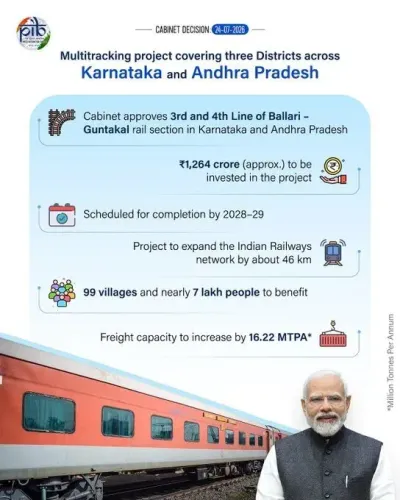
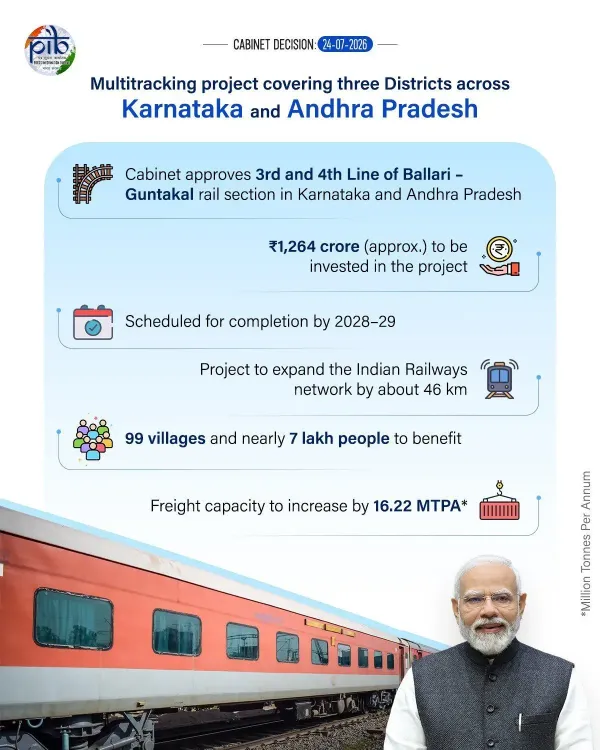
The Cabinet Committee on Economic Affairs, chaired by PM Narendra Modi, has approved construction of the 3rd and 4th railway lines on the Ballari-Guntakal section across Karnataka and Andhra Pradesh at ₹1,264 crore, under the PM Gati Shakti National Master Plan, to boost freight, passenger movement, and regional development.
Key Takeaways
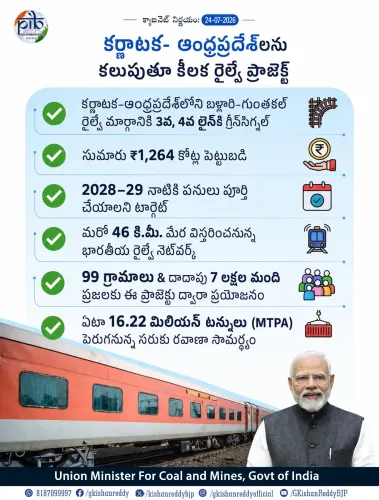
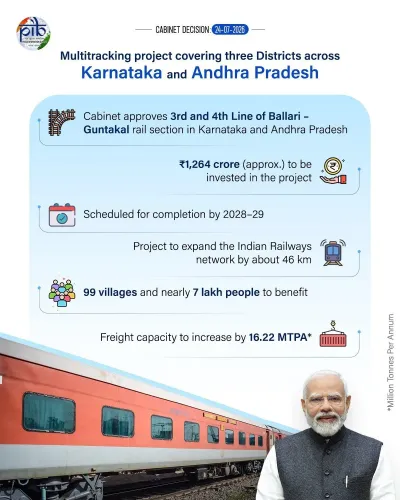
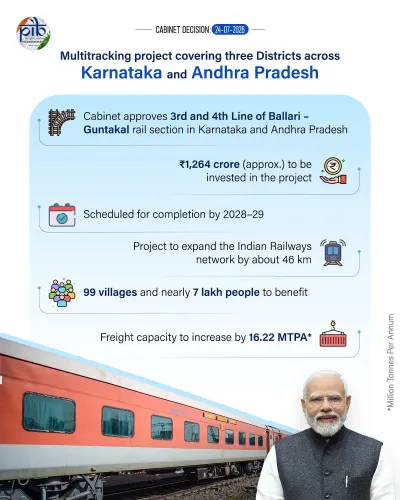
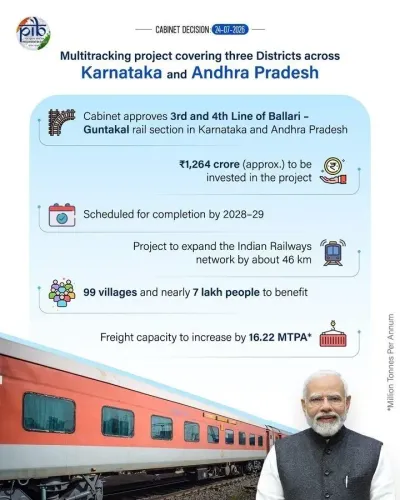
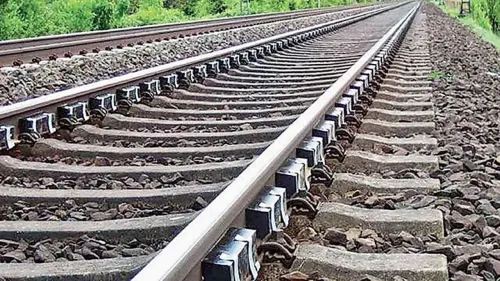
The CCEA , chaired by PM Narendra Modi , approved construction of the 3rd and 4th railway lines on the Ballari–Guntakal section .
The project is estimated to cost ₹1,264 crore and spans Karnataka and Andhra Pradesh .
It is planned under the PM Gati Shakti National Master Plan , launched in October 2021 .
Key benefits cited include easing congestion, improving freight logistics, boosting tourism connectivity, and generating employment.
The project aligns with the Viksit Bharat vision for 2047 and the Atmanirbhar Bharat self-reliance initiative.
Next steps include tendering, land acquisition, and inter-state coordination between Karnataka , Andhra Pradesh , and the Ministry of Railways .
Union Health Minister and BJP national president J. P. Nadda on Friday, 25 July 2026, announced that the Cabinet Committee on Economic Affairs (CCEA), chaired by Prime Minister Narendra Modi, has approved the construction of the 3rd and 4th railway lines on the Ballari–Guntakal section spanning Karnataka and Andhra Pradesh, at an estimated cost of ₹1,264 crore.
Context
Nadda shared the decision on X, stating that the project is 'planned under the PM Gati Shakti National Master Plan' and will 'strengthen multi-modal connectivity, improve logistics efficiency, and enhance the seamless movement of passengers and freight.' The Ballari–Guntakal corridor is a key inter-state rail link connecting Ballari district in Karnataka with Guntakal in Andhra Pradesh, handling significant volumes of both passenger and freight traffic.
The CCEA is the apex cabinet body responsible for approving large-scale economic and infrastructure investments. Its decisions carry the authority of the full cabinet on economic matters, making this approval a formal government commitment to the project.
Policy Backdrop
The project is anchored in the PM Gati Shakti National Master Plan, launched in October 2021, which seeks to integrate infrastructure planning across road, rail, ports, and logistics sectors under a unified digital platform. The plan aims to eliminate silos between ministries and enable coordinated project execution.
The approval also draws on the broader Viksit Bharat vision — the government's long-term goal of a fully developed India by 2047 — and the Atmanirbhar Bharat self-reliance campaign, first announced in May 2020, which emphasises strengthening domestic logistics and internal connectivity as pillars of economic independence. Multi-tracking projects of this nature are a recurring feature of capacity augmentation on high-traffic southern rail corridors.
Stakeholders and Impact
The addition of the 3rd and 4th lines on this section is expected to ease congestion, improve operational efficiency, and enhance service reliability for both passenger and freight operators. The post specifically notes improved connectivity to 'key tourist destinations' and facilitation of 'essential commodities' transport — benefits that would extend to the regional economies of both Karnataka and Andhra Pradesh.
Employment generation during construction and downstream economic activity in the two states are cited as additional outcomes. Freight operators moving bulk commodities through the corridor — including minerals from the Ballari region — and rail passengers on inter-state routes stand to benefit most directly.
What's Next
Following CCEA approval, the project moves to tendering, land acquisition, and detailed construction planning. State-level coordination between Karnataka and Andhra Pradesh governments and the Ministry of Railways will be critical to timely execution. Progress on land acquisition in particular often determines whether multi-tracking projects stay on schedule in southern India.
The Ballari–Guntakal approval adds to a sustained pattern of capacity expansion on congested southern rail sections, and further announcements on linked infrastructure upgrades — including station redevelopment or freight terminal additions — may follow as the project advances through the pipeline.
Point of View
Where mining and steel interests are economically significant.
NationPress
24 Jul 2026
Frequently Asked Questions
What is the Ballari-Guntakal railway project approved by CCEA?
The CCEA approved the construction of the 3rd and 4th railway lines on the Ballari–Guntakal section connecting Karnataka and Andhra Pradesh at an estimated cost of ₹1,264 crore, aimed at easing congestion and improving freight and passenger movement.
What is the PM Gati Shakti National Master Plan?
PM Gati Shakti is a national infrastructure initiative launched in October 2021 to integrate planning across road, rail, ports, and logistics sectors through a unified digital platform, eliminating inter-ministry silos.
How will the Ballari-Guntakal rail project benefit Karnataka and Andhra Pradesh?
The project is expected to ease rail congestion, improve freight logistics for essential commodities, boost connectivity to tourist destinations, generate employment, and support regional economic development in both states.
What is Viksit Bharat and how does this project relate to it?
Viksit Bharat is the government's long-term vision for a fully developed India by 2047. The Ballari–Guntakal rail expansion is cited as contributing to this goal by driving regional development and strengthening internal connectivity.
What are the next steps after CCEA approval of the railway project?
Following CCEA approval, the project will proceed to tendering, land acquisition, and detailed construction planning, requiring coordination between Karnataka, Andhra Pradesh, and the Ministry of Railways.