Nadda to New Doctors: Your Success Belongs to Society
Synopsis
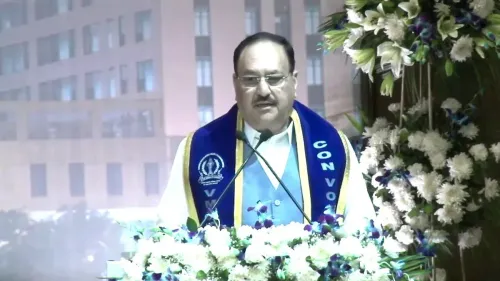
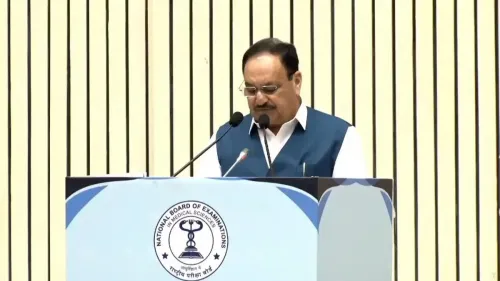
Union Health Minister J. P. Nadda told freshly minted doctors on November 18, 2026 that their success belongs to parents, teachers, and society, calling on them to repay that debt through dedicated, compassionate service — echoing the social-accountability framework at the core of India's medical education reform.
Key Takeaways
Union Health Minister J.
Nadda addressed medical graduates on November 18, 2026 , framing a doctor's success as a collective, not personal, achievement.
Nadda called on new doctors to 'give back by serving society with dedication, compassion, and excellence.' The National Medical Commission Act of 2019 replaced the Medical Council of India and embedded social accountability into India's medical education framework.
Indian health policy has consistently linked medical training to public-system service, including state-level rural posting requirements for fresh graduates.
India has expanded medical college seats significantly over the past decade, making the culture of service — not just seat count — a central policy concern.
Rollout of new National Medical Commission regulations and state rural-posting mandates remain active issues to watch for this cohort of graduates.
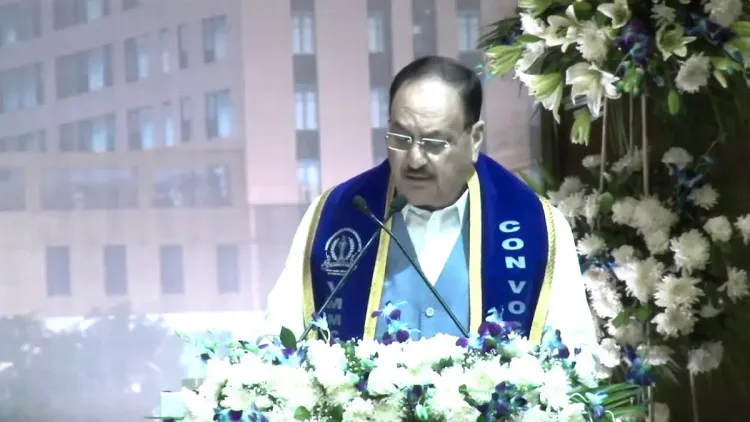
A debt is owed — and Union Health Minister J. P. Nadda wants every new doctor in India to remember exactly to whom. Addressing a gathering of fresh medical graduates on Wednesday, November 18, 2026, Nadda delivered a pointed reminder that a medical degree is not a personal trophy but a social contract, earned on the back of parents, teachers, and a community that invested in each graduate long before they ever held a stethoscope.
Nadda's message was direct: 'Your success is not yours alone; it is the result of the contributions of your parents, teachers, and everyone who has supported you, often behind the scenes.' The call to service — 'with dedication, compassion, and excellence' — framed the transition from student to physician not as a career milestone but as the opening of a lifelong obligation.
The Social Contract at the Heart of Indian Medical Education
Nadda's words land against a backdrop that is decades in the making. Indian health policy has long insisted that the making of a doctor is never purely private. The National Medical Commission Act of 2019, which replaced the old Medical Council of India, was built precisely around this premise — tying medical education reform to ethical practice, public accountability, and the expectation that graduates would serve communities, not just careers. The National Medical Commission now frames regulations with that compact in mind.
State governments have reinforced the message through rural-posting mandates and incentive structures designed to push fresh graduates toward underserved regions. The gap between where doctors are trained and where patients actually need them remains one of the sharpest fault lines in Indian healthcare — and it is new graduates who are expected to begin closing it.
Why This Moment Matters for India's Doctor Shortage
India has expanded medical seats aggressively over the past decade, adding hundreds of new colleges and thousands of new MBBS and postgraduate slots. But quantity without orientation is a half-measure. The ministry's consistent position — articulated again by Nadda on Wednesday — is that expansion must be matched by a culture of service, particularly in primary and rural health infrastructure where the burden of disease is heaviest and the shortage of trained hands is most acute.
Compassion, the minister stressed, is not soft language. It is the operational requirement of a healthcare system that serves more than a billion people across wildly unequal geographies and economic conditions. For the graduates in that hall, it was both inspiration and instruction.
India's medical graduates carry more than a degree when they walk out — they carry the weight of every public rupee spent building the system that trained them. The Minister just made sure they know it.
Point of View
The minister signals that the social-accountability clause in the National Medical Commission framework is not bureaucratic boilerplate but a lived expectation. The timing also matters: with fresh NMC regulations in the pipeline and state governments tightening rural-posting norms, reminding graduates of their obligations publicly sets a political and moral tone before those rules bite. Whether warm words at convocations translate into doctors choosing district hospitals over urban super-speciality clinics is the harder, more structural question India's health system still needs to answer.
NationPress
18 Nov 2026
Frequently Asked Questions
What did J. P. Nadda say to medical graduates on November 18, 2026?
Nadda told fresh medical graduates that their success belongs not only to them but to their parents, teachers, and all who supported them, urging them to give back to society through dedication, compassion, and excellence in their practice.
What is the National Medical Commission and how does it relate to doctor accountability?
The National Medical Commission (NMC) , established under the NMC Act of 2019, replaced the Medical Council of India. It regulates medical education and practice in India with an explicit focus on ethics and social accountability, requiring doctors to serve the public interest alongside pursuing professional careers.
Are fresh medical graduates in India required to serve in rural areas?
Many Indian states have rural or government-service posting requirements for fresh MBBS graduates, and the central government has promoted incentives to encourage doctors to work in underserved regions. These requirements are periodically updated under NMC guidelines.
Why does India stress the social accountability of doctors?
India faces a significant shortage of doctors in rural and semi-urban areas despite expanding medical college seats. Health policy has long held that because medical education is heavily subsidised by public funds, graduates carry an obligation to serve the communities and systems that made their training possible.
What is J. P. Nadda's current role in the Indian government?
J. P. Nadda serves as Union Minister of Health and Family Welfare and Minister of Chemicals and Fertilizers. He also holds the position of national president of the Bharatiya Janata Party (BJP).