Nadda: Govt health spending trebled, out-of-pocket costs at decade low

Synopsis
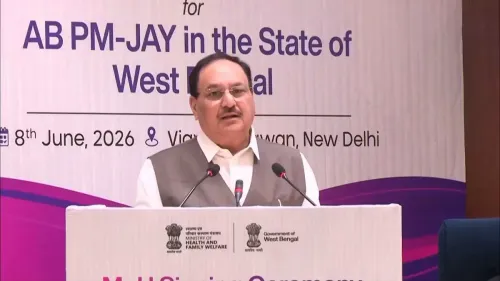
India's National Health Accounts 2023–24 show government health spending has trebled to ₹4.14 lakh crore over a decade, while the out-of-pocket expenditure share has fallen 21.5 percentage points to 42.7 percent, Union Health Minister J. P. Nadda said on 16 November 2026.
Key Takeaways
Government health expenditure rose from ₹1.30 lakh crore to ₹4.14 lakh crore — more than a threefold increase over a decade.
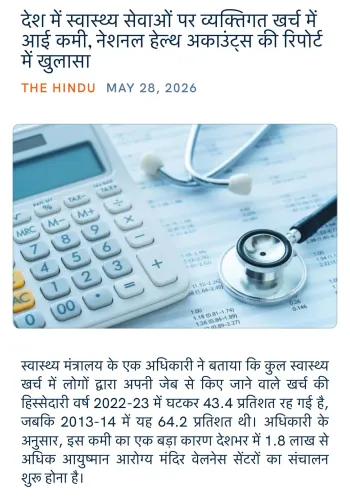
Out-of-pocket expenditure share fell from 64.2 percent to 42.7 percent , a drop of 21.5 percentage points .
Per capita government health spending nearly tripled, from ₹1,042 to ₹2,959 .
Primary healthcare investment trebled to ₹1.53 lakh crore in 2023–24 .
Ayushman Bharat , launched in 2018 , combines PM-JAY insurance cover of up to ₹5 lakh per family with free primary care through Ayushman Arogya Mandirs .
Health economists treat a sub-40 percent out-of-pocket share as a meaningful threshold for financial protection.
India's public health bill has more than tripled in a decade — and the share of medical costs that ordinary families must pay from their own pockets has fallen to its lowest recorded level. Union Health Minister J. P. Nadda cited the freshly released National Health Accounts 2023–24 on Monday, 16 November 2026, to chart what he called a 'decade of sustained efforts to make quality healthcare more affordable, accessible and inclusive.'
Four numbers that define a decade of health spending
The headline figures in the National Health Accounts 2023–24 are striking in their scale. Government health expenditure has climbed from ₹1.30 lakh crore to ₹4.14 lakh crore — a more-than-threefold rise. Per capita government spending has nearly trebled, moving from ₹1,042 to ₹2,959. And primary healthcare alone now absorbs ₹1.53 lakh crore annually, three times what it did a decade ago. The figure that will resonate most with households, though, is the out-of-pocket expenditure share. When a family has no coverage and falls ill, every rupee spent on doctors, medicines, and diagnostics comes directly from savings or borrowings. That share has dropped from 64.2 percent to 42.7 percent — a fall of 21.5 percentage points. In a country where a single hospitalisation has historically pushed millions below the poverty line, that shift is consequential.Ayushman Bharat's dual engine: insurance plus primary care
The architecture behind these numbers is Ayushman Bharat, the flagship programme launched in 2018 that pairs a hospitalisation insurance scheme with a nationwide network of upgraded primary facilities. The insurance arm — Pradhan Mantri Jan Arogya Yojana (PM-JAY) — provides eligible families with up to ₹5 lakh annual cover for secondary and tertiary care. The primary-care arm operates through Ayushman Arogya Mandirs, the renamed and expanded Health and Wellness Centres that now offer free consultations, diagnostics, and medicines at the community level. Nadda specifically credited PM Narendra Modi's leadership, pointing to 'initiatives like Ayushman Bharat, Ayushman Arogya Mandirs and expanded access to free medicines and diagnostics' as the delivery levers. The dual approach — financial protection for catastrophic illness alongside frontline primary care — is designed to address two distinct but linked vulnerabilities: the cost of getting sick and the cost of staying well.From NHA data to the next Budget: what sustains the trajectory
The National Health Accounts is an official annual compilation by the Ministry of Health and Family Welfare tracking public, private, and out-of-pocket health expenditure. Earlier editions from 2016–17 to 2021–22 had already recorded a steady upward trend in government spending and a gradual decline in the out-of-pocket share; the 2023–24 edition represents the most advanced data point in that series. The two variables to watch next are the health allocation in the forthcoming Union Budget and the pace at which additional Ayushman Arogya Mandirs become operational across states. If the spending trajectory holds and state-level uptake of PM-JAY deepens, India's out-of-pocket share could approach the sub-40 percent threshold that health economists often treat as a marker of meaningful financial protection. Nadda framed the ambition in direct terms: 'No family should have to choose between its health and its financial well-being.' A Swasth Bharat [Healthy India], he argued, is the foundation of a Viksit Bharat [Developed India]. The numbers now make the case for the slogan — the next Union Budget will show whether the momentum is a trend or a peak.Point of View
As cited by Nadda, provides the government with its most comprehensive numerical anchor for a decade-long healthcare narrative ahead of a Budget cycle. The near-halving of the out-of-pocket share is politically significant because it speaks directly to household economic security, not just aggregate health system capacity. The dual-track design of Ayushman Bharat — coupling insurance with primary care — reflects a deliberate effort to avoid the trap of pure insurance schemes that protect against catastrophic costs without addressing everyday care access. Whether these gains are distributed equitably across states and income deciles is the analytical question the NHA aggregates alone cannot answer.
NationPress
16 Nov 2026
Frequently Asked Questions
What is the National Health Accounts report in India?
The National Health Accounts is an official annual report compiled by the Ministry of Health and Family Welfare that tracks how much government, private entities, and households spend on healthcare, allowing trends in public investment and out-of-pocket costs to be measured over time.
What is out-of-pocket health expenditure and why does it matter?
Out-of-pocket expenditure is the share of total healthcare costs paid directly by households from their own funds, without insurance or government support. A high share — historically above 60 percent in India — can push families into debt or poverty when illness strikes.
What is Ayushman Bharat and what does it cover?
Ayushman Bharat, launched in 2018, has two components: Pradhan Mantri Jan Arogya Yojana, which offers eligible families up to ₹5 lakh annual insurance cover for hospitalisation, and Ayushman Arogya Mandirs, a network of community-level centres providing free primary care, diagnostics, and medicines.
How much has India's per capita government health spending increased?
According to the National Health Accounts 2023–24, per capita government health spending nearly tripled over the decade, rising from ₹1,042 to ₹2,959.
What does Viksit Bharat mean in the context of health policy?
'Viksit Bharat' means Developed India and is the government's overarching development vision for 2047. Health Minister Nadda has positioned a 'Swasth Bharat' — a Healthy India with reduced financial burden from illness — as a foundational prerequisite for achieving that larger goal.