Nadda Launches 11 New NBEMS Courses at 23rd Convocation
Synopsis
Union Health Minister J. P. Nadda addressed the 23rd NBEMS Convocation at Vigyan Bhawan on 23 May 2026, launching 11 new postgraduate medical courses and announcing NBEMS's inclusion in the One Nation One Subscription scheme to boost medical research access.
Key Takeaways
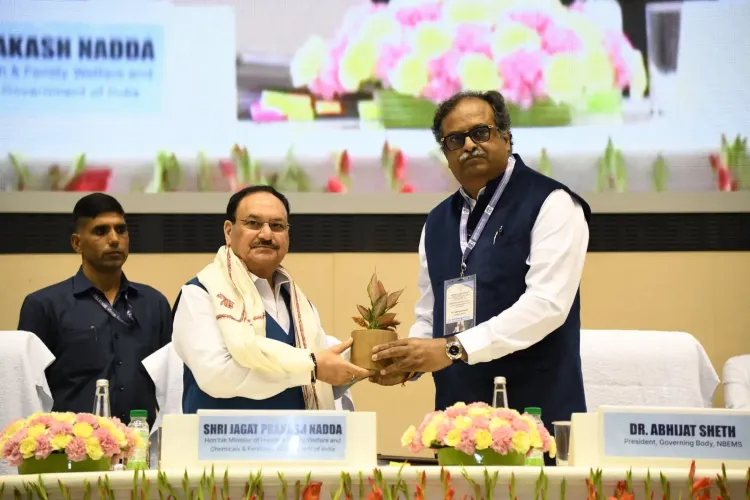
Nadda addressed the 23rd Convocation Ceremony of NBEMS at Vigyan Bhawan, New Delhi on 23 May 2026 .
11 new courses were launched under NBEMS, aimed at strengthening patient care and specialist availability.
NBEMS has been enrolled as a partner institution under the One Nation One Subscription scheme, expanding research journal access for affiliated institutions.
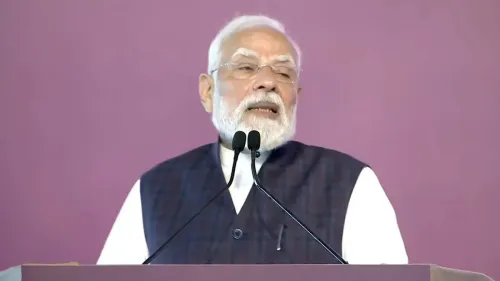
The minister linked the announcements to 12 years of medical education reform under PM Narendra Modi and the Viksit Bharat 2047 national vision.
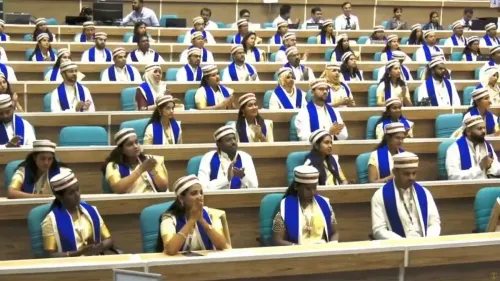
Graduating students were urged to serve society with dedication and strengthen healthcare services across India.
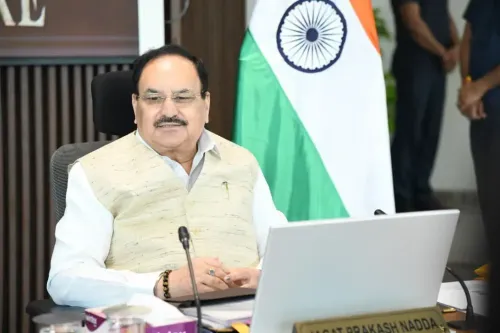
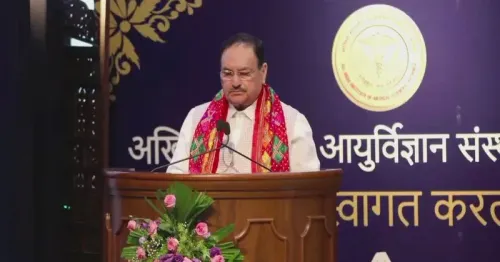
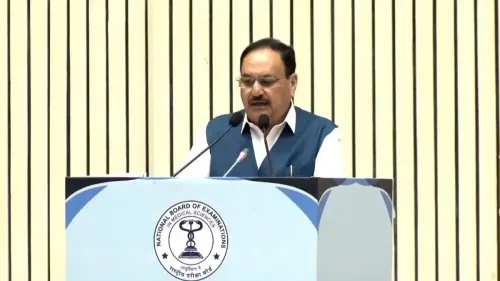
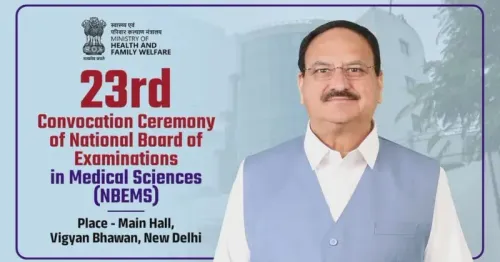
Union Health Minister J. P. Nadda addressed the 23rd Convocation Ceremony of the National Board of Examinations in Medical Sciences (NBEMS) at Vigyan Bhawan, New Delhi, on Saturday, 23 May 2026, marking a significant step in India's postgraduate medical education landscape.
What Was Announced
At the ceremony, 11 new courses were formally launched under the NBEMS framework. The minister stated that these courses 'will significantly strengthen patient care and contribute greatly to the welfare of the society.' The convocation also served as a platform to congratulate graduating students and urge them to 'serve society with dedication and contribute towards strengthening healthcare services in the nation.'
NBEMS has additionally been enrolled as a partner institution under the One Nation One Subscription scheme, a central government initiative that provides academic and research institutions across India with access to scholarly journals and publications. The move is expected to expand research and innovation capacity within the medical education ecosystem.
Context
The National Board of Examinations in Medical Sciences is an autonomous body under the Ministry of Health and Family Welfare, responsible for setting and administering postgraduate medical examinations and maintaining training standards across specialisations. Its annual convocation marks the formal recognition of candidates who have cleared board-level assessments.
The One Nation One Subscription scheme extends the government's access-equity logic — already applied in scientific and engineering research domains — to clinical and biomedical fields. NBEMS's inclusion as a partner institution signals an intent to bring its affiliated training centres into a broader national research infrastructure.
Policy Backdrop
Nadda linked the day's announcements to a wider arc of health-sector reform, stating that 'in the last 12 years unprecedented progress has been made in the field of medical education under the dynamic leadership' of Prime Minister Narendra Modi. Since 2014, the government has pursued successive rounds of approvals for new medical colleges and expanded postgraduate intake, alongside the passage of the National Medical Commission Act, 2019, which replaced the Medical Council of India to modernise regulatory oversight.
The minister also explicitly tied the health sector's trajectory to the government's flagship national vision: 'Healthy India is a key to achieve the goal of Viksit Bharat by 2047.' The Viksit Bharat 2047 framework — India's ambition to attain developed-country status by the centenary of independence — positions health workforce development and research capacity as instruments of broader national progress.
Stakeholders and Impact
The immediate beneficiaries of the 11 new courses are postgraduate medical aspirants and the institutions affiliated with NBEMS, who will gain new specialisation pathways. Patients stand to benefit downstream as a more diversified specialist workforce enters the healthcare system.
For the research community, NBEMS's entry into One Nation One Subscription means that faculty and students at affiliated centres may gain access to peer-reviewed international journals without institutional subscription costs — a barrier that has historically limited evidence-based practice in smaller or newer training hospitals.
What's Next
The key milestones to watch are the roll-out timeline and curriculum notifications for the 11 new NBEMS courses in the 2026-27 academic year, as well as formal health ministry or regulatory notifications confirming journal-access activation for NBEMS-affiliated institutions under One Nation One Subscription. How quickly the new courses attract enrolments and whether they address identified specialist shortages in underserved regions will be a measure of their real-world impact.
Frequently Asked Questions
What is NBEMS and why is its convocation significant?
The National Board of Examinations in Medical Sciences (NBEMS) is an autonomous body under India's Ministry of Health and Family Welfare that conducts postgraduate medical examinations and sets training standards. Its annual convocation formally certifies candidates who have cleared board-level assessments, making it a key milestone in a specialist doctor's career.
What are the 11 new courses launched at the NBEMS convocation?
11 new courses were launched at the 23rd NBEMS Convocation on 23 May 2026 . Specific titles and specialisations of these courses had not been officially notified at the time of reporting and are expected to be detailed in subsequent health ministry or NBEMS circulars.
What is the One Nation One Subscription scheme?
One Nation One Subscription is a central government initiative that provides academic and research institutions across India with access to international scholarly journals and publications, removing the need for individual institutional subscriptions. NBEMS was announced as a new partner institution under this scheme on 23 May 2026 .
How does this relate to Viksit Bharat 2047?
Viksit Bharat 2047 is India's national vision to achieve developed-country status by the centenary of independence. Union Health Minister J. P. Nadda stated that 'Healthy India is a key to achieve the goal of Viksit Bharat by 2047,' framing medical education expansion and research access as enablers of that broader goal.
Where was the NBEMS convocation held?
The 23rd Convocation Ceremony of NBEMS was held at Vigyan Bhawan, New Delhi , on Saturday, 23 May 2026 , and was addressed by Union Health Minister J. P. Nadda .