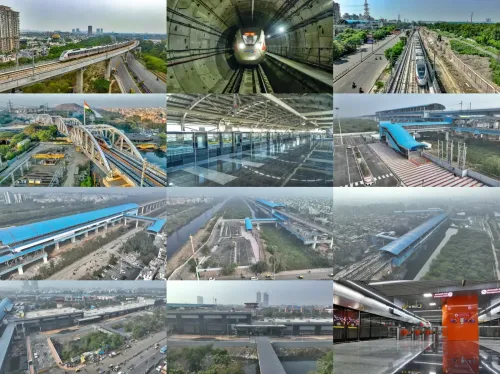
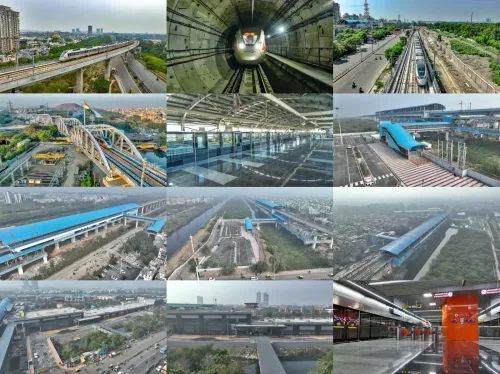
Namo Bharat hits record 1.25 lakh riders in a single day on Delhi-Meerut corridor
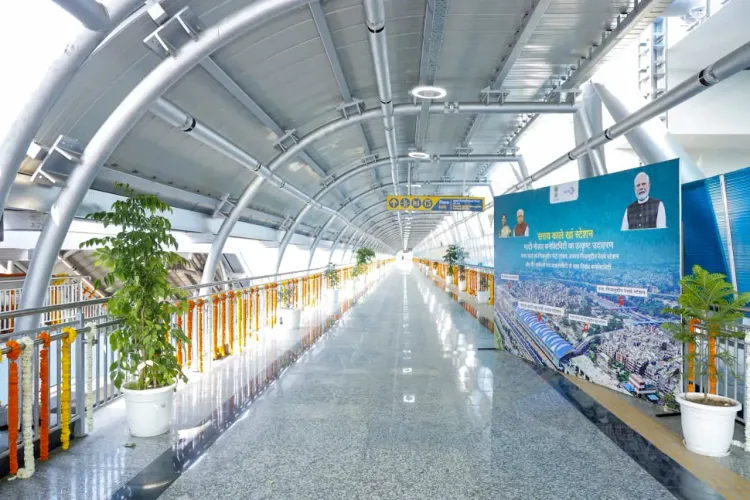
Synopsis
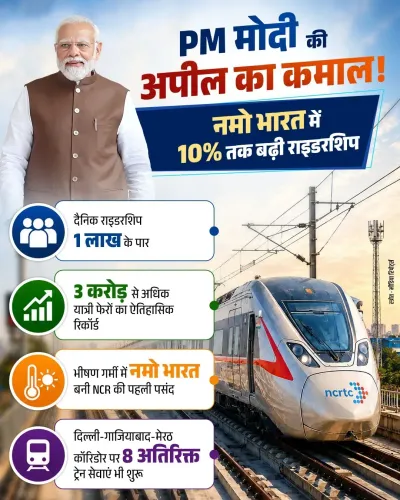
Namo Bharat just hit 1,25,500 riders in a single day — its highest ever — on the Delhi-Meerut corridor, running at 99% punctuality while Delhi bakes at 45°C. With a daily average already at 1 lakh, this isn't a spike; it's a trend line that is quietly rewriting how NCR commutes.
Key Takeaways
Namo Bharat recorded 1,25,500 commuters on 9 June — its highest-ever single-day ridership on the Delhi-Ghaziabad-Meerut corridor.
The corridor's average daily ridership stands at around 1 lakh commuters .
Train operations maintain approximately 99 per cent punctuality, a key driver of commuter preference.
Sarai Kale Khan , New Ashok Nagar , Anand Vihar , Ghaziabad , and Begumpul together account for more than 40 per cent of total ridership.
A heatwave with temperatures between 40 and 45°C and rising fuel costs are accelerating the shift from private vehicles to the air-conditioned service.
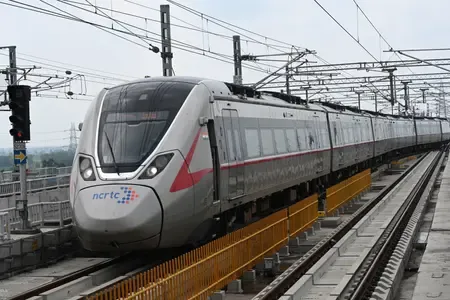
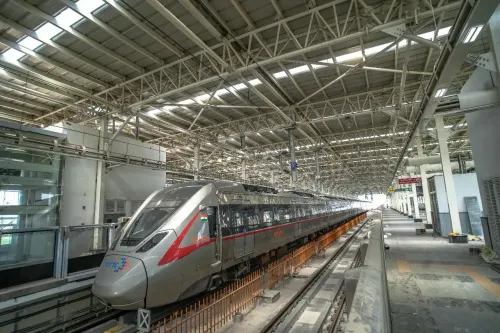
The Delhi-Ghaziabad-Meerut Namo Bharat corridor logged its highest-ever single-day ridership on Monday, 9 June, with approximately 1,25,500 commuters travelling the route in one day, according to an official statement. The milestone signals a decisive shift in commuter preference across the National Capital Region (NCR), with growing numbers choosing the rapid rail service over road travel.
Record Ridership and Daily Averages
While the 9 June figure of 1,25,500 marks a new peak, the corridor already sustains an average daily footfall of around 1 lakh commuters, according to officials. The record represents a jump of roughly 25% above that baseline — a sign that demand is accelerating, not merely holding steady.
Officials attributed the surge to the corridor's near-perfect punctuality record, with train operations maintaining approximately 99 per cent on-time performance. For office-goers and students who depend on reliable schedules, that consistency is increasingly making Namo Bharat the default choice over congested road routes.
Busiest Stations and Connectivity
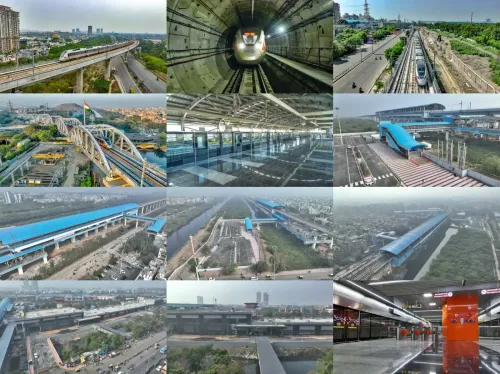
Five stations account for a disproportionate share of the traffic. Sarai Kale Khan, New Ashok Nagar, and Anand Vihar in Delhi, along with Ghaziabad and Begumpul in Meerut, collectively handle more than 40 per cent of total ridership. Their popularity stems from seamless interchange options — each connects to the Delhi Metro, Indian Railways, Inter-State Bus Terminal (ISBT) services, and city buses, making them genuine multi-modal hubs.
Notably, local Metro services operating on the same Namo Bharat infrastructure within Meerut have also improved intra-city mobility, creating a rare dual-purpose corridor that serves both regional and hyperlocal commuters on the same tracks.
Heatwave Tailwind and Affordability Factor
External conditions have given ridership an additional push. With Delhi-NCR temperatures ranging between 40 and 45 degrees Celsius amid a prevailing heatwave, the fully air-conditioned Namo Bharat trains are offering a tangible comfort advantage over road-based alternatives. Officials noted that the climate-controlled environment is drawing commuters who might otherwise have used private vehicles.
Rising fuel prices are reinforcing that calculus. The system is emerging as an affordable mass-transit option, and officials say it is contributing to a measurable shift toward more environmentally sustainable travel patterns in a region long dominated by private car and two-wheeler use.
What This Means for NCR Transit
The Namo Bharat corridor is part of India's broader Regional Rapid Transit System (RRTS) programme, designed to stitch together the sprawling NCR with high-speed, high-frequency rail links. The ridership trajectory — from launch to a 1 lakh daily average and now a 1.25 lakh peak — suggests the model is finding genuine traction among daily commuters, not just occasional users.
With additional RRTS corridors under development, the Delhi-Meerut stretch is being watched as a proof-of-concept for whether rapid regional rail can meaningfully shift modal share in India's most congested urban belt. If ridership momentum holds through the monsoon season and beyond, it will strengthen the case for accelerated investment in the remaining phases.
Point of View
Not just capturing distress riders. The 99% punctuality figure is the real differentiator; Indian commuters have historically been conditioned to absorb delays, and a system that breaks that expectation earns loyalty fast. The harder question is whether the infrastructure investment and fare structure are calibrated to scale this model to the next RRTS corridors — because if the Delhi-Meerut proof-of-concept stalls at the replication stage, the record ridership numbers will remain a data point rather than a turning point.
NationPress
19 Sept 2026
Frequently Asked Questions
What is the Namo Bharat ridership record set on 9 June?
The Delhi-Ghaziabad-Meerut Namo Bharat corridor recorded approximately 1,25,500 commuters in a single day on 9 June, its highest-ever daily ridership figure. The corridor's average daily ridership is around 1 lakh commuters.
Why is Namo Bharat ridership growing so rapidly?
Officials cite near-99% punctuality, full air-conditioning during a severe heatwave, seamless multi-modal connectivity at key stations, and rising fuel prices as the main factors driving commuter preference toward Namo Bharat over road travel.
Which are the busiest stations on the Namo Bharat corridor?
Sarai Kale Khan, New Ashok Nagar, and Anand Vihar in Delhi, along with Ghaziabad and Begumpul in Meerut, are the corridor's busiest stations. Together they account for more than 40% of total ridership, largely because of their interchange connections with Metro, Indian Railways, and bus services.
What is the Namo Bharat corridor and how does it work?
Namo Bharat is India's first Regional Rapid Transit System (RRTS) corridor, connecting Delhi, Ghaziabad, and Meerut with high-speed, high-frequency trains. It also hosts local Metro services within Meerut on the same infrastructure, enabling both regional and intra-city travel on a single corridor.
How does the heatwave affect Namo Bharat ridership?
With Delhi-NCR temperatures between 40 and 45 degrees Celsius, the fully air-conditioned Namo Bharat trains offer a significant comfort advantage over road-based and non-air-conditioned alternatives, which officials say is contributing to the recent ridership surge.