Northeast Frontier Railway Accelerates Electrification in Northeast and Eastern States for FY 2025–26
Synopsis
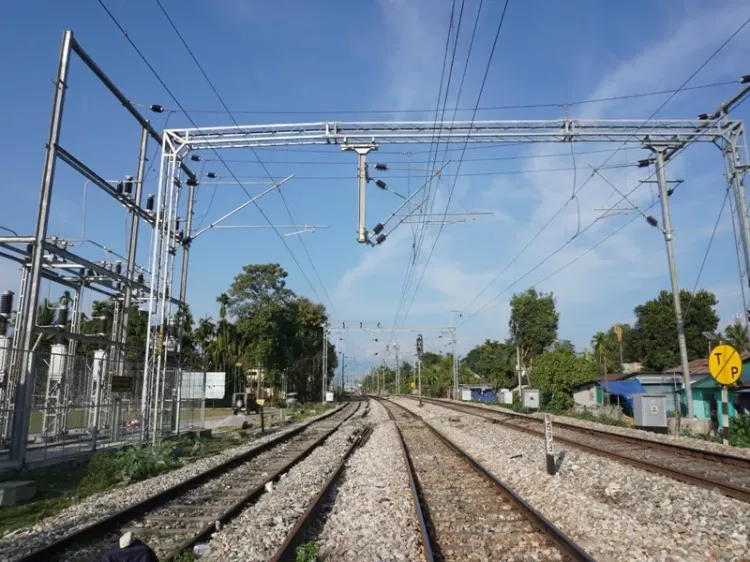
Northeast Frontier Railway (NFR) has made impressive advancements in railway electrification, covering significant routes in Assam, West Bengal, Bihar, Tripura, and Arunachal Pradesh during FY 2025–26. This initiative aims to enhance sustainability and reduce dependence on fossil fuels.
Key Takeaways
NFR achieved significant electrification milestones in FY 2025–26.
1,342.18 RKM and 1,828.42 TKM were electrified.
The Tinsukia Division was the leading contributor to electrification.
Electrification enhances sustainability and reduces fuel dependency.
NFR is committed to completing electrification across its entire zone.
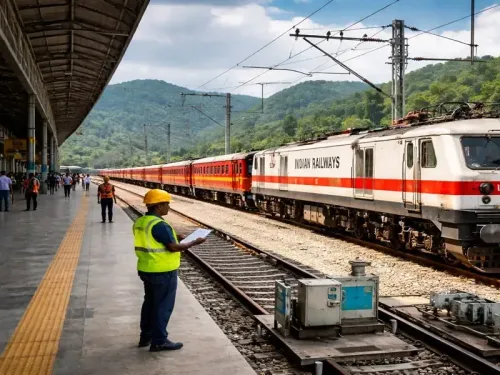
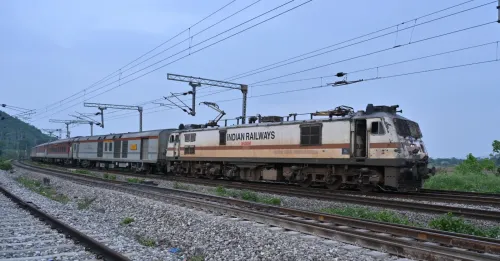
Guwahati, March 28 (NationPress) The Northeast Frontier Railway (NFR) has made remarkable strides in railway electrification throughout the financial year 2025–26, enhancing essential routes across Assam, West Bengal, Bihar, Tripura, and Arunachal Pradesh, as reported by officials on Saturday.
The Chief Public Relations Officer of NFR, Kapinjal Kishore Sharma, highlighted that these accomplishments represent a significant leap toward sustainable, energy-efficient, and modern rail operations in the region. This initiative not only boosts connectivity but also lessens reliance on traditional fuel-based systems.
He noted that this electrification campaign is part of the Indian Railways' overarching goal of achieving 100% electrification, enhancing operational efficiency, and increasing train handling capacity across the network.
According to Sharma, in FY 2025–26, NFR successfully accomplished electrification over 1,342.18 route kilometres (RKM) and 1,828.42 track kilometres (TKM) within its jurisdiction, which includes significant sections in Assam, West Bengal, Bihar, Tripura, and Arunachal Pradesh.
This substantial advancement has greatly enhanced rail connectivity in the Northeast and its surrounding regions, facilitating seamless electric traction operations, he remarked.
Division-wise, notable progress has been recorded across all NFR divisions.
The Tinsukia (TSK) Division in Assam emerged as the leading contributor, achieving 663.59 RKM and 855.48 TKM electrified, which accounts for nearly half of the year's total electrification efforts. Key routes electrified in the TSK Division include crucial segments like Mariani–Simaluguri, Simaluguri–Dibrugarh, Duliajan–New Tinsukia, and North Lakhimpur–Dhamalgaon, essential for both passenger and freight movement in Upper Assam.
In the Rangiya (RNY) Division, also in Assam, the second-highest progress was recorded with 348.92 RKM and 535.43 TKM, focusing on vital sections like Rangapara–Harmuty and Harmuty–Naharlagun, thereby enhancing connectivity to Arunachal Pradesh.
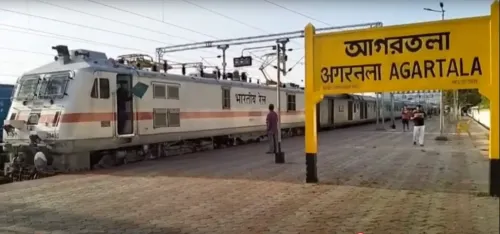
The Lumding (LMG) Division electrified 124.70 RKM and 197.38 TKM, including the important Agartala–Sabroom section in Tripura, which significantly improves connectivity in southern Northeast.
The Katihar (KIR) Division in Bihar accomplished electrification of 108.62 RKM and 130.83 TKM, while the Alipurduar (APDJ) Division in West Bengal added 96.36 RKM and 109.30 TKM, covering essential sections in Bihar and north Bengal, respectively.
Sharma stated that the electrification of these lines will expedite train operations by decreasing reliance on fossil fuels, reducing maintenance costs, and promoting environmental sustainability. It will also enhance line capacity, punctuality, and reliability of train services throughout the region.
With these milestones, the Northeast Frontier Railway has now electrified approximately 4,170.19 route kilometres and 6,690.38 track kilometres overall.
NFR remains dedicated to finalizing electrification efforts across the entire zone, contributing to Indian Railways' mission of achieving 100% electrification of its broad-gauge network, Sharma affirmed.
The Northeast Frontier Railway, headquartered at Maligaon near Guwahati, operates across the Northeastern states and in seven districts of West Bengal and five districts of north Bihar.
Point of View
Environmentally friendly rail transport in the region. These advancements are expected to improve operational efficiency and connectivity, aligning with the Indian Railways' vision of complete electrification.
NationPress
7 Oct 2026
Frequently Asked Questions
What areas are covered by the NFR electrification initiative?
The NFR electrification initiative covers vital sections across Assam, West Bengal, Bihar, Tripura, and Arunachal Pradesh.
What is the total electrification achieved by NFR so far?
NFR has cumulatively electrified approximately 4,170.19 route kilometres and 6,690.38 track kilometres.
What are the benefits of railway electrification?
Railway electrification leads to faster train operations, reduced reliance on fossil fuels, lower maintenance costs, and improved environmental sustainability.
Which division of NFR performed the best in electrification?
The Tinsukia Division in Assam was the top performer, contributing 663.59 RKM and 855.48 TKM of electrification.
Why is electrification important for the NFR?
Electrification is crucial for enhancing operational efficiency, improving train handling capacity, and achieving the Indian Railways' goal of 100% electrification.