CM Majhi adds 10,372 higher-education seats in Odisha
Synopsis
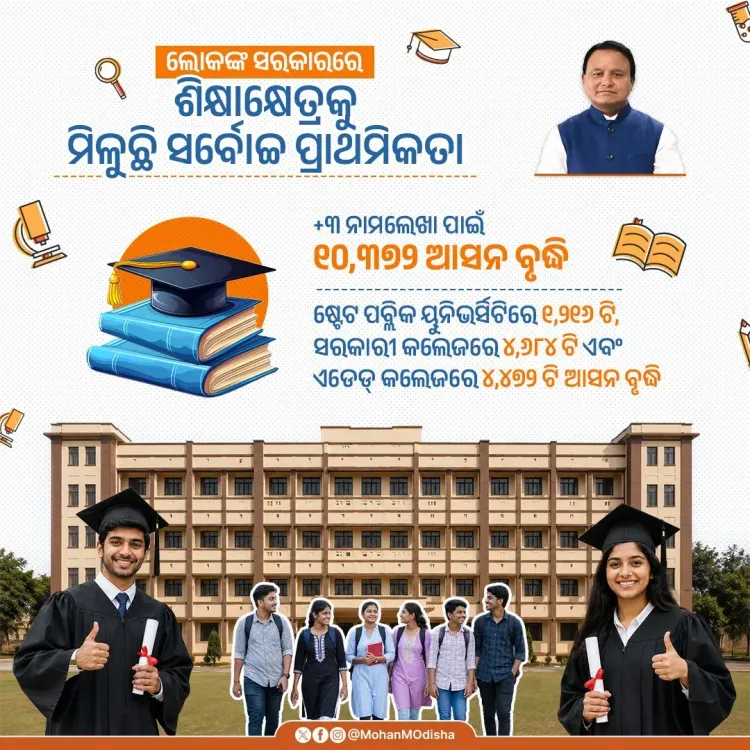
Odisha Chief Minister Mohan Charan Majhi announced 10,372 new undergraduate seats for +3 enrolment on 22 June 2026, marking two years of his government's focus on higher-education expansion and youth empowerment in the state.
Key Takeaways
10,372 new seats have been created for +3 (undergraduate) enrolment in Odisha's colleges and universities.
The announcement was made by Chief Minister Mohan Charan Majhi on 22 June 2026 , coinciding with the BJP government's second anniversary in office.
CM Majhi framed the expansion as a step toward building a knowledge-based, prosperous Odisha and empowering the state's youth.
The move aligns with national targets under the National Education Policy 2020 to raise the gross enrolment ratio in higher education.
Practical impact will depend on accompanying investments in faculty recruitment , infrastructure, and equitable distribution of seats across districts.
Odisha Chief Minister Mohan Charan Majhi announced on Monday, 22 June 2026 that his government has created 10,372 new seats for +3 (undergraduate) enrolment across the state, marking a significant expansion of higher-education access for Odisha's youth. The announcement came as the government marked two years in office, with the Chief Minister framing the move as a foundational step toward building a knowledge-based, prosperous Odisha.
Context
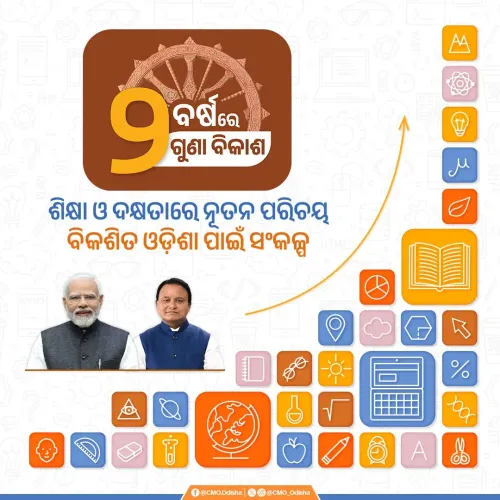
Posting in Odia on X (formerly Twitter), CM Majhi wrote: 'ସଶକ୍ତ ଯୁବଶକ୍ତି, ସମୃଦ୍ଧ ଓଡ଼ିଶାର ଭିତ୍ତି' — 'Empowered youth are the foundation of a prosperous Odisha.' He stated that the 'people's government' (ଲୋକଙ୍କ ସରକାର) has broadened higher-education opportunities by creating 10,372 new seats for +3 enrolment, calling it 'yet another firm step towards building a bright future for the younger generation and a knowledge-driven, prosperous Odisha.' The post carried hashtags #2YearsofLokankaSarakar, #BikasharaDharaOdishaSara, and #2YearsOfShikshaSanskara, signalling the announcement was timed to the government's second anniversary.
Policy Backdrop
The seat expansion sits within the framework of the National Education Policy (NEP) 2020, which set national targets to raise the gross enrolment ratio in higher education and expand institutional capacity across Indian states. Odisha, an eastern state with a large youth population, has seen successive governments invest in undergraduate college infrastructure as a development priority.
Following the 2024 Odisha Assembly elections, the BJP government under CM Majhi identified education expansion as a core pillar of its governance agenda. The +3 programme — the three-year undergraduate degree offered through Odisha's colleges and universities — is the primary entry point to higher education for the state's higher-secondary graduates, making seat capacity a direct determinant of access.
Stakeholders and Impact
The most immediate beneficiaries are Odisha's higher-secondary graduates seeking undergraduate admission in the upcoming academic cycle. Increased seat availability can reduce the pressure of cut-throat competition for limited college places, particularly in districts where government college infrastructure has historically been thin.
Broader stakeholders include higher education institutions across the state, which will need to absorb the new intake, and faculty and administrative staff, whose recruitment and training will determine whether the expanded seats translate into quality education. State-level education planners will also be watching whether the seat addition is accompanied by commensurate investment in classrooms, laboratories, and digital infrastructure.
What's Next
The practical test of this announcement will come during the next +3 admission cycle, when students and institutions will see how the new seats are distributed across colleges and districts. Observers will look for accompanying announcements on faculty recruitment, infrastructure upgrades, and whether any new colleges are being established or existing ones expanded. The government's use of the second-anniversary milestone to publicise this move suggests further education-sector announcements may follow as part of the #2YearsOfShikshaSanskara campaign. If the seat additions are backed by sustained resource allocation, they could meaningfully raise Odisha's gross enrolment ratio in higher education — a benchmark tracked under the NEP 2020 framework.
Point of View
Low-friction deliverable: it produces a concrete number that signals intent without immediately requiring the harder institutional work of faculty hiring or quality assurance. The move tracks a pattern seen across Indian states post-2023, where new governments in power use education-access metrics as early proof-of-governance. The real policy test will be whether the seat addition is matched by resource allocation, or remains a headline figure that outpaces ground-level capacity.
NationPress
21 Sept 2026
Frequently Asked Questions
How many new college seats has the Odisha government created?
The Odisha government, under Chief Minister Mohan Charan Majhi, has created 10,372 new seats for +3 (undergraduate) enrolment across the state's colleges and universities.
What is the +3 programme in Odisha?
The +3 programme refers to the three-year undergraduate degree offered by colleges and universities in Odisha, and is the primary route to higher education for students who have completed higher secondary (Class 12) schooling.
When did Mohan Charan Majhi become Chief Minister of Odisha?
Mohan Charan Majhi became Chief Minister of Odisha in June 2024 after the BJP won the Odisha Assembly elections, ending over two decades of BJD rule in the state.
How does Odisha's seat expansion relate to NEP 2020?
The National Education Policy 2020 set targets to raise India's gross enrolment ratio in higher education. Odisha's addition of new undergraduate seats is aligned with this national goal of expanding access to college-level education.
What should students watch for after this announcement?
Students should track the official +3 admission cycle notifications from Odisha's higher education department, which will detail how the new seats are distributed across colleges and districts, along with any changes to the application process.