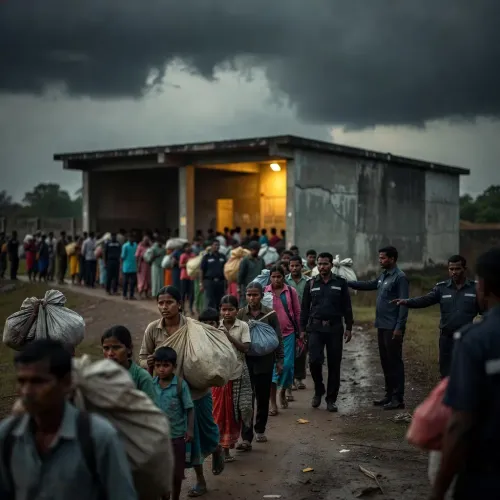
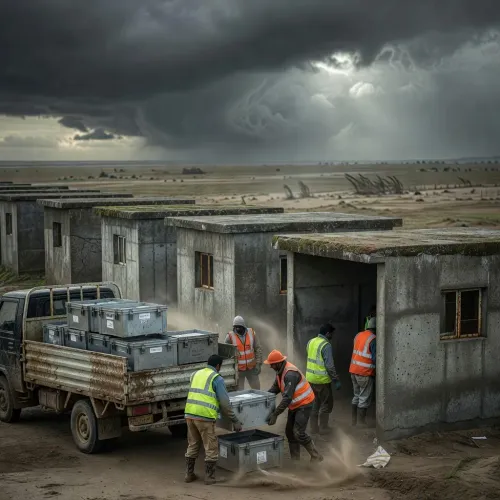
Odisha CMO: Gajapati on high alert for incoming cyclone

Synopsis
The Chief Minister's Office of Odisha has detailed full-scale cyclone preparedness in Gajapati district: 512 shelters activated, 35,000 capacity, continuous river monitoring on the Bansadhara and Mahendratanaya, medical teams on standby, and senior officers deployed to every block ahead of an approaching cyclonic system.
Key Takeaways
512 alternative shelter sites identified in Gajapati district, alongside 6 permanent cyclone-and-flood shelters with a combined capacity of approximately 35,000 people .
The Bansadhara River is under continuous monitoring; the Mahendratanaya River is currently well below warning and danger thresholds.
Public announcement systems are broadcasting safety alerts; medical teams are pre-positioned for emergency deployment.
Road and bridge restoration following cyclone 'Arnab' is described as largely complete, keeping evacuation routes open.
Schools and anganwadi centres remain operational; their status will be reviewed based on the next two-day rainfall forecast .
Senior officers have been deployed to every block in Gajapati, with response teams active at block and gram panchayat levels.
With a cyclone bearing down on the Odisha coast, Gajapati district is on full emergency footing — 512 alternative shelter sites identified, medical teams pre-positioned, and senior officers deployed to every block as the state's disaster machine shifts into high gear. The Chief Minister's Office of Odisha detailed the preparedness measures on Monday, 2 November 2026, painting a district-by-district picture of readiness against the approaching system.
512 shelters, 35,000 beds: the scale of Gajapati's evacuation net
The district administration has identified 512 alternative safe shelter sites and activated 6 permanent cyclone-and-flood shelters, with a combined holding capacity of approximately 35,000 people. The numbers reflect a shelter network built painstakingly since the devastating 1999 Super Cyclone, which reshaped Odisha's entire approach to coastal disaster management and remains the benchmark against which every preparedness drill is measured.
Gajapati — a predominantly tribal, hilly district in southern Odisha — sits squarely on the Bay of Bengal's cyclone track and has historically faced compound hazards: storm winds from the coast amplified by river flooding from inland ranges. Getting 35,000 people into safe structures before a system makes landfall is not a statistic; it is the difference between survival and tragedy.
Bansadhara and Mahendratanaya: rivers under constant watch
Two river corridors are under continuous surveillance. The Bansadhara River, a persistent flood risk during cyclonic rains, is being monitored in real time. The Mahendratanaya River's water level is currently described as well below both the warning and danger thresholds — a relief, though forecasters are clear that heavy rainfall from the approaching system could change that rapidly.
Block-level teams and gram panchayat-level responders are already operational across every administrative unit in the district, ensuring that any sudden rise in river levels triggers an immediate ground response rather than a chain of phone calls up a bureaucratic ladder.
Post-cyclone 'Arnab' repairs and the next 48 hours
The update also notes that restoration of roads and bridges damaged by cyclone 'Arnab' is 'largely complete' — a crucial detail, since blocked evacuation routes in a second storm would be catastrophic. Public awareness drives are underway through public announcement systems, and medical teams stand ready for emergency deployment.
Schools and anganwadi centres remain open for now, but the administration has flagged that their status will be reviewed based on rainfall accumulation and the two-day weather forecast — a calibrated, evidence-led call that avoids both unnecessary disruption and unnecessary risk.
Odisha has turned its hard-won disaster management expertise into a model studied across South Asia. The question for the next 48 hours is whether the system tracks as forecast — and whether that shelter capacity of 35,000 is enough.
Point of View
Successive state governments have institutionalised pre-landfall mobilisation as standard operating procedure rather than reactive scramble. The granular detail in today's update — specific shelter counts, named rivers tracked against precise thresholds, confirmation that post-'Arnab' road repairs are done — signals administrative depth, not just optics. The 48-hour school-closure trigger tied explicitly to forecast data is a mature, evidence-based refinement of earlier blanket shutdowns. Whether the shelter count of 35,000 proves sufficient will depend on the system's final track, and that will be the real test of Odisha's much-lauded model.
NationPress
2 Nov 2026
Frequently Asked Questions
How many cyclone shelters are ready in Gajapati district?
Gajapati district has identified 512 alternative safe shelter sites and has 6 permanent cyclone-and-flood shelters operational, with a combined capacity of roughly 35,000 people , according to the Chief Minister's Office of Odisha.
Is the Bansadhara river in flood danger right now?
The Bansadhara River is under continuous monitoring. The Mahendratanaya River's level is currently well below both the warning and danger thresholds, though authorities are watching both waterways closely given the approaching cyclonic system.
Are schools open in Gajapati during the cyclone alert?
Yes, schools and anganwadi centres in Gajapati remain open as of 2 November 2026. The administration has said a decision on their continued operation will be taken based on rainfall amounts and the two-day weather forecast.
What is cyclone Arnab and has Odisha recovered from it?
Cyclone 'Arnab' is a recent cyclonic system that caused road and bridge damage in Odisha. The Chief Minister's Office stated on 2 November 2026 that major road and bridge restoration work following 'Arnab' is largely complete.
How is Odisha managing disaster response at the local level in Gajapati?
Senior officers have been deployed to every block in Gajapati district, with dedicated response teams formed and operational at both block and gram panchayat levels to ensure rapid on-ground coordination during the cyclone threat.