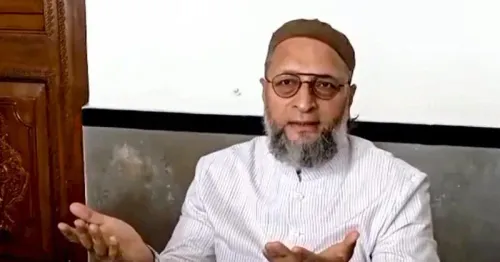
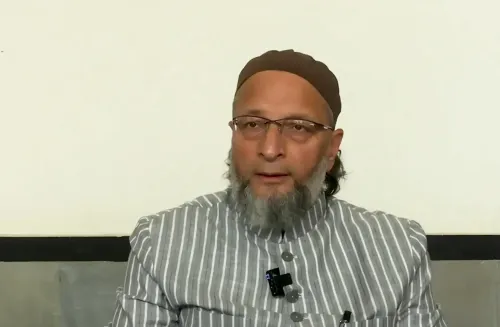
Owaisi: Action on culprits fine, but what about victims?
Synopsis
AIMIM president Asaduddin Owaisi on 29 July 2026 questioned what justice means for those killed or left without a future, insisting that action against perpetrators must be paired with concrete relief for victims — a gap he has repeatedly flagged in Parliament.
Key Takeaways
Owaisi posted on 29 July 2026 asking what becomes of victims whose futures were destroyed or who died, even after perpetrators face action.
His post in Hindi reads: 'Action against the guilty is fine; but what about those whose futures were destroyed and those who died?' The Hyderabad MP has a consistent record of demanding victim compensation and rehabilitation alongside criminal accountability.
India lacks a uniformly enforced national victim-compensation statute; court-ordered relief under existing law is widely seen as inadequate.
AIMIM may follow up with parliamentary questions or proposals on formal victim-relief mechanisms.
Punishing the guilty is necessary — but it is not enough. AIMIM president Asaduddin Owaisi sharpened that distinction on Wednesday, 29 July 2026, demanding accountability not just for perpetrators but for those whose lives were shattered or lost in the process.
Posting on X, Owaisi said — 'दोषियों पर कार्रवाई ठीक; जिनका भविष्य बर्बाद हुआ और जिनकी मौत हुई, उनका क्या' — 'Action against the guilty is fine; but what about those whose futures were destroyed and those who died?' The question, brief and pointed, cuts to a gap that legal proceedings in India routinely leave open: the fate of victims once the headlines move on.
A pattern Owaisi keeps returning to
This is not a one-off intervention. The Hyderabad MP has consistently argued, across incidents ranging from police action to communal violence, that criminal justice cannot be complete if it stops at conviction. Compensation, rehabilitation, and formal recognition of loss — these, in his framing, are the unfinished business of accountability. The logic has a straightforward political and moral force: a family that loses its breadwinner to state or non-state violence is not made whole by a chargesheet. A young person whose education or livelihood is destroyed mid-incident does not recover because a court hands down a sentence. Owaisi's post forces that uncomfortable arithmetic into public view.Why victim relief remains a legislative blind spot
India has no comprehensive, uniformly enforced victim-compensation statute. The Code of Criminal Procedure and its successor legislation allow courts to order compensation, but implementation is patchy and amounts are often nominal. Successive parliamentary sessions have seen calls — including from AIMIM — for a dedicated victim-relief framework, without a conclusive legislative outcome. Owaisi's framing here suggests a possible follow-up: a push in Parliament for clearer mechanisms, whether through a private member's bill or direct questions to the government on existing relief disbursement. Watch for AIMIM's next move on this front. The two-part test Owaisi is applying — punish the perpetrator, restore the victim — is simple enough to state and hard enough to ignore. Until both halves are answered, he is arguing, justice remains half-done.Point of View
He frames accountability as a two-part test — a framing that appeals well beyond his core constituency to anyone who has watched a case close with a conviction while affected families receive nothing. The absence of a robust national victim-compensation law gives his argument structural credibility, not just rhetorical force. If AIMIM follows this with a concrete legislative proposal, it could pressure the government to defend — or improve — the existing patchwork of relief mechanisms.
NationPress
29 Jul 2026
Frequently Asked Questions
What did Owaisi say about victims and culprits on 29 July 2026?
Owaisi posted on X saying that while action against the guilty is fine, the question remains: what happens to those whose futures were destroyed or who lost their lives? He demanded that victim relief be treated as an equal part of accountability.
What is AIMIM's position on victim compensation in India?
AIMIM, led by Owaisi, has consistently argued that punishing perpetrators is insufficient without formal compensation and rehabilitation for victims, particularly in cases involving police action or communal violence.
Does India have a law for victim compensation in criminal cases?
India's criminal procedure law allows courts to order compensation for victims, but there is no comprehensive, uniformly enforced national victim-compensation statute, and awarded amounts are often seen as inadequate.
Why does Owaisi frequently raise victim-relief issues in Parliament?
As a vocal opposition MP from Hyderabad, Owaisi has made legal accountability and minority rights a central part of his parliamentary work, regularly questioning whether justice systems adequately address the suffering of victims and their families.
What could AIMIM do next on victim compensation?
AIMIM may follow Owaisi's post with parliamentary questions, a private member's bill, or formal demands for the government to report on the disbursement of existing victim-relief funds.