Jal Shakti Minister Paatil Hails SBM-G's 12-Year Sanitation Gains

Synopsis
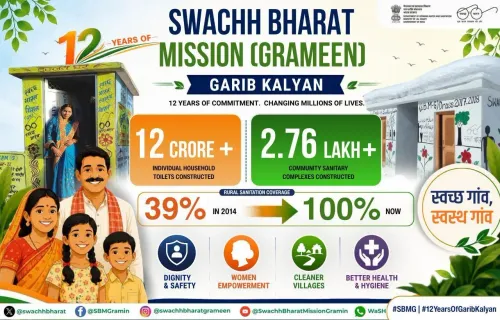
Union Jal Shakti Minister C. R. Paatil has marked twelve years of Swachh Bharat Mission (Gramin), claiming rural sanitation coverage has risen from 39% in 2014 to 100%, backed by construction of over 12 crore individual toilets and 2.76 lakh community sanitation complexes under PM Modi's leadership.
Key Takeaways
Union Jal Shakti Minister C.
Paatil posted on 12 June 2026 marking 12 years of the Swachh Bharat Mission (Gramin) .
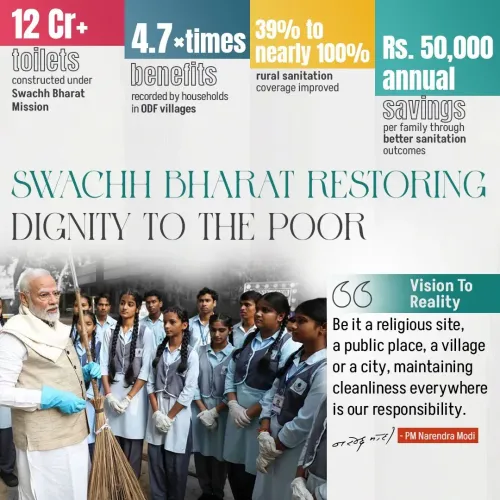
Rural sanitation coverage reportedly rose from 39% in 2014 to 100% under the mission.
More than 12 crore individual household toilets have been constructed since the mission's launch.
Over 2.76 lakh community sanitation complexes have been built to serve households without space for individual units.
The mission is credited with advancing women's empowerment by improving safety and dignity in rural areas.
The post is part of the #12YearsOfGaribKalyan campaign marking the NDA government's twelve-year anniversary in office.
Union Jal Shakti Minister C. R. Paatil on Friday, 12 June 2026, highlighted the twelve-year journey of the Swachh Bharat Mission (Gramin), crediting Prime Minister Narendra Modi's leadership for transforming rural sanitation coverage from 39 per cent in 2014 to a claimed 100 per cent today. Paatil posted on X that the mission had delivered dignity, safety and better health to crores of rural families through the construction of over 12 crore individual household toilets and more than 2.76 lakh community sanitation complexes.
Context
Paatil's post, shared under the hashtags #SBMG, #12YearsOfGaribKalyan and #ModiGovernment12Years, frames the sanitation drive as a story of social uplift — 'swachhata se samman tak' ('from cleanliness to dignity'). The post coincides with the twelfth anniversary of the National Democratic Alliance government that took office in May 2014, making sanitation a centrepiece of its rural welfare narrative. As the minister who oversees drinking water and sanitation under the Ministry of Jal Shakti, Paatil is among the most senior voices on the programme's implementation.
The minister also underlined the mission's role in women's empowerment, noting that access to toilets has improved safety and dignity for women in villages across India. The post carries a video attachment, suggesting an official communication campaign timed to the anniversary.
Policy Backdrop
Swachh Bharat Mission (Gramin) was launched by Prime Minister Narendra Modi on 2 October 2014 — the 145th birth anniversary of Mahatma Gandhi — with the stated goal of eliminating open defecation in rural India. By 2019, the government declared India open-defecation free after reporting construction of over 10 crore toilets under the first phase. A subsequent ODF-Plus phase extended the mission's scope to include greywater management, solid waste disposal and long-term sustainability of sanitation infrastructure.
The Ministry of Jal Shakti, created in 2019 by merging the erstwhile ministries of Water Resources and Drinking Water and Sanitation, now administers SBM-G alongside the Jal Jeevan Mission, which targets piped drinking water to every rural household. This convergence positions sanitation and water access as two pillars of a single rural welfare architecture.
Stakeholders and Impact
The primary beneficiaries of SBM-G are rural households, particularly women and girls, for whom open defecation posed acute safety and health risks. Independent research has consistently linked improved sanitation to reductions in diarrhoeal diseases, child stunting and maternal health complications. Community sanitation complexes — of which Paatil cites more than 2.76 lakh — are designed to serve households without space for individual toilets, including densely populated hamlets and scheduled-caste settlements.
Civil society observers and parliamentary committees have, over the years, raised questions about toilet usage rates and the long-term functionality of constructed units, distinguishing between physical construction and behavioural change. The government has responded by incorporating usage monitoring and community-led sanitation drives into the ODF-Plus framework.
What's Next
With the NDA government's twelve-year mark serving as a communication milestone, the Ministry of Jal Shakti is expected to intensify outreach around SBM-G's ODF-Plus targets in the coming months. Upcoming Union Budget allocations and any revised targets for community sanitation infrastructure will be closely watched as indicators of the programme's next phase. Parliamentary scrutiny, including audit reports on toilet functionality and fund utilisation, is likely to shape the policy conversation around whether the headline coverage figure translates into sustained behavioural change at the village level.
Point of View
Anchoring the NDA government's twelve-year record to one of its most visible flagship schemes. By foregrounding the 39%-to-100% coverage arc, the minister seeks to translate an administrative metric into a social dignity narrative — a framing that has proved politically resonant with rural and women voters. The emphasis on women's empowerment is particularly pointed, aligning sanitation outcomes with a broader BJP electoral messaging strategy. However, the gap between constructed infrastructure and sustained usage remains an open policy question that independent audits and parliamentary committees are likely to revisit as the ODF-Plus phase matures.
NationPress
23 Sept 2026
Frequently Asked Questions
What is Swachh Bharat Mission Gramin and who runs it?
Swachh Bharat Mission (Gramin), or SBM-G, is India's flagship rural sanitation programme launched on 2 October 2014 to eliminate open defecation. It is administered by the Ministry of Jal Shakti, currently headed by Union Minister C. R. Paatil.
What did C. R. Paatil say about Swachh Bharat Mission in June 2026?
Paatil stated that rural sanitation coverage has risen from 39% in 2014 to 100%, with over 12 crore individual household toilets and 2.76 lakh community sanitation complexes constructed under PM Modi's leadership over twelve years.
How many toilets have been built under Swachh Bharat Mission Gramin?
According to Paatil's post, more than 12 crore individual household toilets have been built under SBM-G since the mission's launch in 2014.
What is ODF-Plus under Swachh Bharat Mission?
ODF-Plus is the second phase of Swachh Bharat Mission (Gramin) that goes beyond toilet construction to focus on greywater management, solid waste disposal and the long-term sustainability of sanitation infrastructure in villages declared open-defecation free.
What is the Ministry of Jal Shakti responsible for?
The Ministry of Jal Shakti, formed in 2019 by merging two earlier ministries, oversees India's drinking water and rural sanitation programmes, including Swachh Bharat Mission (Gramin) and the Jal Jeevan Mission.