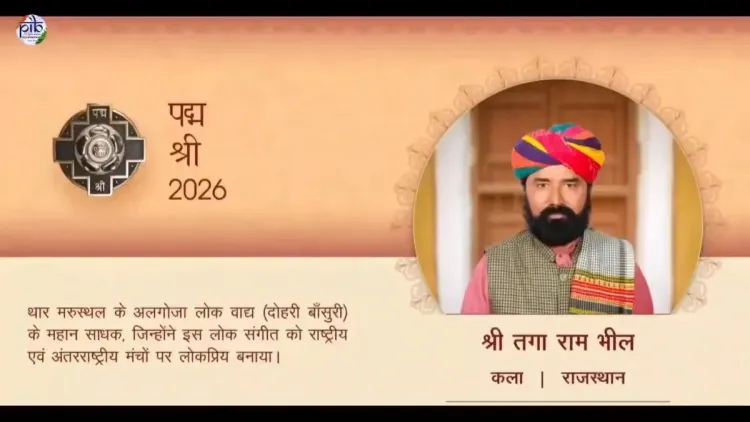
Shekhawat hails Padma Shri for Jaisalmer algoja maestro Taga Ram Bhil
Synopsis
Union Culture Minister Gajendra Singh Shekhawat hailed the Padma Shri conferred on Jaisalmer algoja maestro Taga Ram Bhil by President Draupadi Murmu, calling it a celebration of Rajasthan's living folk culture and its global reach.
Key Takeaways
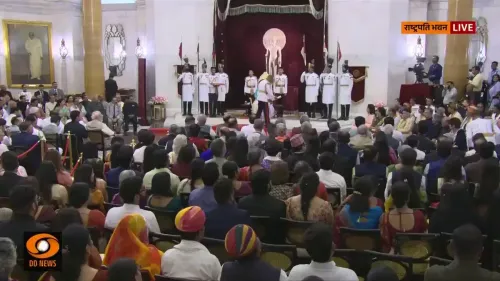
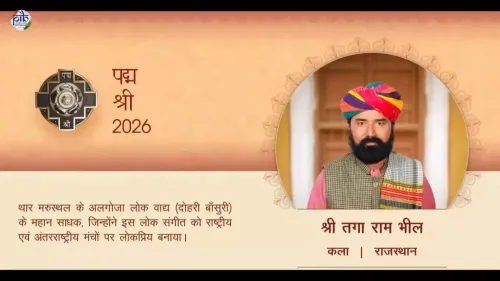
Taga Ram Bhil , an algoja (twin-flute) player from Jaisalmer, Rajasthan , was conferred the Padma Shri by President Draupadi Murmu .
Union Culture and Tourism Minister Gajendra Singh Shekhawat publicly congratulated Bhil on 25 May 2026 , calling the honour a 'yashgaan' (song of glory) for folk culture.
The algoja is a twin-flute wind instrument closely associated with the Bhil and pastoral communities of western Rajasthan.
The Padma Awards , instituted in 1954 , are India's highest civilian honours, conferred annually by the President on Republic Day eve.
Shekhawat noted that Bhil had already earned global recognition for Jaisalmer's folk culture before the award.
The recognition is expected to boost documentation and platform opportunities for algoja music under bodies such as the Sangeet Natak Akademi and the West Zone Cultural Centre .
Union Culture and Tourism Minister Gajendra Singh Shekhawat on Monday, 25 May 2026 congratulated folk musician Taga Ram Bhil of Jaisalmer on being conferred the Padma Shri by President Draupadi Murmu, calling the honour a celebration of living folk culture.
Context
Shekhawat, posting in Hindi on X, wrote that the folk culture of Jaisalmer carries its own fragrance and sweetness — 'जैसलमेर की लोक संस्कृति की अपनी सुगंध और अपनी मिठास है' [the folk culture of Jaisalmer has its own fragrance and its own sweetness] — and that Taga Ram Bhil, an algoja player, has brought it global recognition. He described the Padma Shri conferment as a 'yashgaan' — a song of glory — for folk culture, and extended his 'sadar badhai' (respectful congratulations) to the artist.
The algoja is a twin-flute wind instrument native to the desert and pastoral belts of Rajasthan, played by blowing both pipes simultaneously. It is closely associated with the Bhil and other communities of western Rajasthan and has been documented as one of the region's most distinctive oral and instrumental traditions.
Policy Backdrop
The Padma Awards, instituted in 1954, are India's highest civilian honours and are conferred annually by the President of India. The awards are announced on the eve of Republic Day and span categories including arts, literature, science, and public affairs. The Padma Shri is the fourth-highest civilian award in the series, after the Bharat Ratna, Padma Vibhushan, and Padma Bhushan.
The Ministry of Culture and bodies such as the Sangeet Natak Akademi have for decades run parallel programmes to document and support folk practitioners, particularly those from oral and instrumental traditions in desert and tribal belts. Successive governments have used the Padma Awards to bring regional folk artists into national visibility, and Rajasthan has featured consistently among recipient states given its rich heritage of desert music.
Stakeholders and Impact
For Rajasthan's folk-music community, a Padma Shri for an algoja player carries symbolic weight beyond the individual award: it signals institutional recognition for an instrument and a performance tradition that exists largely outside mainstream concert circuits. Artists from the Bhil and allied communities, who have preserved the algoja across generations, stand to benefit from increased documentation funding and platform opportunities that typically follow Padma recognition.
The West Zone Cultural Centre, headquartered in Udaipur, is among the bodies that may amplify algoja music through festival programming and archival projects in the wake of this recognition. Tourism stakeholders in Jaisalmer — a city that draws visitors partly through its living folk-arts ecosystem — may also see renewed interest in authentic desert-music experiences.
What's Next
The full Padma Awards 2026 list, notified by the Ministry of Home Affairs, will detail the complete roster of recipients across all categories and states. Observers will watch whether the Ministry of Culture follows the award with targeted outreach — such as dedicated algoja showcases at national festivals or inclusion in the Sangeet Natak Akademi's oral-tradition preservation calendar. For Taga Ram Bhil, the Padma Shri is likely to open doors to national and international folk-music platforms, extending the reach of a Jaisalmer tradition that Shekhawat described as already carrying 'global recognition.'
Point of View
Lending the awards a cultural-diplomacy dimension alongside their ceremonial one. For Minister Shekhawat, whose constituency of Jodhpur sits in the same desert cultural belt as Jaisalmer, the public congratulation is consistent with his ministry's stated agenda of mainstreaming India's intangible cultural heritage. The specific mention of 'global recognition' for the algoja player signals an intent to project regional folk traditions outward — aligning with the broader 'Brand India' tourism and soft-power push. Whether this translates into sustained institutional support or remains symbolic will depend on follow-through from the Sangeet Natak Akademi and the West Zone Cultural Centre.
NationPress
15 Sept 2026
Frequently Asked Questions
Who is Taga Ram Bhil and why did he receive the Padma Shri?
Taga Ram Bhil is an algoja player from Jaisalmer, Rajasthan, recognised for preserving and popularising the twin-flute folk instrument of the desert region. He received the Padma Shri in 2026 for his contribution to Indian folk arts and for bringing global attention to Jaisalmer's musical heritage.
What is the algoja instrument?
The algoja is a traditional twin-flute wind instrument played simultaneously through both pipes. It is native to the desert and pastoral communities of western Rajasthan, particularly associated with the Bhil community, and is considered one of the region's most distinctive folk instruments.
What did Gajendra Singh Shekhawat say about the Padma Shri for Taga Ram Bhil?
Shekhawat wrote on X that Jaisalmer's folk culture has its own fragrance and sweetness, and that Taga Ram Bhil had already earned it global recognition. He called the Padma Shri a 'yashgaan' — a song of glory — for folk culture and extended his respectful congratulations to the artist.
When are the Padma Awards given and who confers them?
The Padma Awards are announced annually on the eve of Republic Day (26 January) and are formally conferred by the President of India at a ceremony held later in the year. The awards were instituted in 1954 and are among India's highest civilian honours.
How does the Padma Shri benefit folk musicians in India?
A Padma Shri typically brings a folk musician increased visibility on national and international platforms, greater access to government-funded documentation and archival programmes, and invitations to perform at major cultural festivals. Bodies such as the Sangeet Natak Akademi often follow up with dedicated support for the honoured tradition.