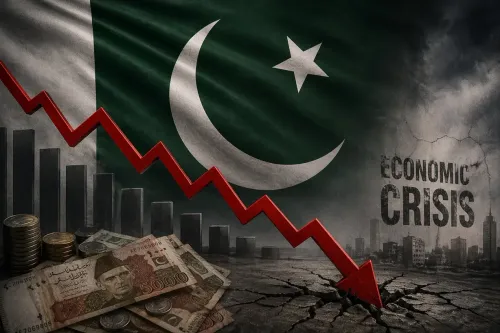
How is Pakistan Ranked 150th in the Index of Economic Freedom?
Synopsis
Pakistan has been ranked 150th out of 184 economies in the latest Index of Economic Freedom, indicating a 'repressed' economy with a score of 49.1. This report highlights significant challenges in economic reform and stability, raising questions about future prospects.
Key Takeaways
Pakistan is ranked 150th in the Index of Economic Freedom.
The economy is classified as 'repressed.' A score of 49.1 out of 100 indicates significant barriers to economic growth.
High inflation and stagnant labor market are pressing issues.
Structural reforms are urgently needed to improve economic conditions.
New Delhi, Feb 10 (NationPress) The Heritage Institute's Index of Economic Freedom has categorized Pakistan as a "repressed" economy, placing it at 150th among 184 economies, with a score of 49.1 out of 100 for 2025.
This index evaluates 12 economic freedoms, including property rights, government integrity, judicial effectiveness, tax burden, government spending, fiscal health, business freedom, labour freedom, monetary freedom, trade freedom, investment freedom, and financial freedom.
These fundamental pillars are essential for fostering sustainable economic growth and development in any nation.
The report remarked, "The government has exhibited minimal commitment to essential economic reform. Initiatives in crucial areas have been at best marginal. Attempts to enhance public finance management and modernize outdated economic frameworks have faced institutional resistance. A judiciary prone to political interference and corruption undermines property rights. The entrepreneurial landscape and private sector vitality have not seen significant improvements. The labour market remains stagnant, with a considerable portion of the workforce underemployed within the informal sector. High inflation has disrupted monetary stability."
The data cutoff for the 2025 Index was June 2024. Therefore, it’s crucial to highlight issues such as high inflation, which hovered around 12 percent at that time and was already on a downward trajectory, as well as a perceived lack of reform commitment when the national discourse centered on avoiding default rather than structural reforms.
Pakistani economist Ali Salman noted that the Heritage Index does not accurately reflect the actual dynamics, underscoring the limitations of such indices.
The index awarded a relatively high score of 88.9 percent for government spending and 78.3 percent for tax burden. This is due to the index's reliance on two figures: government spending and tax collection as a percentage of GDP. In Pakistan, government spending accounts for approximately 20 percent of GDP, while the tax-to-GDP ratio stands at 10 percent.
From an absolute standpoint, 20 percent of GDP does not necessarily indicate a disproportionately large government. However, considering that interest payments and defense expenditures comprise nearly 70 percent of total spending, alongside wasteful expenditures in other sectors, a high score in public spending becomes largely irrelevant, the article suggested.
Moreover, while a 10 percent tax-to-GDP ratio might suggest a low tax burden and consequently high economic freedom, the actual tax burden on taxpayers remains significantly elevated. Fast forward to the first quarter of 2026: How will the upcoming edition of the Index of Economic Freedom assess economic freedom in Pakistan?
Since the last index was published, the tax burden on taxpayers has escalated considerably. The highest marginal tax rate on individual incomes has surged from 35 percent to 45 percent. The super tax, initially introduced as a temporary measure on corporate incomes exceeding a specific threshold to cover costs for internally displaced populations, has recently gained judicial endorsement, raising the effective tax burden on major corporations to over 50 percent, the article concluded.
Point of View
I acknowledge the serious implications of Pakistan's low ranking in the Index of Economic Freedom. This classification signals the urgent need for structural reforms, commitment to economic stability, and a more robust legal framework to protect property rights and encourage entrepreneurship. The findings serve as a wake-up call for policymakers to prioritize economic health over short-term fixes.
NationPress
10 Oct 2026
Frequently Asked Questions
What is the Index of Economic Freedom?
The Index of Economic Freedom is a report published by the Heritage Foundation that measures the degree of economic freedom in countries based on various factors like property rights, government integrity, and business freedom.
Why is Pakistan ranked 150th?
Pakistan's low ranking reflects minimal commitment to economic reforms, high inflation, and a stagnant labor market, among other challenges.
What does a score of 49.1 indicate?
A score of 49.1 indicates a 'repressed' economy, suggesting significant barriers to economic freedom and growth.
What are the consequences of being classified as a 'repressed' economy?
Being classified as a 'repressed' economy can deter foreign investment, hinder economic growth, and lead to increased poverty levels.
How can Pakistan improve its economic ranking?
Improvements can be made through comprehensive economic reforms, enhancing government transparency, and fostering a more conducive environment for entrepreneurship.