PM Modi Marks 12 Years of Infrastructure Push, Reaffirms Viksit Bharat Vision
Synopsis
Prime Minister Narendra Modi marked twelve years of BJP-led governance on June 16, 2026, citing record infrastructure upgrading and reaffirming the government's commitment to next-generation infrastructure as the foundation of the Viksit Bharat 2047 vision. The post anchors a broader #12YearsOfNayaBharatNirman anniversary communication.
Key Takeaways
Prime Minister Narendra Modi posted on June 16, 2026 , marking 12 years of BJP governance under the hashtag #12YearsOfNayaBharatNirman .
Modi reaffirmed the government's commitment to 'next-generation infrastructure' as a pillar of the Viksit Bharat vision targeting 2047 .
The Bharatmala Pariyojana (2017) targets 34,800 km of national highways with an outlay of Rs 6.92 lakh crore .
The National Infrastructure Pipeline (2019) projected Rs 111 lakh crore in infrastructure investment through 2025 .
PM Gati Shakti , launched in October 2021 , integrates 16 ministries via a GIS platform to coordinate project execution.
The Union Budget 2023-24 raised infrastructure capital expenditure to Rs 10 lakh crore , the highest in the post-2014 trajectory.
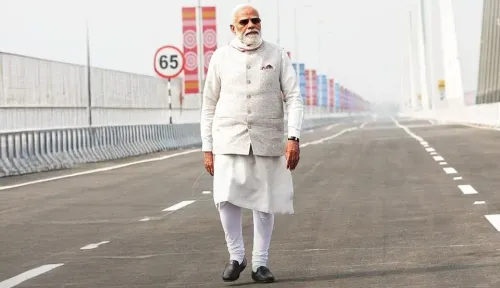
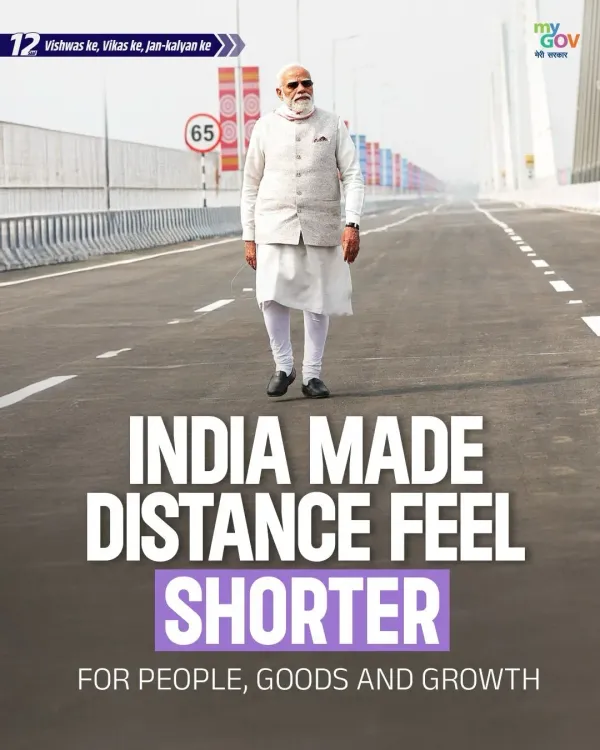
Prime Minister Narendra Modi on Tuesday, June 16, 2026, highlighted a decade of infrastructure expansion under his government, reaffirming the administration's commitment to next-generation infrastructure as a cornerstone of the Viksit Bharat vision targeting 2047. The post, shared on X under the hashtag #12YearsOfNayaBharatNirman, marks twelve years since the BJP-led government assumed office at the Centre.
Context
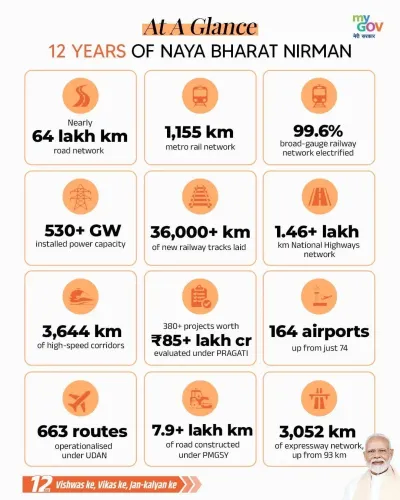
Modi wrote: 'The last decade has witnessed record infrastructure upgrading. We are committed to building next-generation infrastructure for the people of our nation to realise our vision of a Viksit Bharat.' The message arrives as the ruling Bharatiya Janata Party (BJP) marks twelve years of continuous governance at the Centre, a milestone the party has branded Naya Bharat Nirman — or 'New India Building.' The post is part of a broader commemorative communication push timed to that anniversary.
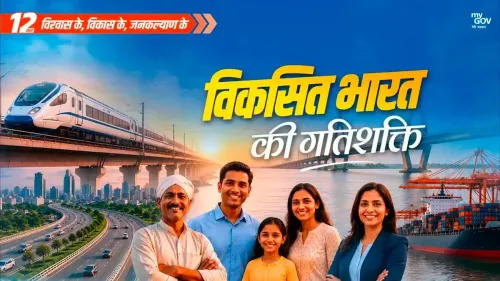
The Viksit Bharat framework, articulated by Modi as a long-range national goal, envisions India as a fully developed economy by 2047, the centenary of Independence. Infrastructure modernisation — spanning roads, railways, airports, and ports — has been positioned as the foundational pillar of that ambition.
Policy Backdrop
The government's infrastructure push has been structured through several flagship programmes. The Bharatmala Pariyojana, approved by the Cabinet in 2017, set out to develop 34,800 km of national highways with an outlay of Rs 6.92 lakh crore, consolidating earlier road projects into integrated economic corridors. The National Infrastructure Pipeline, unveiled in 2019, projected Rs 111 lakh crore in investment across roads, railways, airports, and urban infrastructure through 2025.
In October 2021, the government launched the PM Gati Shakti National Master Plan, a GIS-based coordination platform integrating 16 ministries to reduce project execution gaps and lower logistics costs — a structural drag long identified as a constraint on Indian manufacturing competitiveness. The Union Budget 2023-24 raised infrastructure capital expenditure to Rs 10 lakh crore, continuing an upward annual trajectory since 2014.
Stakeholders and Impact
The cumulative effect of these programmes spans multiple segments of the economy. Construction companies and logistics firms have been direct beneficiaries of expanded project pipelines and improved corridor connectivity. Rural households have gained from village road connectivity schemes, while urban commuters have seen metro rail networks expand across several cities.
Economists and policy analysts have noted that sustained capital expenditure on physical infrastructure serves a dual purpose: it acts as a counter-cyclical growth stimulus and structurally reduces the logistics costs that have historically limited India's export competitiveness. The government's shift from siloed ministry-level projects to integrated multi-modal corridors — formalised through PM Gati Shakti — reflects a deliberate evolution in planning doctrine over the twelve-year period.
What's Next
The #12YearsOfNayaBharatNirman messaging signals that infrastructure will remain a central political and policy theme for the BJP government heading into the next budget cycle. Analysts will watch PM Gati Shakti project dashboards for updated completion metrics and any fresh capital expenditure allocations or new programme phases announced in the forthcoming Union Budget.
With the Viksit Bharat 2047 deadline still more than two decades away, the government faces the challenge of sustaining fiscal headroom for capital spending while managing competing demands on public finances. How the next budget balances infrastructure outlay against social expenditure will be a key indicator of the administration's continued commitment to the infrastructure-first growth model.
Point of View
A record the BJP has consistently used to distinguish itself from predecessor governments. By coupling the anniversary hashtag with the 'Viksit Bharat' slogan, the communication deliberately bridges short-term project milestones to the long-horizon 2047 goal, extending the government's accountability narrative well beyond the electoral cycle. The emphasis on 'next-generation' infrastructure also signals an intent to shift the discourse from basic connectivity — roads and power — toward higher-order assets such as freight corridors, digital infrastructure, and green energy grids. Sustaining political capital on this theme will depend on whether project completion rates and logistics cost data in forthcoming reports validate the 'record upgrading' claim.
NationPress
14 Sept 2026
Frequently Asked Questions
What is Viksit Bharat and how does infrastructure relate to it?
Viksit Bharat is the Modi government's vision to transform India into a fully developed nation by 2047, the centenary of Independence. Infrastructure modernisation — covering roads, railways, airports, and ports — is presented as a foundational pillar of achieving that goal.
What is the #12YearsOfNayaBharatNirman hashtag about?
The hashtag marks twelve years of BJP-led governance at the Centre since May 2014. 'Naya Bharat Nirman' translates to 'New India Building' and has been used as a branding theme to highlight development work undertaken during this period.
What is PM Gati Shakti and what does it do?
PM Gati Shakti National Master Plan, launched in October 2021, is a GIS-based digital platform that integrates 16 central ministries to coordinate infrastructure project planning and execution, aiming to reduce delays and lower logistics costs across the economy.
How much has India invested in infrastructure under Modi?
The National Infrastructure Pipeline unveiled in 2019 projected Rs 111 lakh crore in investment through 2025. The Union Budget 2023-24 alone allocated Rs 10 lakh crore as infrastructure capital expenditure, continuing an upward trend since 2014.
What is Bharatmala Pariyojana?
Bharatmala Pariyojana is a national highway development programme approved by the Cabinet in 2017, targeting 34,800 km of new highways and economic corridors with an outlay of Rs 6.92 lakh crore to improve freight and passenger connectivity across India.