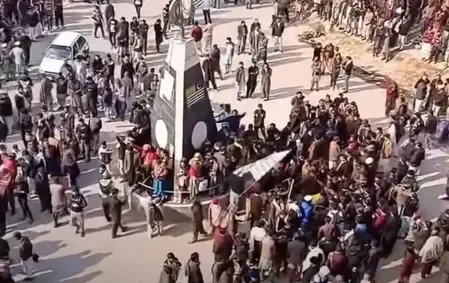
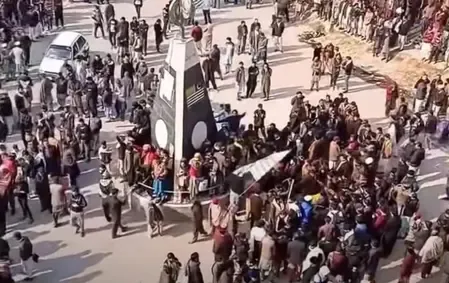
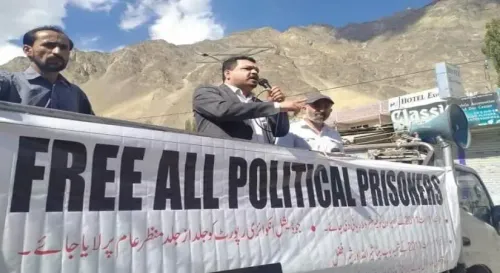
PoK unrest: How denial of democracy and development fuels anger
Synopsis
PoK's simmering unrest is not a sudden eruption — it is the accumulated cost of 77 years of military-dictated governance, zero democratic accountability, and a development gap that widens every time J&K advances. As J&K deepens grassroots democracy post-Article 370, the contrast has become Pakistan's most uncomfortable political problem.
Key Takeaways
Maharaja Hari Singh acceded all of J&K to India in 1947 ; a Pakistan-sponsored tribal invasion forcibly seized Muzaffarabad , Gilgit , and Baltistan , creating PoK.
PoK has been governed by the Pakistan Army since 1947 , with nominal Prime Ministers holding no real authority over bureaucracy or administration.
Analysts link Pakistan's sponsorship of terrorism in J&K to its inability to deliver democratic governance and development in PoK.
The abrogation of Article 370 in 2019 extended property rights to women, devolved power to Panchayati Raj institutions, and opened investment to all Indian investors.
District Development Councils were formed in 2020 and a Legislative Assembly elected in 2024 , deepening participatory democracy in J&K.
J&K is the only state or Union Territory where the Ayushman Bharat health scheme carries no income restriction , covering all residents universally.
Pakistan-occupied Kashmir (PoK) has been gripped by deepening unrest, rooted in decades of democratic denial, stunted development, and centralised military control — a stark contrast to the governance trajectory of Jammu and Kashmir (J&K) on the Indian side of the Line of Control (LoC). The structural divergence between the two regions, which share a common historical origin in the accession of Maharaja Hari Singh's princely state to India in 1947, has become impossible to ignore.
How the Division Began
When Maharaja Hari Singh signed the instrument of accession in 1947, he acceded all parts of his domain to India. However, a Pakistan-sponsored tribal invasion forcibly seized portions of the state, bringing areas including Muzaffarabad, Gilgit, and Baltistan under Islamabad's control. These territories came to be collectively known as Pakistan-occupied Kashmir (PoK).
This forcible occupation created what is widely referred to as the 'Kashmir problem' — a dispute rooted not in a voluntary partition but in military aggression against a princely state that had legally joined India. The division also set the two halves of the former state on diametrically opposed governance paths from the outset.
Military Rule Versus Democratic Governance
While democratic governments took shape in J&K from 1947 onwards — with both regional and national parties participating in competitive elections — PoK was effectively governed by the Pakistan Army. A succession of so-called Prime Ministers nominally headed the territory, but according to analysts, real authority over bureaucracy, governance, and day-to-day administration rested with the military establishment in Islamabad.
The gap between the two regions, critics argue, is not merely geographic or demographic. It reflects a systemic difference: one model is participatory and reform-oriented, the other extractive and centralised. Residents of PoK have had little meaningful say in their governance, with Islamabad and the army dictating policy across both mainland PoK and Gilgit-Baltistan.
Development Contrast and Pakistan's Response
J&K received substantial central government assistance over the decades, with development schemes reaching citizens across religious and regional lines. The widening development gap reportedly became a source of acute discomfort for Pakistan's establishment. Unable to replicate democratic dividends in PoK, Pakistan is widely accused of sponsoring terrorism in J&K — a strategy, analysts contend, aimed at suppressing public anger within PoK by pointing to instability on the Indian side of the LoC.
Notably, whenever democratic aspirations surfaced in PoK, the Pakistan Army and its political proxies reportedly deflected attention by citing unrest in J&K. This cycle, observers say, has deepened frustration and despondency among PoK residents over generations.
Article 370 Abrogation and Its Impact on J&K
The abrogation of Article 370 in 2019 marked a turning point for J&K. Property rights were extended to women, previously denied under the old framework. Power was devolved to the grassroots through strengthened Panchayati Raj institutions. Investment, once restricted to a narrow set of privileged families, was opened to all investors across India.
Monopolies over property, education, government jobs, and official privileges were dismantled. Democracy deepened further with the formation of District Development Councils in 2020 and the election of a Legislative Assembly in 2024. Central flagship programmes including Ayushman Bharat were extended to J&K — and notably, J&K is the only state or Union Territory where the scheme carries no income restriction, giving universal health coverage access to all residents regardless of economic status.
What Lies Ahead for PoK
The contrast between J&K's expanding democratic and developmental footprint and PoK's continued military-dominated governance is increasingly difficult for Islamabad to manage. Analysts warn that without genuine political reform and economic investment, resentment in PoK will continue to intensify. The unrest simmering in the region, they argue, is not incidental — it is the predictable outcome of decades of governance failure and democratic suppression.
Point of View
The sharper the contrast becomes; the more it liberalises, the louder the demand for genuine self-governance will grow.
NationPress
20 Sept 2026
Frequently Asked Questions
Why is there unrest in Pakistan-occupied Kashmir (PoK)?
Unrest in PoK stems from decades of military-controlled governance, denial of democratic rights, and a widening development gap compared to Jammu and Kashmir on the Indian side. Residents have had little meaningful political participation, with real authority historically held by the Pakistan Army rather than elected representatives.
How did Pakistan-occupied Kashmir come into existence?
When Maharaja Hari Singh acceded J&K to India in 1947, a Pakistan-sponsored tribal invasion forcibly seized parts of the state, including Muzaffarabad, Gilgit, and Baltistan. These territories came to be known as Pakistan-occupied Kashmir (PoK) and have remained under Pakistani control since.
How does governance in J&K differ from PoK?
J&K has had competitive democratic elections since 1947, with power devolved to Panchayati Raj institutions and, most recently, District Development Councils formed in 2020 and a Legislative Assembly elected in 2024. PoK, by contrast, has been governed by the Pakistan Army, with Prime Ministers holding nominal authority and no real control over administration or bureaucracy.
What changed in J&K after the abrogation of Article 370?
The abrogation of Article 370 in 2019 extended property rights to women, opened investment to all Indian investors, dismantled monopolies on education and government jobs, and made central schemes like Ayushman Bharat applicable to J&K. Uniquely, J&K is the only state or Union Territory where Ayushman Bharat carries no income restriction.
Why did Pakistan sponsor terrorism in J&K, according to analysts?
Analysts argue Pakistan sponsored terrorism in J&K to deflect attention from its own governance failures in PoK. Unable to deliver democratic rights or development to PoK residents, Pakistan reportedly stoked instability in J&K to suppress demands for political reform within its occupied territories by pointing to unrest on the Indian side of the Line of Control.