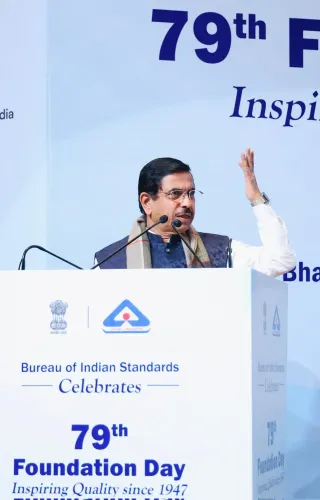
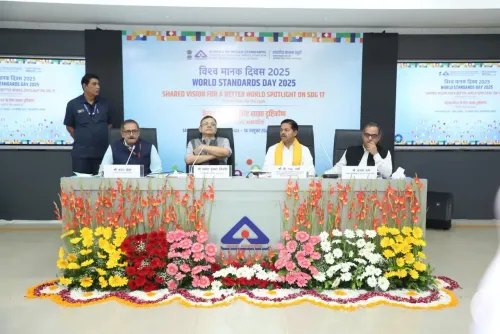
Pralhad Joshi marks World Standards Day, calls for quality-driven growth
Synopsis
On World Standards Day 2026, Union Minister Pralhad Joshi called for renewed commitment to quality, safety, and reliability standards, linking robust standardisation to consumer confidence, innovation, and India's global export competitiveness under the Atmanirbhar Bharat framework.
Key Takeaways
World Standards Day is observed on 14 October every year, coordinated by ISO, IEC, and ITU.
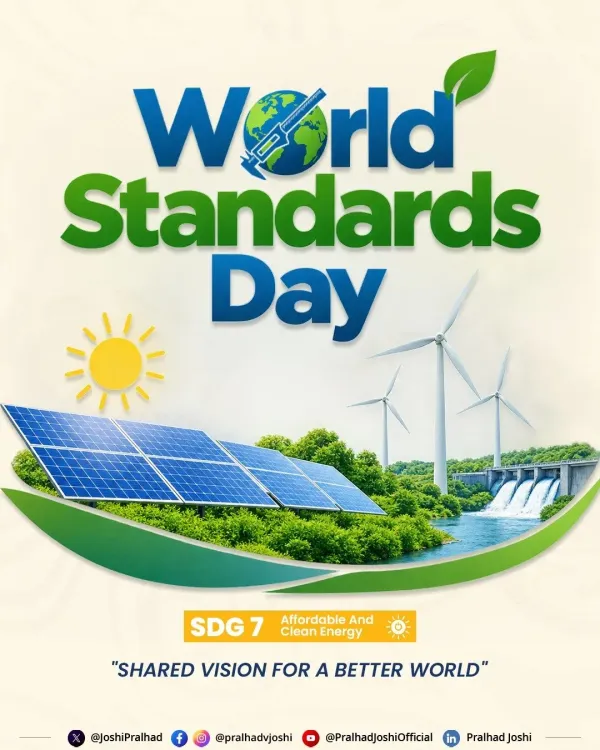
Minister Pralhad Joshi posted in both English and Kannada, linking strong standards to consumer confidence and India's global market competitiveness.
The BIS Act, 2016 expanded India's Bureau of Indian Standards mandate to include conformity assessment and international alignment.
Standards harmonisation has been a stated pillar of Make in India (2014) and Atmanirbhar Bharat (2020).
India has been increasing participation in ISO and IEC technical committees to shape — not just adapt to — global standards.
Key indicators to track: BIS annual report on revised standards and progress on mutual recognition agreements with trading partners.
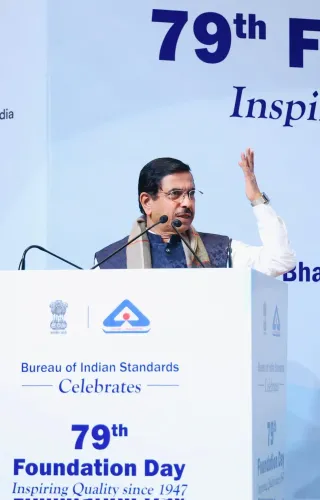
Standards are the silent architecture of every product a consumer trusts — and on World Standards Day, 14 October 2026, Union Consumer Affairs Minister Pralhad Joshi used the global observance to call on India to double down on quality, safety, and reliability as engines of economic growth.
Posting in both English and Kannada, the Minister declared: 'Quality begins with strong standards,' adding that 'robust standards strengthen consumer confidence, encourage innovation and enhance India's competitiveness in global markets, laying a strong foundation for sustainable growth.' The Kannada portion called on citizens — 'ಪ್ರತಿಯೊಂದು ಕಾರ್ಯದಲ್ಲೂ ಗುಣಮಟ್ಟಕ್ಕೆ ಆದ್ಯತೆ ನೀಡಿ' ['prioritise quality in every endeavour'] — to join hands in building a developed and self-reliant India.
Why October 14 matters: ISO, IEC and the global standards calendar
World Standards Day is observed every year on 14 October, coordinated by the three major international standards bodies: the International Organization for Standardization (ISO), the International Electrotechnical Commission (IEC), and the International Telecommunication Union (ITU). The day is designed specifically to spotlight the role standards play in enabling safe products, fair trade, and technological interoperability across borders.
For India, the day lands at a pointed moment. The country's quality infrastructure has been steadily upgraded since the Bureau of Indian Standards (BIS) Act, 2016 replaced the older 1986 Act, expanding BIS's mandate to cover conformity assessment and deeper alignment with international frameworks. That legislative shift was part of a broader push — dating to the Make in India programme launched in 2014 — to treat standards harmonisation as a front-line tool for manufacturing competitiveness.
Standards as a pillar of Atmanirbhar Bharat
Joshi's invocation of a 'developed and self-reliant India' directly echoes the language of Atmanirbhar Bharat, the self-reliance initiative unveiled in 2020. That programme explicitly identified quality standards as enablers of domestic manufacturing and export readiness — the logic being that products built to internationally recognised benchmarks face fewer technical barriers when they reach foreign markets.
India has also been expanding its participation in ISO and IEC technical committees, a quiet but consequential effort to ensure Indian industry norms feed into global rule-writing rather than simply adapting to it. Greater clout inside those bodies translates, over time, into standards that are easier for Indian exporters to meet — and harder for overseas competitors to use as non-tariff barriers.
The Minister's portfolio puts him squarely at the intersection of these concerns: Consumer Affairs oversees product safety and BIS, while his New and Renewable Energy brief adds a technology-intensive sector where international standards increasingly govern everything from solar panel efficiency ratings to battery safety certifications.
One observation to watch in the months ahead: BIS's annual tally of new and revised Indian standards, and any progress on mutual recognition agreements with major trading partners — deals that allow test results from one country's labs to be accepted by another, cutting compliance costs for exporters. Those numbers will tell us whether this World Standards Day resolve translates into measurable infrastructure on the ground.
Point of View
Tying routine observance to the government's broader quality-infrastructure agenda. His dual Consumer Affairs and Renewable Energy brief gives the message concrete operational weight — BIS sits in his portfolio, and renewable energy is a sector where standards gaps can become export barriers overnight. The Atmanirbhar Bharat framing is deliberate: it positions standards compliance not as a regulatory burden but as a sovereignty play, where domestic manufacturers who meet international benchmarks become India's frontline in reducing technical trade barriers. The real test will come in BIS activity data and mutual recognition agreement progress — rhetoric on quality standards has a long Indian history; institutional follow-through is the harder variable.
NationPress
14 Oct 2026
Frequently Asked Questions
What is World Standards Day and when is it celebrated?
World Standards Day is an annual observance held every year on 14 October. It is coordinated by the International Organization for Standardization (ISO), the International Electrotechnical Commission (IEC), and the International Telecommunication Union (ITU) to highlight how international standards benefit economies and consumers.
What did Pralhad Joshi say on World Standards Day 2026?
Minister Pralhad Joshi posted in English and Kannada, stating that 'quality begins with strong standards' and calling on India to uphold quality, safety, and reliability to strengthen consumer confidence, drive innovation, and improve competitiveness in global markets.
What is the Bureau of Indian Standards (BIS) and how does it relate to this?
The Bureau of Indian Standards is India's national standards body, operating under the Consumer Affairs Ministry. The BIS Act of 2016 expanded its mandate to include conformity assessment and alignment with international frameworks, making it a key instrument in India's quality infrastructure push.
How do quality standards connect to Atmanirbhar Bharat?
Atmanirbhar Bharat, launched in 2020, identified quality standards as enablers of domestic manufacturing and export readiness. Products built to internationally recognised benchmarks face fewer technical barriers in foreign markets, directly supporting India's self-reliance and export growth goals.
What are mutual recognition agreements and why do they matter for India?
Mutual recognition agreements (MRAs) allow test results and certifications from one country's laboratories to be accepted by another, reducing duplication and compliance costs for exporters. Progress on MRAs with major trading partners is a key indicator of whether India's standards modernisation is translating into real export advantages.