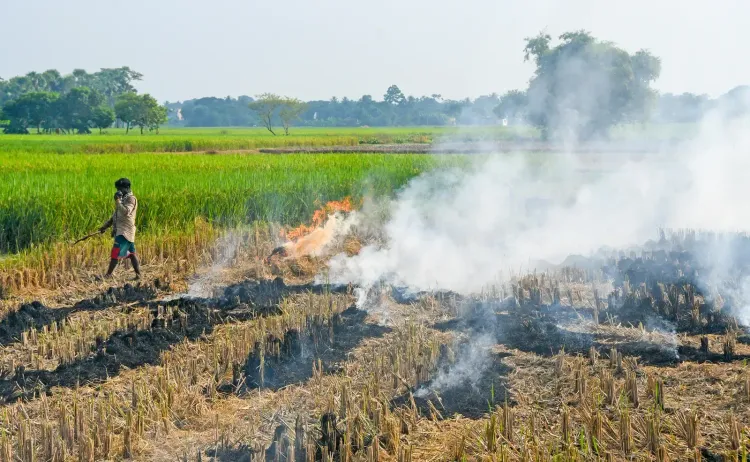
Punjab logs 84 stubble-burning fires this season; Amritsar leads with 49 cases
Synopsis
Punjab has recorded 84 paddy stubble-burning fires this season — and we are only in early October, before the harvest peak. Amritsar alone accounts for 49 of those cases, yet only ₹55,000 of the ₹1.40 lakh in penalties imposed has actually been collected. As Delhi braces for its annual smog season, the recovery gap in Punjab's enforcement chain is the detail that matters most.
Key Takeaways
Punjab has recorded 84 paddy stubble-burning incidents so far this season, per the CAQM report dated 5 October 2026 .
Amritsar leads with 49 cases ; Tarn Taran is second with 18 cases .
Environmental compensation of ₹1.40 lakh has been imposed in 28 cases; only ₹55,000 — under 40% — recovered so far.
One FIR registered in Patiala ; 36 warning and show-cause notices issued statewide.
Red remarks entered in farm records in 13 cases as part of the enforcement action.
Bulk of burning typically peaks in late October–November as paddy harvesting accelerates.
Punjab has recorded 84 paddy stubble-burning incidents so far this season, with Amritsar accounting for the highest share at 49 cases, according to the latest enforcement report of the Commission for Air Quality Management (CAQM) updated on 5 October 2026. The figures come as authorities intensify crackdowns during the critical paddy harvesting window, when crop residue fires peak and air quality in northern India deteriorates sharply.
Scale of Enforcement Action
Of the 84 reported fire incidents, field inspections have been carried out in 78 cases. Physical verification during these inspections confirmed crop residue burning at 30 locations across the state. Environmental compensation (EC) has been imposed in 28 cases, with the cumulative penalty amount reaching ₹1.40 lakh. Of this, only ₹55,000 has been recovered so far — a recovery rate that critics argue reflects weak follow-through on financial deterrence.
Enforcement measures have also included red remarks entered in farm records in 13 cases, one FIR registered, and 36 warning and show-cause notices issued by nodal and supervisory officers.
Amritsar Leads District-Wise Tally
Amritsar district recorded the highest number of fire incidents in the state with 49 cases. Field inspections were conducted in 45 of these, with burning confirmed at 13 locations. Environmental compensation of ₹55,000 was imposed in 11 cases, of which ₹35,000 has been recovered. Authorities have also issued 32 warning notices in the district.
Other Districts: Tarn Taran, Ferozepur, Patiala
Tarn Taran recorded the second-highest tally with 18 cases. Inspections were conducted in 16, confirming burning at 9 locations. Environmental compensation of ₹45,000 was imposed across 9 confirmed cases, with ₹10,000 recovered so far. Red entries were made in farm records in 9 cases.
Ferozepur reported 5 incidents, all inspected and all confirmed. The district saw environmental compensation of ₹25,000 imposed, with ₹5,000 recovered and red entries made in 4 farm records.
Patiala logged 2 incidents, both confirmed on physical inspection. A combined penalty of ₹10,000 was imposed, though according to the CAQM report, no amount had been recovered as of 5 October. One FIR has also been registered in Patiala in connection with stubble burning.
Why This Matters: Air Quality and the Seasonal Pattern
Paddy stubble burning in Punjab and neighbouring Haryana is among the leading contributors to seasonal smog that blankets the Delhi-NCR region between October and November each year. The CAQM, a statutory body established under a Supreme Court directive, monitors and enforces restrictions on farm fires in the National Capital Region airshed. Notably, 84 fires at this point in the season represents early-stage activity; the bulk of burning typically occurs in late October and early November once the paddy harvest accelerates.
This is the third consecutive season in which the CAQM has maintained a district-wise enforcement dashboard, a mechanism introduced after court directions demanding real-time accountability from state administrations. Whether the fines — averaging roughly ₹5,000 per confirmed case — serve as adequate deterrents remains a subject of debate among environment researchers.
What Happens Next
Enforcement is expected to intensify through October as harvesting picks up pace. The CAQM report signals that recovery of imposed penalties remains a priority, with a significant portion of financial compensation yet to be collected. Authorities have been directed to expedite recovery proceedings while continuing field inspections across all stubble-burning-prone districts.
Point of View
But 84 fires in early October is a prelude, not a summary — the real crunch arrives when harvesting scales up in late October. More telling is the penalty-recovery gap: only ₹55,000 of ₹1.40 lakh imposed has been collected, suggesting that financial deterrence is blunted by slow recovery. At roughly ₹5,000 per confirmed burning case, the fines are also unlikely to alter a farmer's cost calculus when alternatives like happy seeders remain out of reach for smallholders. The CAQM dashboard has improved transparency, but transparency alone will not reduce Delhi's smog if enforcement stops at issuing notices.
NationPress
6 Oct 2026
Frequently Asked Questions
How many stubble-burning incidents has Punjab recorded this season?
Punjab has recorded 84 paddy stubble-burning incidents so far this season, according to the CAQM enforcement report updated on 5 October 2026. Field inspections have been conducted in 78 of these cases, with burning physically confirmed at 30 locations.
Which district in Punjab has the most stubble-burning cases?
Amritsar has recorded the highest number of fire incidents in Punjab this season, with 49 cases reported as of 5 October 2026. Tarn Taran is second with 18 cases, followed by Ferozepur with 5 and Patiala with 2.
What penalties have been imposed for stubble burning in Punjab?
Environmental compensation totalling ₹1.40 lakh has been imposed in 28 confirmed stubble-burning cases across Punjab. However, only ₹55,000 of that amount had been recovered as of 5 October 2026, indicating a significant shortfall in penalty collection.
What is the CAQM and why does it monitor stubble burning?
The Commission for Air Quality Management (CAQM) is a statutory body established under a Supreme Court directive to oversee air quality in the National Capital Region airshed. It monitors and enforces restrictions on farm fires in Punjab, Haryana, and neighbouring states because paddy stubble burning is a major contributor to the severe smog that blankets Delhi-NCR every October–November.
When does paddy stubble burning typically peak in Punjab?
Paddy stubble burning in Punjab usually peaks in late October and November, when the paddy harvest accelerates and farmers clear fields rapidly for the next crop cycle. The current figures of 84 fires represent early-season activity, and enforcement agencies expect the count to rise sharply over the coming weeks.